Do-it-yourself alternator and regulator repair
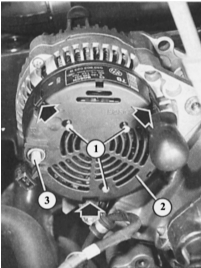
To remove the cover (2) of the Bosch alternator, unscrew the three Phillips-head screws (1), disconnect the B+ wire from the threaded stud (3), and press out the two retaining tabs (arrows).
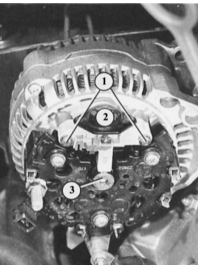
The voltage regulator (2) is secured with two Phillips-head bolts (1). Item (3) indicates the rotor shaft.

On the removed voltage regulator (item (4) in the illustration shows the new design), the length of the brushes (2) is indicated by arrows. Item (1) shows the voltage regulator contacts, and (3) are the mounting bolts.
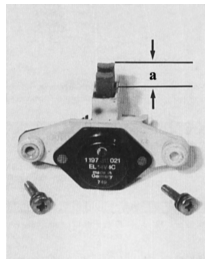
The illustration shows measuring the length of the sliding carbon brushes on the removed older-design Bosch voltage regulator: the brushes must not be shorter than a = 5 mm.
As a rule, the alternator does not require repair, except when replacing the alternator brushes. More serious damage cannot be repaired with household tools.
Checking charging voltage
PROCEDURE
Connect a voltmeter between the alternator's thick red wire terminal and ground.
Let the engine run at medium speed.
If the voltage regulator is serviceable, the voltmeter should read 13.3 to 14.6 V.
If this is not the case, check the brushes or replace the regulator.
Otherwise, the alternator itself is faulty.
Checking the brushes
PROCEDURE
Disconnect the negative battery terminal.
Bosch alternators: remove the rear battery cover (where fitted).
Disconnect the regulator from the alternator. To do this, remove the two screws.
Fold back the regulator so that the carbon brushes do not stick in their holders.
Measure the brush protrusion.
New brush length is 13 mm; minimum length is 5 mm.
Valeo alternators: remove both regulator mounting screws on the rear of the alternator.
Pull out the regulator.
Measure the length of the protruding brushes.
If the remaining length is 5 mm, the brushes are worn.
Brushes for Valeo alternators are not available separately; the entire regulator must be replaced.
Replacing the brushes
On the newer generation Bosch alternator regulators, brush replacement is no longer possible, so carbon brushes are no longer sold as spare parts. If they are worn, the entire regulator must be replaced. The same applies to Valeo alternators: carbon brushes are not sold as a spare part, and a new voltage regulator must be purchased if the brushes of the old one are worn.
However, on older generation Bosch alternators, this replacement is possible. You will need a soldering iron, solder, and soldering skills.
PROCEDURE
Remove the voltage regulator as described above.
Unsolder the stranded flexible leads and pull out the carbon brushes.
Remove the pressure springs from the old brushes and fit them to the new brushes.
Solder the stranded flexible leads.
Use a small amount of solder and work quickly so the leads do not absorb too much solder. Otherwise they will become stiff.
Hint: if the brushes are removed, you can check the copper slip rings at the same time (the brushes run on them). If deep running grooves are found on them, have them turned and polished at an auto electrical workshop.
Test yourself
A quick Audi 80 quiz: every answer comes with an explanation and a link to the manual page.