AdBlue (BlueHDi)
To comply with environmental standards and Euro 6, without compromising the performance or fuel consumption of its diesel engines, CITROËN has chosen to equip its vehicles with a system that combines the SCR (Selective Catalytic Reduction) system and the diesel particulate filter (DPF) to treat exhaust gases.
SCR system
Using a liquid called AdBlue, which contains urea, a catalyst converts up to 85% of nitrogen oxides (NOx) into nitrogen and water, which are harmless to health and the environment.
 AdBlue is stored in a dedicated tank of approximately 17 litres.
Its capacity provides a driving range before the warning is triggered of approximately 6,500 km, which varies considerably depending on driving style.
A warning is triggered when the reserve level is reached: the vehicle can then travel approximately 2,400 km before the tank is empty and the vehicle is immobilised.
For more information on the warning lights and associated alerts or the indicators, refer to the relevant sections.
When the AdBlue tank is empty, a regulatory device prevents the engine from restarting.
When the SCR system is faulty, the vehicle's emissions no longer comply with Euro 6 regulations: the vehicle becomes a polluter.
If a fault in the SCR system is confirmed, it is essential to go to a CITROËN dealer or a qualified workshop as soon as possible.
After 1,100 km have been driven, a device is automatically activated to prevent the engine from starting.
In both cases, a range indicator shows the distance that can be travelled before the vehicle is immobilised.
AdBlue Freezing
AdBlue freezes at temperatures below approximately -11 °C.
The SCR system includes a heating device for the AdBlue tank, which allows driving in very cold climatic conditions.
Topping Up AdBlue
It is recommended to top up AdBlue as soon as the first warning indicating that the reserve level has been reached appears.
For the SCR system to operate correctly:
- Only use AdBlue that complies with ISO 22241.
- Never transfer AdBlue into another container: its purity would be compromised.
- Never dilute AdBlue with water.
AdBlue is available from CITROËN dealers or qualified workshops, as well as from filling stations equipped with AdBlue pumps specifically designed for passenger vehicles.
Storage Recommendations
AdBlue freezes below approximately -11 °C and degrades above +25 °C. It is recommended to store containers in a cool place, away from direct exposure to sunlight.
Under these conditions, the liquid can be stored for at least one year.
If the liquid has frozen, it can be used once it has completely thawed at ambient air temperature.
Do not store AdBlue containers in the vehicle.
Precautions for use
AdBlue is a urea-based solution. This liquid is non-flammable, colourless and odourless (store in a cool place).
In case of skin contact, wash the affected area with running water and soap. In case of eye contact, rinse immediately and thoroughly with running water or an eye-wash solution for at least 15 minutes. If a burning sensation or persistent irritation occurs, consult a doctor.
In case of ingestion, rinse the mouth immediately with clean water, then drink plenty of water.
Under certain conditions (for example, high temperatures), the release of ammonia cannot be ruled out: do not inhale the liquid. Ammonia vapours irritate mucous membranes (eyes, nose and throat).
Keep AdBlue out of the reach of children, in its original container.
Procedure
Before topping up, make sure the vehicle is parked on a flat, level surface.
In winter, check that the vehicle temperature is above -11 °C. Otherwise, the AdBlue is frozen and cannot be poured into the tank. Park the vehicle in a warmer place for a few hours to allow topping up.
Never pour AdBlue into the diesel fuel tank.
If AdBlue has splashed or dripped onto the body side, rinse immediately with cold water or wipe with a damp cloth.
If the liquid has crystallised, remove it with a sponge and hot water.
Important: after topping up following an AdBlue failure, it is essential to wait approximately 5 minutes before switching on the ignition, without opening the driver's door, unlocking the vehicle, inserting the key into the ignition switch, or bringing the "hands-free access and starting" key into the passenger compartment.
Switch on the ignition, then, after a 10-second delay, start the engine.
► Switch off the ignition and remove the key from the ignition switch to stop the engine.
or
► With the hands-free access and starting system, press the "START/STOP" button to stop the engine.
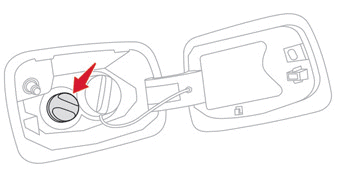
► Turn the blue AdBlue tank cap anticlockwise and remove it.
► With an AdBlue container: after checking the expiry date, carefully read the instructions on the label before pouring the contents into the vehicle's AdBlue tank.
► With an AdBlue pump: insert the nozzle and fill the tank until the nozzle cuts off automatically.
To avoid overfilling the AdBlue tank:
- Top up between 10 and 13 litres when using AdBlue containers.
- Do not continue filling after the first automatic cut-off of the nozzle when refuelling at a filling station.
Any intermediate top-up of AdBlue must be at least 5 litres for the system to register it.
If the AdBlue tank has run completely empty, as confirmed by the message "Add AdBlue: starting not possible", you must top up with at least 10 litres.
The system may not detect a top-up immediately, but only after a few kilometres.
Test yourself
A quick Citroen C5 Aircross quiz: every answer comes with an explanation and a link to the manual page.