Oil circuit
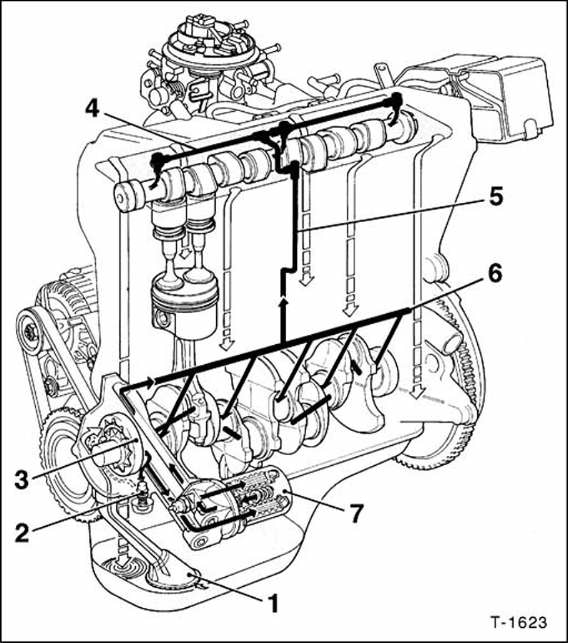
The oil pump - 3 - (crescent-type pump) draws engine oil from the oil pan through the oil strainer - 1 - and pushes it into the main oil filter - 7 - On the pressure side of the oil pump there is a pressure relief valve (oil pressure regulator valve) - 2 -.
If oil pressure is too high, the valve opens and some of the oil can flow back into the oil pan. The illustration shows the 1.4 l engine.
Through the centre shaft of the filter cartridge, the filtered oil reaches the main oil gallery - 6 -. If the oil filter is clogged, a bypass valve directs the oil directly and unfiltered into the main oil gallery.
Galleries branch off from the main oil gallery to lubricate the crankshaft bearings. Through angled drillings in the crankshaft, the oil is routed to the connecting rod bearings and from there sprayed against the piston pins and cylinder walls.
At the same time, engine oil passes through a riser pipe - 5 - into the cylinder head, where it supplies the camshaft bearings and valve tappets via line - 4 -.
Specific to 1.6 l engine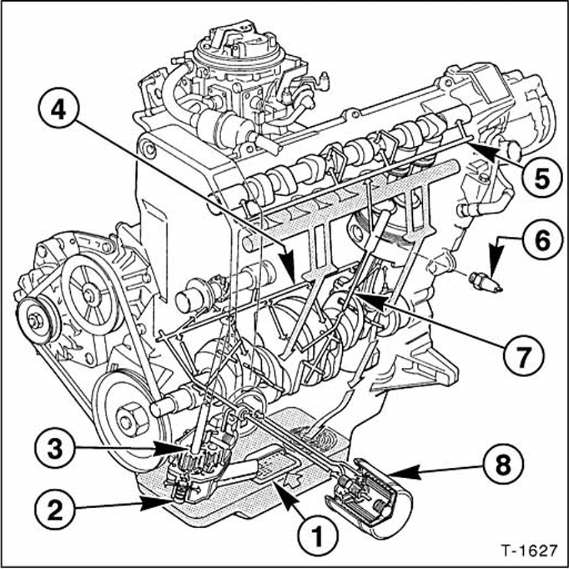
Oil strainer
Oil pressure regulator valve
Gear-type oil pump
Main oil gallery
Oil line
Oil pressure switch
Riser pipe
Main oil filter
The 1.6 l engine has a gear-type oil pump in the oil pan, driven by the auxiliary shaft.
Specific to 1.8/2.0 l engine and diesel engineLike the 1.4 l engine, these engines have an oil pump at the end of the crankshaft. On the 2.0 l engine the oil pump is driven by a chain. On the 2.0 l and diesel engines, an oil cooler is integrated into the oil circuit; it is mounted on the oil filter flange and flows through with coolant to prevent the oil temperature from becoming too high. The diesel turbocharger is connected to the oil circuit by 2 lines, as the turbocharger shaft must be lubricated.
Test yourself
A quick Fiat Bravo quiz: every answer comes with an explanation and a link to the manual page.