Wheel alignment
Optimum handling and minimum tire wear can only be achieved if the wheel positions are correct. If tire wear is increased and uneven, or if road holding is poor - with poor straight-line stability and poor steering behavior when cornering - have the vehicle visually aligned at a workshop.
Wheel alignment cannot be carried out without suitable alignment equipment. This section is therefore limited to describing the basic terms required for alignment.
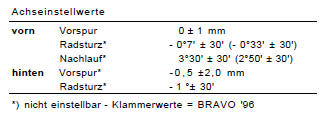
Toe/camber/kingpin inclination/casterToe is the lateral distance between the wheels. Toe-in means the front wheels are slightly closer together at the front than at the rear, measured at wheel hub height. Toe-out means the front wheels are slightly further apart at the front than at the rear.
Camber and kingpin inclination reduce the transmission of road shocks to the steering and keep friction as low as possible when cornering.
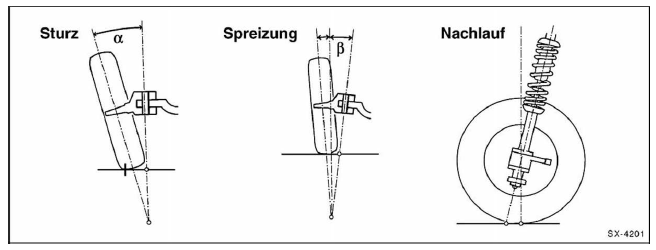
Camber is the angle by which the wheel plane deviates from the vertical. The front wheels are therefore tilted. With negative camber, for example, the wheels are further apart at the contact patch than at the top.
Kingpin inclination is the angle between the steering axis of the steering knuckle and the vertical at the tire contact patch, viewed in the longitudinal direction of the vehicle.
Caster is the angle between the steering axis of the steering knuckle and the vertical at the tire contact patch, viewed in the transverse direction of the vehicle. Caster has a significant influence on the straight-line stability of the front wheels.
Insufficient caster promotes drifting off the straight course on poor roads or in crosswinds. It also prevents the steering from returning far enough to the center position after cornering.
Test requirementsSteering correctly adjusted.
No impermissible play in the tie rod and suspension joints or wheel bearings. Rims and tires in perfect condition.
Tire pressure set to specified value.
Vehicle in curb weight condition: spare wheel and jack are in their designated positions.
Otherwise the vehicle must be empty. 5 l of fuel in the fuel tank.
Before measuring, bounce the vehicle up and down vigorously.
Test yourself
A quick Fiat Bravo quiz: every answer comes with an explanation and a link to the manual page.