Engine lubrication
Multigrade oils are specified for engine lubrication, so a seasonal oil change (summer/winter) is not required. Multigrade oils are based on a thin single-grade oil (for example: 10W) and are stabilised when hot by so-called viscosity index improvers. This provides the correct lubricating properties for both a cold and a hot engine.
The SAE designation indicates the viscosity of the engine oil.
SAE = Society of Automotive Engineers.
Example: SAE 10W-40: 10 - viscosity of the oil when cold. The smaller the number, the thinner the cold engine oil.
W - the engine oil is suitable for winter use.
40 - viscosity of the oil when hot. The larger the number, the thicker the hot engine oil.
Low-friction oils (high-performance oils) may also be used. These are multigrade oils to which, among other things, friction modifiers have been added, which reduce friction within the engine.
Application range and viscosity classes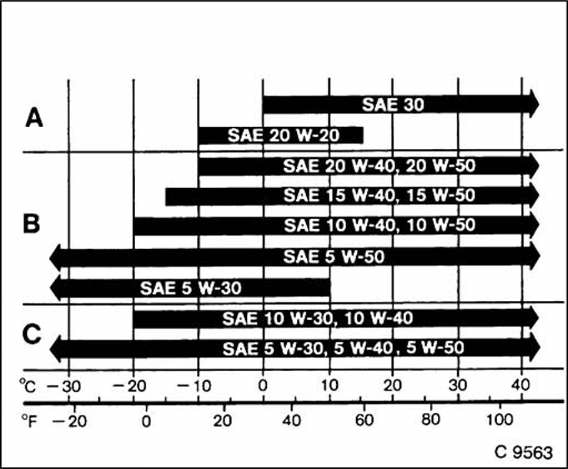
Single-grade oils
Multigrade oils
Low-friction oils
Fiat recommends the use of oil of specification SAE 10W-40, and SAE 15W-40 for the diesel engine. Since the operating ranges of adjacent SAE classes overlap, short-term temperature fluctuations can be disregarded. It is permissible to mix oils of different viscosity classes if oil has to be topped up.
Additives of any kind should not be added to either the fuel or the engine oils.
Engine oil specificationThe quality of an engine oil is identified by standards of the automotive and oil manufacturers.
American oil manufacturers classify their oils according to the API system (American Petroleum Institute): the designation consists of two letters each.
The first letter indicates the application range: S = Service, suitable for petrol engines; C = Commercial, suitable for diesel engines. The second letter indicates the quality in alphabetical order. The highest quality oils are API specification SL for petrol engines and CF for diesel engines.
European oil manufacturers classify their oils according to the "ACEA" specification (Association des Constructeurs Européens d'Automobiles), which mainly takes European engine technology into account. Oils for passenger car petrol engines have the ACEA quality classes A1-96 to A3-96; diesel engine oils range from B1-96 to B4-96. The highest quality oils are "A3" for petrol engines and "B3" for diesel engines.
"B4" is designed for diesel direct-injection engines, but should only be used if the specification "B3" is also stated. "96" indicates the year in which the ACEA classification came into effect, 1996. Engine oils with later year designations may also be used.
Warning: Engine oils that the manufacturer expressly designates as oils for diesel engines are not suitable for petrol engines. There are oils that are suitable for both petrol and diesel engines. In this case, both specifications (for example ACEA A3-96/B3-96 or API SH/CF) are shown on the oil container. The correct engine oil for the Fiat Bravo/BravaFiat prescribes the following oils: petrol engines: oil of specification SAE 10W-40 or 5W-30, which must meet the minimum standards ACEA A3 and API SJ.
Diesel engine: oil of specification SAE 10W-40, which must meet the minimum standards ACEA B3 and API CD.
Oil consumptionIn an internal combustion engine, oil consumption means the quantity of oil that is consumed as a result of the combustion process. Oil consumption must in no way be confused with oil loss, such as occurs through leaks at the oil sump, rocker cover, etc.
Normal oil consumption results from the combustion of small quantities of oil in the cylinders, from the removal of combustion residues and abrasion particles. In addition, the oil deteriorates due to the high temperatures and high pressures to which it is continuously exposed in the engine. External operating conditions, such as driving style, as well as manufacturing tolerances also influence oil consumption. Oil consumption per 1000 km should not exceed 0.3 litres for petrol engines and 0.8 litres for diesel engines.
Oil must be topped up whenever the "refill" mark is reached. Caution: do not fill oil above the "maximum" mark. If too much oil has been added, the excess oil must be drained. Otherwise the catalytic converter may be damaged, as unburned oil enters the exhaust system.
Test yourself
A quick Fiat Bravo quiz: every answer comes with an explanation and a link to the manual page.