Ignition/spark plugs
The ignition system generates the spark that ignites the air-fuel mixture drawn in. To generate a strong spark, the ignition coils convert the 12 V battery voltage to over 30,000 V.
The diesel engine has no ignition system, since the high compression heats the air so much that ignition occurs by itself after the fuel is injected.
The petrol engines of the Fiat Bravo/Brava are equipped with a map-controlled ignition system, whose control is integrated in the engine control unit. The control unit sends electrical pulses to the ignition coils. The ignition system is synchronized by signals that a pulse generator sends to the control unit. The pulse generator is located on the side of the engine block and detects engine speed and crankshaft position using a toothed disc on the crankshaft.
The ignition is designed as a direct ignition system. It no longer has a conventional distributor. Instead, the ignition voltage is distributed to the individual cylinders by static, electronically controlled components. The ignition voltage is generated in the 1.4/1.6 L engines by 2 dual ignition coils mounted on the cylinder head. The 1.8/2.0 L engines have a single ignition coil for each cylinder, mounted above the spark plug.
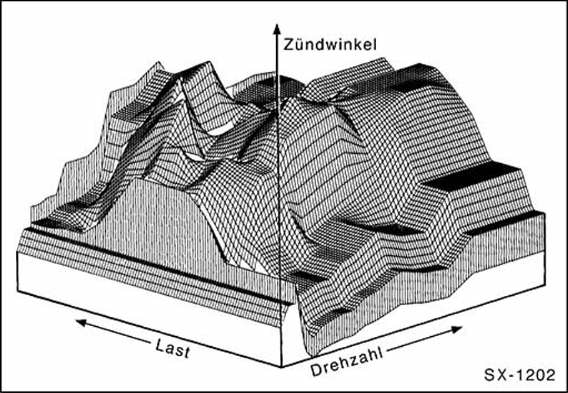
To determine the correct ignition timing, the control unit relies on an electronically stored ignition map.
This allows the ignition system to be easily adapted to different driving conditions.
The ignition timing is also influenced by a knock sensor (except on the 1.6 L engine). The 2.0 i engine has 2 knock sensors. Since fuel consumption is lowest at high compression, modern engines are designed with compression ratios as high as possible. However, high compression can cause uncontrolled combustion, known as engine knock. Engine knock causes engine damage over time. To prevent this, a knock sensor is required. It is bolted to the engine block, detects abnormal combustion and reports it to the control unit, which temporarily shifts the ignition timing toward "retard".
All components of the ignition system are matched to each other and ensure that the ignition timing is always optimal. Adjustment of the ignition timing is no longer possible.
When working on the electronic ignition system, certain points must be observed to avoid injury to persons or destruction of the ignition system.Test yourself
A quick Fiat Bravo quiz: every answer comes with an explanation and a link to the manual page.