Engine cooling
The coolant circuit is thermostatically controlled. While the engine is cold, coolant circulates only in the cylinder head, the engine block and the heater heat exchanger.
As the engine warms up, the thermostat opens the coolant flow through the radiator. The coolant is moved by the coolant pump, which on the 1.6 l engine is driven by a V-belt and on all other engines by the camshaft timing belt. The coolant flows through the radiator from top to bottom and is cooled by air passing the cooling fins. As soon as the coolant temperature rises to approx. +92 °C, a thermoswitch switches on the electric fan. If the coolant temperature falls below +87 °C, the thermoswitch switches the fan off again. Models with diesel engine or air conditioning have a two-stage fan; the fan runs faster in stage 2. The temperature difference between switching on the first and second fan stages is about 5 °C. Note: on the 1.8 l engine the fan is switched on by the engine control unit.
The expansion tank serves as a coolant reservoir and absorbs coolant expansion when heated. The cooling system is under pressure at operating temperature. A valve in the expansion tank cap limits the pressure to 0.98 bar, and on the diesel engine to 0.78 bar.
Warning: when the engine is warm, the radiator fan may switch on suddenly even with the ignition key removed – risk of injury! Only reach into the fan area when the engine has cooled down.
Coolant circuit 1.6 l petrol engine (1.8/1.9/2.0 l engines are similar to the illustration)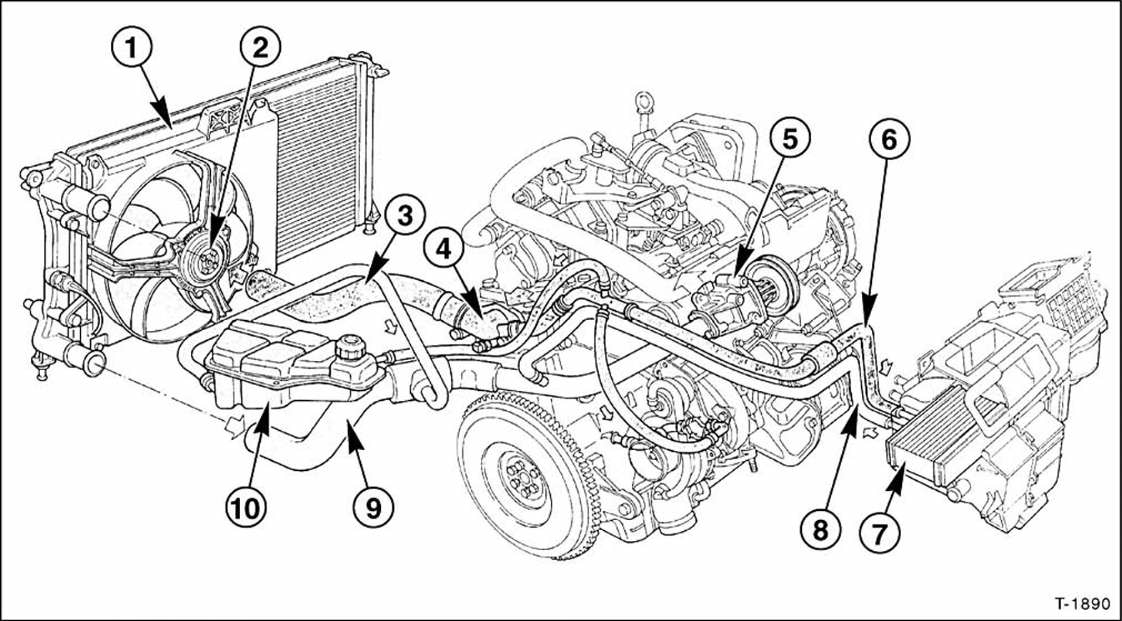
Radiator
Electric fan
Coolant hose to radiator
Thermostat
Coolant pump
Coolant hose to heat exchanger
Heater heat exchanger
Coolant hose from heat exchanger
Coolant hose from radiator to pump
Expansion tank

Radiator
Electric fan
Expansion tank
Coolant pump
Coolant hose to throttle body
Coolant hose from throttle body
Heater heat exchanger
Coolant hose from heat exchanger
Coolant hose to heat exchanger
Thermostat
Coolant hose to radiator
Coolant hose from radiator to pump
Test yourself
A quick Fiat Bravo quiz: every answer comes with an explanation and a link to the manual page.