Function of the catalytic converter
All engines are equipped with a catalytic converter for exhaust gas purification.
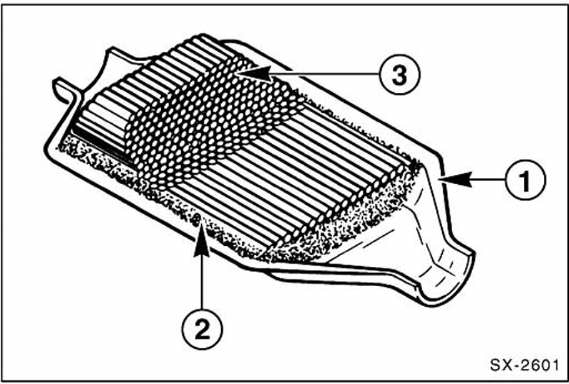
The catalytic converter consists of a ceramic honeycomb body - 3 - coated with a carrier layer. The carrier layer contains precious metal salts, which carry out the conversion process. In the housing - 1 - the catalytic converter is held in place by an insulating support mat - 2 -, which also compensates for thermal expansion.
Petrol enginesIn conjunction with the electronic fuel injection system and the lambda sensor, the quantity of fuel for combustion is metered precisely so that the catalytic converter can reduce pollutants. The lambda sensor is located in the exhaust pipe upstream of the catalytic converter and is washed by the exhaust gas flow. The lambda sensor is an electrical sensor that indicates the residual oxygen content in the exhaust gas through electrical voltage fluctuations and allows conclusions to be drawn about the composition of the air-petrol mixture. Within fractions of a second, the lambda sensor can send corresponding signals to the injection system control unit, which continuously changes the fuel-air ratio. This is necessary on the one hand because operating conditions (idle, full throttle) change constantly, and on the other hand because optimum post-combustion in the catalytic converter only takes place when enough petrol is still present in the engine exhaust gas.
So that post-combustion can take place in the catalytic converter at temperatures of +300 to +800 °C, the fuel-air mixture must contain more fuel than would be required for pure combustion.
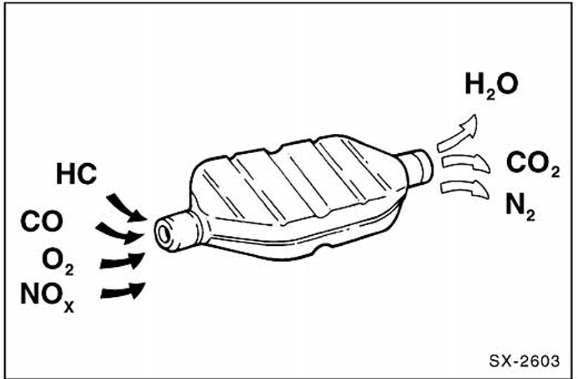
The catalytic converter used is a so-called three-way catalytic converter. This means that, due to lambda control, the oxidation of carbon monoxide (CO) and hydrocarbons (HC) and the reduction of nitrogen oxides (NOx) take place simultaneously in this converter.
Catalytic converter on diesel engineA catalytic converter is also fitted as standard on diesel engines.
However, mixture adjustment is not possible here.
The catalytic converter nevertheless reduces the environmentally harmful carbon monoxide and hydrocarbon emissions to a level well below that of petrol engines with controlled catalytic converters. In addition, the typical diesel exhaust odour is reduced.
The higher proportion of nitrogen oxides in diesel exhaust gas is kept low before the catalytic converter by an additional exhaust gas recirculation system (EGR system). Depending on the engine operating condition, the exhaust gas recirculation feeds a specific amount of exhaust gas back into the intake air via a controlled valve. This lowers the combustion temperature. The lower the combustion temperature, the fewer toxic nitrogen oxides are formed in the exhaust gas.
Test yourself
A quick Fiat Bravo quiz: every answer comes with an explanation and a link to the manual page.