Passive safety features for the driver and passengers
Introduction The instructions on the following pages explain how to ensure maximum protection for the driver, adult passengers, and older teenagers who are already permitted to ride in the front seat of the vehicle.
The following pages, 34 - 40, provide recommendations for the safety of young children and infants.
1. Close the vehicle doors
After the driver and passengers have taken their seats in the vehicle, make sure that all vehicle doors are securely closed.
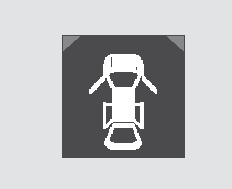
Any door that is not fully closed is shown on the multi-information display.
The illustration shows a case where all doors are open, including the rear door.
For more detailed information on how the door monitor display works, see page 99.
2. Adjust the front seat positions
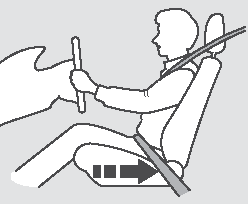
Move the driver's seat as far from the steering wheel as possible, but without compromising your ability to control the vehicle. The front passenger seat should also be moved as far rearward as possible.
If the driver sits too close to the steering wheel, or the passenger sits too close to the instrument panel, serious injury may result in an accident from airbag deployment or from striking the steering wheel or instrument panel.
Along with adjusting the driver's seat, adjust the steering wheel height and tilt (page 147).
If you are of short stature and cannot move the driver's seat far enough back from the steering wheel and pedals without compromising your ability to control the vehicle, we recommend considering the use of an adaptive seating accessory.
After adjusting the seat positions, rock the seats forward and backward to check that they are securely locked.
Instructions for adjusting the front seat positions are given on page 160.

WARNING
Positioning the driver's seat too close to the steering wheel, or the front passenger seat too close to the instrument panel, may result in serious injury or even death if the airbags deploy in a collision.
Always keep the front seats as far as possible from the airbags
3. Adjust the seatback positions
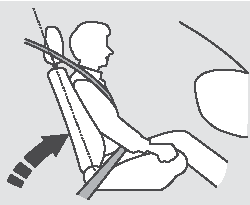
Adjust the driver's seat backrest to an upright, comfortable position, leaving a clearance between your chest and the steering wheel hub, behind the cover of which the front airbag is located.
Passengers seated in seats with adjustable backrests must also set their seatbacks to the upright position.
WARNING
Excessive seatback recline in the event of a traffic accident may result in serious injury or even death.
Adjust the seatback to the upright position and sit firmly against the seatback with your back.
An excessively reclined seatback prevents the shoulder belt from lying across the chest, reducing the protective effectiveness of the belt.
In addition, the risk of submarining under the belt increases in a severe frontal impact. The more the seatback is reclined, the greater the severity of possible injuries.
For information on adjusting the front seatbacks, refer to page 160.
4. Head Restraint Adjustment
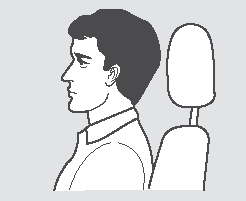
The driver's head restraint must be adjusted in height so that the back of the head contacts its center portion.
Adjustable head restraints of the passenger seats must also be set to the correct positions. A tall driver (passenger) should set the head restraint to its highest position.
Except for the "Type R" version: when a passenger is seated in the center rear seat, the head restraint of this seat must be set to its highest position.
WARNING
Incorrect head restraint position reduces their protective effectiveness and increases the risk of serious injury in a traffic accident.
Before driving, make sure the head restraints of all seats are correctly positioned.
Correct head restraint positioning helps prevent neck and head injuries in a rear-end collision and in other impacts.
For information on adjusting the head restraints, refer to page 162.
5. Fastening and Adjusting Seat Belts
Insert the belt tongue into the buckle, then pull on the webbing to check that the tongue is securely latched in the buckle. Make sure the belt webbing is not twisted, as a twisted belt itself poses a risk of injury.
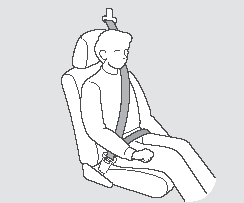
Lower the lap portion of the belt as far as possible onto the hips, then pull the shoulder portion of the belt to remove slack and ensure the belt fits snugly against the body.
Correct positioning of the lap belt ensures that, in a crash, the inertial load is absorbed by the strong pelvic bones.
If necessary, tighten the belt further and make sure the shoulder belt passes over the collarbone and lies against the chest.
This belt position distributes the impact inertial load to the stronger upper part of the chest.
WARNING
Driving with an improperly fastened seat belt increases the likelihood of serious injury or death in a traffic accident.
Fasten your seat belt and make sure all passengers are properly belted.
If the shoulder belt touches the neck or runs across the forearm instead of the shoulder, adjust the position of the upper belt anchor.
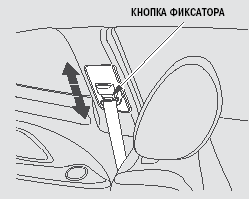
The front seat belts are equipped with adjustable anchors. To adjust the upper belt anchor position, press the release button and move the anchor up or down until it locks in the desired position (the latch design allows the belt anchor to be set in four positions).
Do not place the shoulder belt under your arm or behind your back. This may result in serious injury in an accident.
A faulty or improperly fastened seat belt will not protect the occupant in an accident.
Do not use faulty seat belts. Using a faulty seat belt carries a serious risk of injury or even death. Contact an authorized dealer immediately to have the seat belts inspected.
For additional information on the vehicle's seat belt system and care recommendations, refer to page 22.
6. Proper Seating Posture
After the driver and all passengers have taken their seats, adjusted the seats, and fastened their seat belts, maintain an upright posture with your back firmly against the seatback and keep your feet on the floor until the vehicle has come to a complete stop and the engine is switched off.
Improper seating posture while driving increases the risk of injury in a traffic accident. For example, if passengers sit hunched over, lie down, turn sideways, lean forward or to the side, or place their feet on the seats, the risk of serious injury in a crash increases significantly.
In addition, front passengers in an incorrect seating position may be seriously injured by interior trim parts broken in an accident, as well as by the deployment of the front airbags.
If a front passenger leans sideways so that their head is within the deployment zone of the side airbag, they may receive a strong impact from the airbag when it deploys, which can cause serious injury.
WARNING
An incorrect seating position during a trip may result in serious injury in a traffic accident.
Always maintain the correct seating position, keeping your back firmly against the seatback and your feet on the floor.
Test yourself
A quick Honda Civic quiz: every answer comes with an explanation and a link to the manual page.