Installing Child Restraint Systems
After selecting a suitable child restraint system and determining its installation location, perform the three main installation steps.
1. Securely fasten the child restraint system to the vehicle. All types of restraint systems must be secured using the lap portion of the lap-and-shoulder seat belt or the lower anchorages.
An improperly installed and insecurely fastened restraint device may cause serious injury to the child in an accident.
For vehicles not sold in Europe: If the child safety seat is secured with the lap-and-shoulder seat belt, be sure to use the locking clip attached to the belt webbing (see page 57).
2. Make sure the child restraint device is securely fastened. After installing the child restraint device, try to move it forward and backward and from side to side to check that it is firmly secured in the required position.
It is recommended to secure the position of the child restraint device as firmly as possible.
However, the child restraint device must not be "rock solid." Slight lateral movement of the restraint device is acceptable and does not reduce the effectiveness of its protective functions.
If the child restraint cannot be securely attached, try installing it in a different rear seat position, or use a different child restraint whose design allows it to be firmly secured in the desired position.
A list of child restraint systems recommended for use in European countries is provided on page 47.
3. Seat the child and secure the child firmly in the child restraint.
Make sure the child is securely fastened in the seat in accordance with the instructions and recommendations of the child restraint manufacturer. If the child is not securely restrained, the child may be thrown from the child seat in a crash, resulting in serious injury.
The following pages provide guidance on selecting and installing child safety restraints used in European countries. All examples show child seats installed in the forward-facing position; however, the installation rules remain the same for rearward-facing seats.
Child Safety Restraints (for European Countries)
Many types of child safety restraint systems are available on the market. However, not all of them are suitable for your vehicle.
When selecting a child seat or baby cradle, refer to the table, which shows whether child seats can be installed in each vehicle seat position.
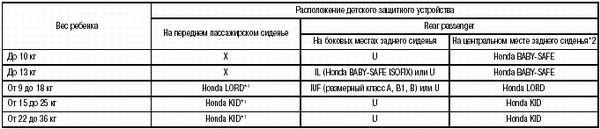
IL: Installation of manufacturer-approved ISOFIX child restraint systems listed in the table is permitted.
IUF: Installation of universal ISOFIX child restraint systems approved for the indicated weight group, in the forward-facing position, is permitted.
U: Installation of universal child restraint systems approved for the indicated weight group is permitted.
X: Installation of child restraint systems for children in the indicated weight group is not permitted.
* 1: Move the front seat as far back as possible.
* 2: Except for the "Type R" model
Some child seats are classified by size class. Check the size class that may be specified by the manufacturer for some child seats in the instructions, on the packaging, or on the labels.
The genuine child seats listed in the table are original Honda products. You can purchase them from an authorized Honda dealer.
Instructions for proper installation of child seats in the vehicle are provided in the separate Child Safety Restraint Installation Guide.

WARNING
Using a child restraint that is not suitable for the vehicle will not provide proper protection for the child in a traffic accident. As a result, the child may be killed or seriously injured.
Your vehicle may be equipped with lower anchors for installing child seats in the outboard rear seat positions.
These anchors may be used only with child seats specifically designed for this type of attachment.
For information on installing a child restraint system using the lower anchors, see page 49.
Test yourself
A quick Honda Civic quiz: every answer comes with an explanation and a link to the manual page.