Inspection of Automatic Transaxle Control System Components
1. THROTTLE POSITION SENSOR (TPS) INSPECTION The throttle position sensor is a sliding-contact potentiometer that moves with the rotation of the throttle valve shaft, indicating the throttle opening angle. When the throttle shaft rotates, the sensor signal voltage changes. Based on the change and rate of change of the sensor signal voltage, the engine control module determines the degree and speed of throttle opening.
(For more information, refer to the "Fuel System" section.)
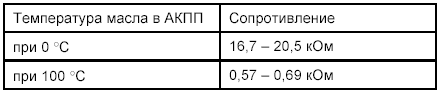
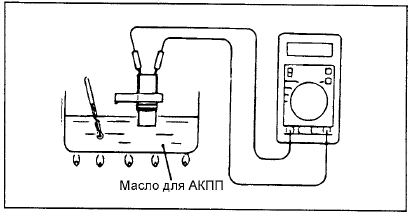
2. TRANSAXLE OIL TEMPERATURE SENSOR INSPECTION
a) Remove the transaxle oil temperature sensor.
b) Measure the resistance between terminals 1 and 2 of the sensor connector at the check points.
Standard value:
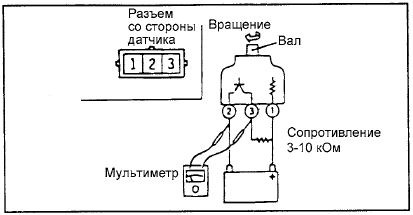
3. VEHICLE SPEED SENSOR INSPECTION
a) Remove the vehicle speed sensor and connect a 3 – 10 kΩ resistor to it, as shown in the figure.
b) Rotate the vehicle speed sensor shaft and check that voltage is generated between terminals 2 and 3 of the sensor connector (4 pulses per revolution).
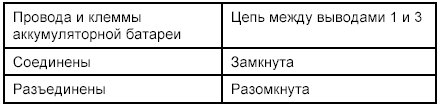
4. A/T CONTROL RELAY INSPECTION
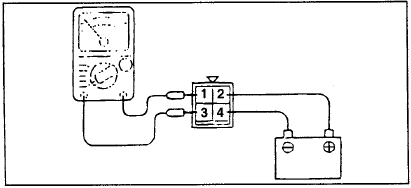
a) Remove the A/T control relay.
b) Using jumper wires, connect terminal 2 of the A/T control relay to the battery positive (+) terminal, and terminal 4 to the battery negative (-) terminal.
c) Check the continuity between terminals 1 and 3 of the control relay with the jumper wires connected and disconnected from the battery terminals.
d) If relay operation differs from the specification, replace the A/T control relay.
5. SOLENOID VALVE INSPECTION
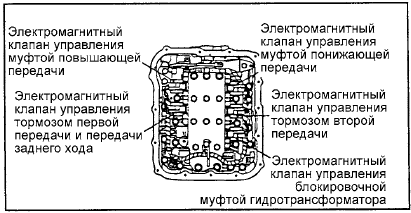
a) Remove the control valve body cover.
b) Disconnect the connector of each solenoid valve.
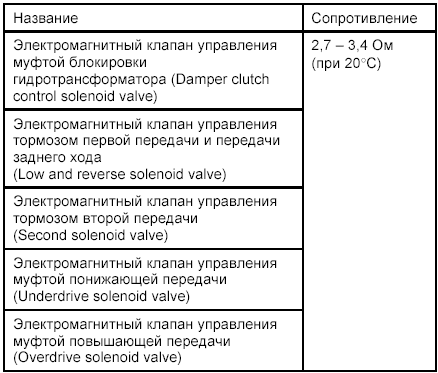
c) Measure the resistance between terminals 1 and 2 of each solenoid valve.
Standard value:
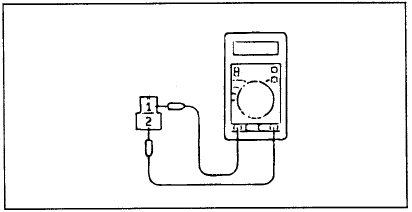
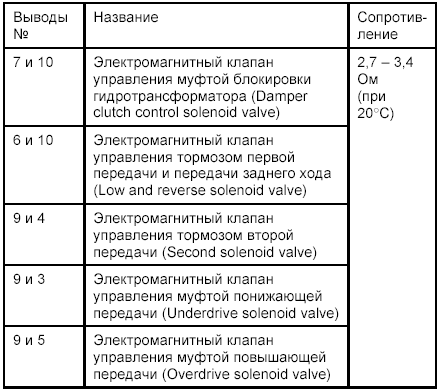
d) If the resistance is outside the specified value, replace the solenoid valve.
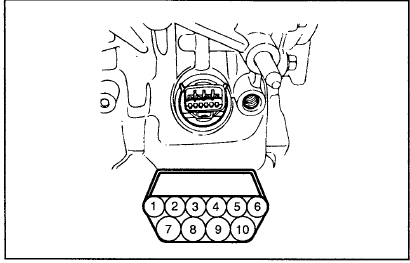
Resistance at the terminals of the control valve body connector.
Test yourself
A quick Hyundai Elantra CN7 quiz: every answer comes with an explanation and a link to the manual page.