Engine Control System/Fuel System
Description and Operation
In this manual: Engine Control System/Fuel System
9steps
~54min
2/5difficulty
Done 0 of 9
Description
If any component of the gasoline engine control system (sensors, ECM, injector, etc.) malfunctions, fuel supply may stop or an incorrect amount of fuel may be supplied under various engine operating conditions. The following situations may occur.- Engine is hard to start or does not start at all.
- Unstable idle.
- Poor drivability
- Catalyst
- Fuel System
- Mass Air Flow Sensor
- Intake Air Temperature Sensor
- Engine Coolant Temperature Sensor
- Throttle position sensor
- Heated Oxygen Sensor (Upstream)
- Heated Oxygen Sensor Heater (Upstream)
- Heated Oxygen Sensor (Downstream)
- Heated oxygen sensor heater (downstream)
- Injector
- misfire
- Crankshaft Position (CKP) sensor
- Camshaft Position Sensor
- Evaporative Emission Control System
- Vehicle speed sensor
- Idle Speed Control System
- Power Supply
- PCM/PCM
- MT/AT Coding
- Acceleration Sensor
- MIL-ON Request Signal
- Power Stage
[NON-EOBD]
The MIL illuminates to notify the driver of a problem with the vehicle. However, the MIL turns off automatically after 3 consecutive driving cycles without the same malfunction. Immediately after the ignition is turned ON (engine not running), the MIL illuminates continuously to indicate that the MIL is operating normally. Malfunctions with the following items illuminate the MIL.- Heated Oxygen Sensor (HO2S)
- Mass Air Flow Sensor (MAFS)
- Throttle Position Sensor (TPS)
- Engine Coolant Temperature Sensor (ECTS)
- Idle Speed Control Actuator (ISCA)
- Injectors
- ECM
[INSPECTION]
- After turning the ignition switch ON, make sure the indicator illuminates for about 5 seconds and then goes off.
- If the lamp does not illuminate, check for an open circuit in the wiring harness, a blown fuse, or a burned-out bulb.
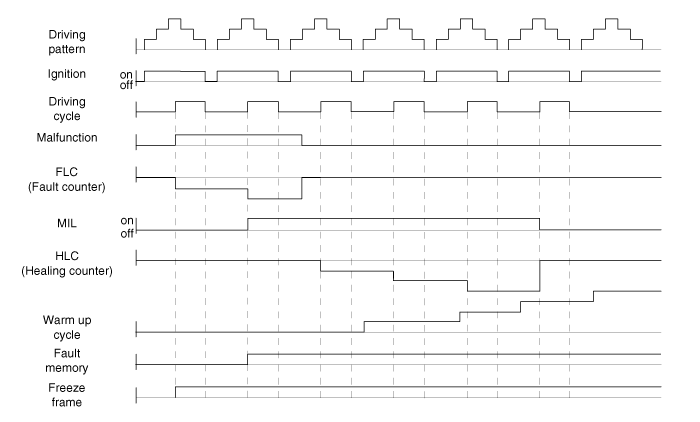
- When the same malfunction is detected and stored during two consecutive driving cycles, the MIL will illuminate automatically.
- The MIL will go off automatically if the malfunction is not detected after 3 consecutive driving cycles.
- A Diagnostic Trouble Code (DTC) is stored in the ECM memory when a malfunction is detected during two consecutive driving cycles. The MIL illuminates when the malfunction is detected in the second driving cycle. When a misfire is detected, a DTC is stored and the MIL illuminates immediately after the malfunction is detected.
- A Diagnostic Trouble Code (DTC) is automatically erased from the ECM memory if the same malfunction is not detected within 40 driving cycles.
Test yourself
A quick Hyundai Kona quiz: every answer comes with an explanation and a link to the manual page.
Was this page helpful?