Hazard warning flasher switch
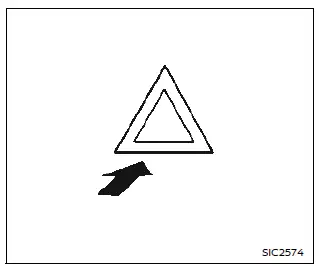
In this manual: Hazard warning flasher switch
Foreword — 1Seats, seat belts and Supplemental RestraintSystem (SRS) — 1Passenger compartment — 1Instrument panel — 1Warning and indicator lights — 1The EV (Electric Vehicle) system — 1Li-ion battery — 1High voltage precautions — 1EV (Electric Vehicle) characteristics — 1Life with an EV (Electric Vehicle) (scene guide) — 1Efficient use of your vehicle — 1EV (Electric Vehicle) unique information — 1Types of charge and how to charge the Li-ion battery — 1Charging methods — 1Charging related indicator lights — 1Seats — 1Head restraints/headrests — 1Seat belts — 1Child safety — 1Child restraints — 1Supplemental Restraint System (SRS) — 1Cockpit — 1Meters and gauges — 1Warning lights, indicator lights and audible reminders — 1Vehicle information display — 1Head Up Display (HUD) — 1Security systems — 1Wiper and washer switch — 1Rear window and outside mirror defroster switch — 1Headlight and turn signal switch — 1Horn — 1Heated seats — 1Climate controlled seats — 1Rear Door Alert — 1Power outlets — 1Emergency Call (SOS) button — 1Storage — 1Roof rack — 1Windows — 1Moonroof — 1Interior lights — 1HomeLink Universal Transceiver — 1Keys — 1Doors — 1Intelligent Key system — 1Hood — 1Liftgate — 1Charge port lid — 1Tilt/telescopic steering — 1Sun visors — 1Mirrors — 1Memory seat — 1NissanConnect Owner's Manual — 1RearView Monitor — 1Intelligent Around View Monitor — 1Moving Object Detection (MOD) — 1Ventilators — 1Heater and air conditioner — 1Radio antenna — 1Push-button power switch — 1Before starting the EV system — 1Driving the vehicle — 1e-Step system — 1Parking brake — 1Automatic brake hold — 1Drive Mode Selector — 1Driver Assistance systems — 1Traffic Sign Recognition (TSR) — 1Lane Departure Warning (LDW) — 1Intelligent Lane Intervention (I-LI) — 1Blind Spot Warning (BSW) — 1Intelligent Blind Spot Intervention (I-BSI) — 1Rear Cross Traffic Alert (RCTA) — 1ProPILOT Assist Systems — 1Automatic Emergency Braking (AEB) with Pedestrian Detection system — 1Intelligent Forward Collision Warning (I-FCW) — 1Intelligent Driver Alertness (I-DA) — 1Rear Automatic Braking (RAB) — 1Increasing power economy — 1All-Wheel Drive (AWD) system — 1Electric power steering — 1Brake system — 1Brake assist — 1Vehicle Dynamic Control (VDC) system — 1Chassis control — 1Hill Start Assist system — 1Sonar system — 1ProPILOT Park — 1Cold weather driving — 1Hazard warning flasher switch — 1Flat tire — 1Jump starting — 1If the Li-ion battery becomes completely discharged — 1Towing your vehicle — 1Cleaning exterior — 1Cleaning interior — 1Corrosion protection — 1Cooling system — 1Reduction gear oil — 1Windshield wiper blades — 1Window washer fluid — 112-volt battery — 1Intelligent Key battery replacement — 1Lights — 1Wheels and tires — 1Maintenance requirement — 1General maintenance — 1Explanation of scheduled maintenance items — 1Maintenance schedules — 1Recommended fluids/lubricants and capacities — 1Vehicle identification — 1Vehicle loading information — 1Towing a trailer (2WD models) — 1Flat towing — 1Reporting safety defects — 1Event Data Recorders (EDR) — 1
~2min read
Nissan Ariya. Hazard warning flasher switch

The hazard indicator flasher switch operates regardless of the power switch position except when the battery is discharged.

The hazard indicator flasher is used to warn other drivers when you have to stop or park under emergency conditions.

When the hazard indicator flasher switch is pushed, all turn signal lights will flash.

To turn off the hazard indicator flasher, push the hazard indicator flasher switch again.

When an impact that could activate the supplemental air bags is detected, the hazard warning flasher lights blink automatically.

If the hazard warning flasher switch is pushed, the hazard warning flashers will turn off.

WARNING

  • If stopping for an emergency, be sure to move the vehicle well off the road.
  • Do not use the hazard warning flashers while moving on the highway unless unusual circumstances force you to drive so slowly that your vehicle might become a hazard to other traffic.
  • Turn signals do not work when the hazard warning flasher lights are on.

WARNING

Do not turn the hazard warning flasher switch to off until you can make sure that it is safe to do so. Also, the hazard flasher warning may not blink automatically depending on the force of impact.

Connection to Roadside Assistance

In the event of a roadside emergency, Roadside Assistance Service is available to you. Please refer to your Warranty Information Booklet (U.S.) or Warranty & Roadside Assistance Information Booklet (Canada) for details.

Emergency EV system shut off

To shut off the EV system in an emergency situation while driving, perform the following procedure:

  • Rapidly push the push-button power switch 3 consecutive times in less than 1.5 seconds, or
  • Push and hold the push-button power switch for more than 2 seconds.