Automatic Emergency Braking (AEB) with Pedestrian Detection system
- Basic information
- Turning the AEB with Pedestrian Detection system ON/OFF
- System temporarily unavailable
- System maintenance
Basic information Nissan Ariya 1st generation
WARNING
Failure to follow the warnings and instructions for proper use of the AEB with Pedestrian Detection system could result in serious injury or death.
- The AEB with Pedestrian Detection system is a supplemental aid to the driver. It is not a replacement for the driver's attention to traffic conditions or responsibility to drive safely. It cannot prevent accidents due to carelessness or dangerous driving techniques.
- The AEB with Pedestrian Detection system does not function in all driving, traffic, weather and road conditions.
The AEB with Pedestrian Detection system can assist the driver when there is a risk of a forward collision with
- a vehicle ahead in the travelling lane
- a pedestrian ahead in the travelling lane
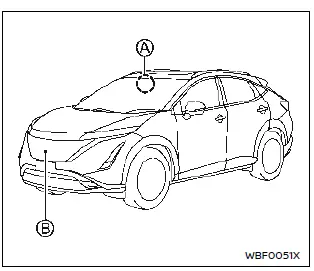
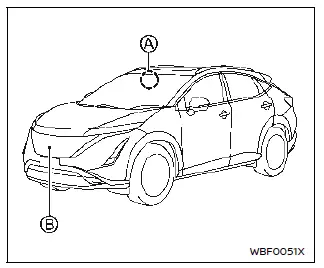
The AEB with Pedestrian Detection system uses a radar sensor B located on the front of the vehicle to measure the distance to the vehicle ahead in the same lane.
For pedestrians, the AEB system uses a camera A installed behind the windshield in addition to the radar sensor.
AEB with Pedestrian Detection system operation
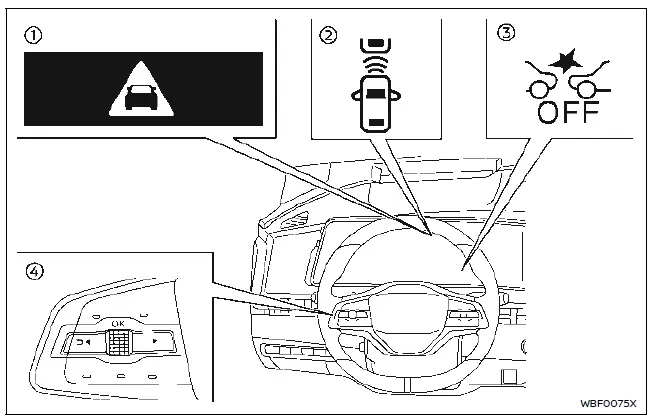
- AEB emergency warning indicator
- Vehicle ahead detection indicator (on the vehicle information display)
- AEB system OFF warning light (on the meter panel)
- Steering-wheel-mounted controls (left side)
The AEB with Pedestrian Detection system will function when your vehicle is driven at speeds above approximately 5 km/h.
For the pedestrian detection function, the AEB with Pedestrian Detection system operates at speeds between 6 - 60 km/h.
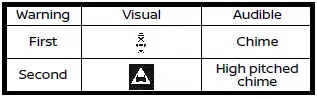
If a risk of a forward collision is detected, the AEB with Pedestrian Detection system will firstly provide the warning to the driver by flashing the vehicle ahead detection indicator (yellow) in the vehicle information display and providing an audible alert. In addition, the system applies partial braking.
If the driver applies the brakes quickly and forcefully after the warning, and the AEB with Pedestrian Detection system detects that there is still the possibility of a forward collision, the system will automatically increase the braking force.
If the driver does not take action, the AEB with Pedestrian Detection system issues the second visual (flashing red and white) and audible warning. Then the system applies partial braking.
If the risk of a collision becomes imminent, the AEB with Pedestrian Detection system applies harder braking automatically.
While the AEB with Pedestrian Detection system is operating, you may hear the sound of brake operation. This is normal and indicates that the AEB with Pedestrian Detection system is operating properly.
NOTE
The vehicle's stop lights come on when braking is performed by the AEB with Pedestrian Detection system.
Depending on vehicle speed and distance to the vehicle, pedestrian ahead, as well as driving and roadway conditions, the system may help the driver avoid a forward collision or may help mitigate the consequences of a collision should one be unavoidable.
If the driver is handling the steering wheel, accelerating or braking, the AEB with Pedestrian Detection system will function later or will not function.
The automatic braking will cease under the following conditions:
- When the steering wheel is turned as far as necessary to avoid a collision.
- When the accelerator pedal is depressed.
- When there is no longer a vehicle, pedestrian detected ahead.
If the AEB with Pedestrian Detection system has stopped the vehicle, the vehicle will remain at a standstill for approximately 2 seconds before the brakes are released.
When the brake pedal is depressed while the brake is applied by the system, you may feel the pedal effort is changed and may hear a sound and vibration noise.
This is normal and does not indicate a malfunction. In addition, the braking force can be increased by adding the pedal effort.
Turning the AEB with Pedestrian Detection system ON/OFF Nissan Ariya: FE0
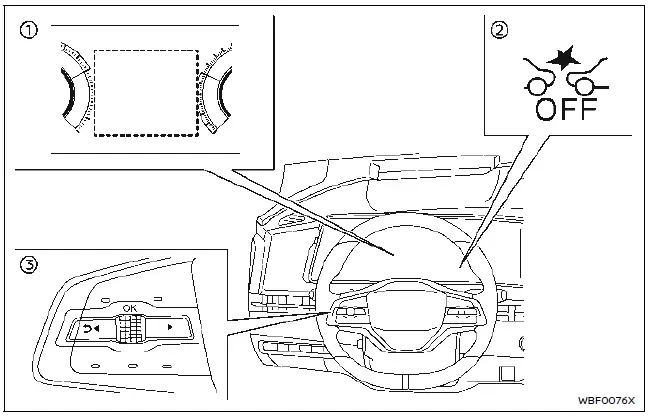
- AEB system OFF warning light (on the meter panel)
- Vehicle information display
- Steering-wheel-mounted controls (left side)
Perform the following steps to turn the AEB with Pedestrian Detection system on or off.
1. Push the  button until "Settings" appears in the vehicle information display and then push the scroll dial. Use the scroll dial to select "Driver Assistance." Then push the scroll dial.
2. Select "Emergency Assist" and push the scroll dial.
3. Select "Emergency Braking" and use the scroll dial to turn the system on or off.
When the AEB with Pedestrian Detection system is turned off, the AEB system OFF warning light illuminates.
NOTE
- The AEB with Pedestrian Detection system will be automatically turned ON when the EV system is restarted.
- The Intelligent Forward Collision Warning (I-FCW) system is integrated into the AEB system. There is not a separate selection for the I-FCW system. When the AEB with Pedestrian Detection system is turned off, the I-FCW system is also turned off.
AEB with Pedestrian Detection system limitations
WARNING
Listed below are the system limitations for the AEB with Pedestrian Detection system. Failure to operate the vehicle in accordance with these system limitations could result in serious injury or death.
- The AEB with Pedestrian Detection system cannot detect all vehicles, pedestrians under all conditions.
- The AEB with Pedestrian Detection system does not detect the following:
- Pedestrians that are small (for example, children), in a sitting position, operating toys/skateboards, on scooters or in wheelchairs, or not in an upright standing or walking position.
- Animals of any size.
- Obstacles (for example, cargo or debris) on the roadway or roadside.
- Oncoming or crossing vehicles.
- Vehicles where the tires are difficult to see or the shape of the rear of the vehicle is unclear or obstructed.
- Parked vehicles.
- The AEB with Pedestrian Detection system has some performance limitations.
- If a stationary vehicle is in the vehicle's path, the system will not function when the vehicle approaches the stationary vehicle at speeds over approximately 80 km/h.
- Pedestrian detection will not function when the vehicle is driven at speeds over approximately 60 km/h or below approximately 10 km/h.
- For pedestrians, the AEB with Pedestrian Detection system will not issue the first warning.
- The AEB with Pedestrian Detection system may not function properly or detect a vehicle or pedestrian ahead in the following conditions:
- In poor visibility conditions (such as rain, snow, fog, dust storms, sand storms, smoke, and road spray from other vehicles).
- If dirt, ice, snow, fog or other material is covering the radar sensor area or camera area of the windshield.
- If strong light (for example, sunlight or high beams) enters the front camera or a sudden change in brightness occurs (for example, entering a tunnel or driving in lightning).
- In dark or dimly lit conditions, such as at night or in tunnels, including cases where your vehicle's headlights are off or dim, or the tail lights of the vehicle ahead are off.
- When the direction of the camera is misaligned.
- When driving on a steep downhill slope, on roads with sharp curves, and/or bumpy or dirt roads.
- If there is interference by other radar sources.
- When your vehicle's position or movement is changed quickly or significantly (for example, lane change, turning vehicle, abrupt steering, sudden acceleration or deceleration).
- When your vehicle or the vehicle or pedestrian ahead moves quickly or significantly such that the system cannot detect and react in time (for example, pedestrian moving quickly toward the vehicle at close range, vehicle cutting in, changing lanes, making a turn, steering abruptly, sudden acceleration or deceleration).
- When the vehicle or pedestrian is offset from the vehicle's forward path.
- If the speed difference between the two vehicles is small.
- The pedestrian's profile is partially obscured or unidentifiable; for example, due to transporting luggage, pushing a stroller, wearing bulky or very loose-fitting clothing or accessories, or being in a unique posture (such as raising hands).
- There is poor contrast of a person to the background, such as having clothing color or pattern which is similar to the background.
- For approximately 15 seconds after starting the EV system
- If the vehicle ahead has a unique or unusual shape, extremely low or high clearance heights, or unusual cargo loading or is narrow (for example, a motorcycle).
- When the vehicle or pedestrian is located near a traffic sign, a reflective area (for example, water on road), or is in a shadow.
- When multiple pedestrians are grouped together.
- When the view of the pedestrian is obscured by a vehicle or other object.
- While towing a trailer or other vehicle (AWD models).
- The system performance may be degraded in the following conditions:
- The vehicle is driven on a slippery road.
- The vehicle is driven on a slope.
- Excessively heavy baggage is loaded in the rear seat or the cargo area of your vehicle.
- The system is designed to automatically check the sensor (radar and camera)'s functionality, within certain limitations. The system may not detect some forms of obstruction of the sensor area such as ice, snow or stickers, for example. In these cases, the system may not be able to warn the driver properly. Be sure that you check, clean and clear sensor areas regularly.
- In some road and traffic conditions, the AEB with Pedestrian Detection system may unexpectedly apply partial braking. When acceleration is necessary, depress the accelerator pedal to override the system.
- The AEB with Pedestrian Detection system may operate when a pattern, object, shadow or lights are detected that are similar to the outline of vehicles or pedestrians, or if they are the same size and position as a vehicle or motorcycle's tail lights.
- The system may keep operating when the vehicle ahead is turning right or left.
- The system may operate when your vehicle is approaching and passing a vehicle ahead.
- Depending on the road shape (curved road, entrance and exit of the curve, winding road, lane regulation, under construction, etc.), the system may operate temporarily for the oncoming vehicle in front of your vehicle.
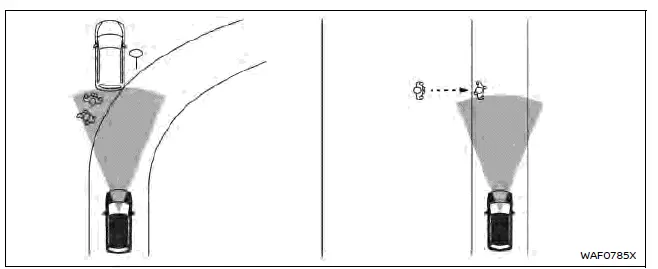
WARNING
Listed below are the system limitations for the AEB with Pedestrian Detection system. Failure to operate the vehicle in accordance with these system limitations could result in serious injury or death.
- The AEB with Pedestrian Detection system may react to:
- objects on the roadside (traffic sign, guardrail, pedestrian, motorcycle, vehicle, etc.)
- pedestrians when driving on the narrow alleys, etc.
- pedestrians who temporarily protrude into or approaching the driving lane to avoid the obstacles on the road shoulder
- objects above road (low bridge, traffic sign, etc.)
- objects on the road surface (railroad track, grate, steel plate, etc.)
- objects in the parking garage (beam, pillar, etc.)
- pedestrians or motorcycles approaching the traveling lane vehicles, pedestrians, motorcycles or objects in adjacent lanes or close to the vehicle
- oncoming pedestrians
- objects on the road (such as trees)
- Braking distances increase on slippery surfaces.
- Excessive noise will interfere with the warning chime sound, and the chime may not be heard.

When driving on some roads, such as winding, hilly, curved, narrow roads, or roads which are under construction or on a slope, the sensor may detect vehicles in a different lane, or may temporarily not detect a vehicle traveling ahead. This may cause the system to work inappropriately.
The detection of vehicles may also be affected by vehicle operation (steering maneuver or traveling position in the lane, etc.) or vehicle condition. If this occurs, the system may warn you by blinking the system indicator and sounding the chime unexpectedly. You will have to manually control the proper distance away from the vehicle traveling ahead.
System temporarily unavailable Nissan Ariya: FE0
Condition A
If the following conditions, the AEB system OFF warning light will flash (no message appears in the vehicle information display).
- Strong light is shining from the front of the vehicle.
- The cabin temperature is over approximately 104ºF (40ºC) in direct sunlight.
- The camera area of the windshield is misted or frozen.
- The camera unit detects it's misalignment condition.
- The radar sensor picks up interference from another radar source.
Action to take:
When the above conditions no longer exist, the AEB with Pedestrian Detection system will resume automatically.
NOTE
When the inside of the windshield on camera area is misted or frozen, it will take a period of time to remove it after air conditioner turns on. If dirt appears on this area, it is recommended you visit a NISSAN certified ARIYA dealer.
Condition B
In the following condition, the AEB system OFF warning light will flash and the "Forward Driving Aids temporarily disabled Front Sensor blocked See Owner's Manual" warning message will appear in the vehicle information display.
- The sensor area of the front of the vehicle is covered with dirt or is obstructed
Action to take:
If the warning light flashes, stop the vehicle in a safe place and turn the EV system off. Clean the radar cover on the front of the vehicle with a soft cloth, and restart the EV system. If the warning message continues to appear, have the AEB with Pedestrian Detection system checked. It is recommended that you visit a NISSAN certified ARIYA dealer for this service.
- When driving on roads with limited road structures or buildings (for example, long bridges, deserts, snow fields, driving next to long walls).
Action to take:
When the above conditions no longer exist, the AEB with Pedestrian Detection system will resume automatically.
Condition C
When the Vehicle Dynamic Control (VDC) system is OFF, the AEB brake will not operate. In this case only visible and audible warning operates. The AEB system OFF warning light (orange) will illuminate.
Action to take:
When the VDC system is ON, the AEB with Pedestrian Detection system will resume automatically.
System malfunction
If the AEB with Pedestrian Detection system malfunctions, it will be turned off automatically, a chime will sound, the AEB system OFF warning light will (orange) will illuminate and the "Malfunction See Owner's Manual" warning message will appear in the vehicle information display.
Action to take:
If the warning light (orange) comes on, stop the vehicle in a safe location. Turn the EV system off and restart the EV system.
If the warning light continues to illuminate, have the AEB with Pedestrian Detection system checked. It is recommended that you visit a NISSAN certified ARIYA dealer for this service.
System maintenance Nissan Ariya: FE0
Basic information
The radar sensor is located on the front of the vehicle. The camera is located on the upper side of the windshield.
To keep the AEB with Pedestrian Detection system operating properly, be sure to observe the following:
- Always keep the sensor area on the front of the vehicle and windshield clean.
- Do not strike or damage the areas around the sensors (ex. bumper, windshield).
- Do not cover or attach stickers or similar objects on the front of the vehicle near the sensor area. This could cause failure or malfunction.
- Do not attach metallic objects near the radar sensor area (brush guard, etc.).
This could cause failure or malfunction.
- Do not place reflective materials, such as white paper or a mirror, on the instrument panel. The reflection of sunlight may adversely affect the camera unit's detection capability.
- Do not alter, remove or paint the front of the vehicle near the sensor area.
Before customizing or restoring the sensor area, it is recommended that you visit a NISSAN certified ARIYA dealer.
Radio frequency statement
NOTE
FCC Notice:
For USA:
This device complies with Part 15 of the FCC Rules. Operation is subject to the following two conditions: (1) this device may not cause harmful interference, and (2) this device must accept any interference received, including interference that may cause undesired operation.
NOTE
Changes or modifications not expressly approved by the party responsible for compliance could void the user's authority to operate the equipment.
For Canada:
This device contains licence-exempt transmitter(s)/receiver(s) that comply with Innovation, Science and Economic Development Canada's licence-exempt RSS(s). Operation is subject to the following two conditions: (1) This device may not cause interference. (2) This device must accept any interference, including interference that may cause undesired operation of the device.