Child safety lock

In this manual: Child safety lock
About this Owner's Manual — 1Illustrated index — 1Symbols in the instrument cluster — 1Warning and information texts — 1Introduction to the instrument cluster — 1ID. Light — 1Service menu/ Service display — 1Limits of the Driver Alert System — 1Correct seating position — 1Automatic safety belt retractor, safety belt pretensioner, safety belt load limiter — 1Indicator light — 1Installation locations and deployment zones of the airbags — 1Switching the Front Passenger's Front Airbag On and Off — 1Types of child restraints — 1Securing yourself and the vehicle — 1Emergency equipment — 1Information Call, Roadside Assistance Call and Emergency Call Service — 1Troubleshooting — 1Legally required eCall Emergency System — 1Vehicle key functions — 1Unlocking or locking using Keyless Access — 1Child safety lock — 1Anti-theft alarm system — 1Interior monitoring and towing protection — 1Opening and closing the trunk lid — 1Opening and closing the windows — 1Power window pinch protection — 1Adjusting the steering wheel position — 1Manually adjusting front seats — 1Adjusting the head restraints — 1Removing and installing the head restraints — 1Center armrest — 1Memory function — 1Massage feature — 1Switching the turn signals on and off — 1Switching the lights on and off — 1Switching the high beam headlights on and off — 1Switching the poor weather lights on and off — 1Switching on and off the rear fog light — 1Switching the parking light on and off — 1Entry and exit lighting (orientation lighting) — 1Headlight range control — 1Interior/reading lights, ambient lighting — 1Operating the windshield wiper lever — 1Rain/light sensor — 1General safety precautions — 1Overview of the Climatronic — 1Overview of seat heating — 1Operating the stationary air conditioning — 1Programming the stationary air conditioning — 1Functions of the electric drivetrain — 1Steering information — 1Information on the pedals — 1Information on the brakes — 1Switching the ignition on and off — 1Activating the vehicle's drive system — 1Exiting a vehicle while the vehicle's drive system is active — 1Deactivating the vehicle's drive system — 1Driving mode selector — 1Brake energy recuperation — 1Selecting the driving mode — 1Standard behavior of the driving mode and the vehicle systems — 1Eco tips — 1Operating the vehicle in different countries and continents — 1Limits of the sensor system — 1Operating the cruise control system — 1Operating the speed limiter — 1System Limitations of the Predictive Control — 1Driving with predictive control — 1Eco assist — 1Special driving situations — 1System Limitations of ACC — 1Switching ACC on and off — 1Adjusting the ACC settings — 1System Limitations of Predictive Cruise Control — 1Driving with predictive cruise control — 1Warning levels and braking support — 1System Limitations of Front Assist — 1Oncoming vehicle braking when turning — 1Lane Assist system limitations — 1Driving with Lane Assist — 1Operating Travel Assist — 1Using assisted lane changing — 1Driving with Emergency Assist — 1Side Assist system limitations — 1Driving with Side Assist — 1Parking — 1Electronic parking brake — 1Auto Hold — 1Safety instructions — 1Automatic braking intervention — 1Switching Park Distance Control (PDC) on and off — 1Parking (Rear View Camera system with parking mode selection) — 1Changing the camera perspective — 1Searching for parking spaces — 1Calibrating the parking process — 1Displaying and editing parking spaces — 1Driving into or out of a parking space — 1Rear Traffic Alert — 1Information about braking assistance systems — 1Switching ASR Sport on and off — 1Sockets in the vehicle — 1Cyber security — 1Downloading and installing an Over-the-Air Update — 1V2X limitations — 1Activating and deactivating V2X — 1Traffic hazard alert — 1USB port — 1Bluetooth interface — 1Setting up the Internet connection — 1Activating and deactivating a Wi-Fi hotspot — 1Apple CarPlay — 1Android Auto — 1MirrorLink — 1Introduction to online services — 1Viewing and enabling functions — 1Safety instructions — 1Overview of Infotainment system — 1Brands, licenses, copyright — 1Functions and radio symbols — 1Setting a 360º range display and Electric Vehicle Route Planner — 1Stowing luggage and cargo — 1Mounting the bicycle rack mount — 1Information on the roof rack — 1Warning signs for the high-voltage system — 1Handling the high-voltage battery — 1Charging — 1Placement — 1Information on bulb replacement — 1Replacing bulbs in LED headlights — 1Fuses in the hood space — 1Ground jump-start point — 1Instructions for towing — 1Safety precautions for working in the hood space — 1Preparing the vehicle for work in the hood space — 1Operating fluids and operating equipment — 1Charging, replacing, disconnecting, or connecting the 12 V vehicle battery — 1Handling tires — 1Preparing Your Vehicle — 1Maintenance procedures and digital maintenance schedule — 1Information about operating conditions — 1Scope of service — 1Vehicle care information — 1Washing the vehicle — 1Accessories and replacement parts — 1Sensors and Cameras — 1Repairs and technical modifications — 1Airbag system repairs and situations that can affect the system function — 1Mobile phone usage in the vehicle — 1Data Storage and Data Protection Information — 1Event data recorder (crash data recorder) — 1Labels and signs — 1Fluids in the air conditioning system — 1Infotainment system and aerials — 1Disposal of old batteries and electronic devices — 1Product recycling — 1Old vehicle return and scrap disposal — 1Useful information on vehicles with N1 type approval (light commercial vehicle) — 1Radar Sensors — 1Specifications & Consumer information — 1
9steps
~54min
2/5difficulty
Done 0 of 9

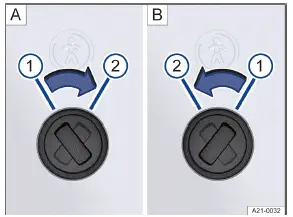
Volkswagen ID.3. Fig. 1 Child safety lock: left rear door, right rear door.
Fig. 1 Child safety lock: left rear door, right rear door.

  1. Child safety lock is switched off.

  2. Child safety lock is switched on.

The child safety locks are located on the inner door panels of the rear doors.

The child safety lock reduces the risk of the rear doors being opened from the inside→ .

When the child safety lock is switched on, the door can only be opened from the outside.

Switching the child safety lock on or off

  1. Unlock the Volkswagen ID.3 vehicle the open the respective rear door.

  2. Bring the slot into the corresponding position → fig. 1 .

WARNING

When the child safety lock is switched on, that door cannot be opened from the inside. This can result in people locking themselves inside the Volkswagen ID.3 vehicle. In an emergency, they may not be able to exit the vehicle without assistance or help themselves.

  • Never leave children or people requiring assistance unattended in the vehicle when the doors are locked.

WARNING

If you leave children, people requiring assistance or animals unattended in the Volkswagen ID.3 vehicle, they may be subjected to very high or low temperatures. There is a risk of serious or fatal injuries.

  • Never leave children, people requiring assistance or animals unattended in the vehicle.

SAFELOCK

Your Volkswagen ID.3 vehicle may be equipped with a SAFE lock.

The SAFE lock deactivates the door handles when the vehicle is locked to reduce the risk of someone breaking into the vehicle. The doors can no longer be opened from the inside → .

Deactivating SAFE lock

The SAFE lock can be deactivated through one of the following methods:

  • Press the button on the vehicle key for a second time within two seconds.

  • Touch the sensors on the outside of the door handle again within two seconds .

  • Switch the ignition on.

Or: Deactivate the interior monitoring and towing protection functions (→ Interior monitoring and towing protection) .

Depending on Volkswagen ID.3 vehicle equipment, the interior monitoring and towing protection functions can be temporarily deactivated in the Vehicle settings menu in the Infotainment system before locking the vehicle (→ Interior monitoring and towing protection) .

The ID. cockpit may indicate an active SAFELOCK.

If the SAFE lock is deactivated, then:

  • The vehicle can be unlocked and opened from the inside using the door handle.

  • The anti-theft alarm system is active (→ Anti-theft alarm system) .

  • The interior monitoring and towing protection functions are deactivated (→ Interior monitoring and towing protection) .

WARNING

When SAFELOCK is activated, the doors can no longer be opened from the inside. Careless or unintended use of SAFELOCK can result in people being locked in the Volkswagen ID.3 vehicle interior and can cause serious injuries in an emergency.

  • Never leave any individuals in the vehicle when the vehicle is locked using the vehicle key.

Unlocking the driver's door mechanically using the vehicle key will only unlock that door, and not the entire vehicle. Once the ignition is switched on, all doors will be released but not unlocked, and the central locking button will be activated.

Troubleshooting

If the indicator light does not turn off

The red LED in the vehicle door flashes briefly and then stays on.

There is a malfunction in the locking system.

  1. Contact a suitably qualified professional. Volkswagen recommends contacting an authorized Volkswagen dealer or authorized Volkswagen Service Facility.

If the turn signals are not flashing

The turn signals are not blinking as confirmation when locking the Volkswagen ID.3 vehicle:

  1. Check whether all of the doors and the trunk lid and engine hood are closed.

  2. Close any doors and trunk lid or engine hood that are not closed.

If the Volkswagen ID.3 vehicle is locking automatically

The vehicle will lock again automatically after approximately 45 seconds if one of the following conditions apply:

  • The vehicle was unlocked, but not opened

  • The ignition was not switched on

  • The trunk lid was not opened.

  • The Volkswagen ID.3 vehicle was unlocked using the lock cylinder

  • The vehicle was locked via the control panel in the vehicle interior.

Locking with a second vehicle key

The key inside the Volkswagen ID.3 vehicle will be blocked from activating the vehicle's drive system if the vehicle is locked from the outside with a different vehicle key.

  1. To enable the vehicle key inside the vehicle so that it can be used to activate the vehicle's drive system as usual, press the button on the vehicle key inside the vehicle (→ Activating the vehicle's drive readiness) .

Locking the vehicle after an airbag deploys

The entire vehicle unlocks when an airbag deploys in a collision. Depending on the severity of the damage, it may be possible to lock the vehicle as follows after the collision:

  1. Switch the ignition off.

  2. Open the driver door and shut it again.

  3. Lock the vehicle.

NOTICE

Strong streams of water or vapor could activate the sensors in the door handles if a valid vehicle key is located near the Volkswagen ID.3 vehicle. This may cause the windows to open and moisture may enter the vehicle interior. This could lead to damage to the vehicle interior.

  • Never direct the jet of a high pressure cleaner or a steam jet directly towards the sensors in the door handles.

It may not be possible to unlock or lock the vehicle using Keyless Access if the 12 V vehicle battery or button cell battery in the vehicle is weak or drained. The vehicle can be manually unlocked or locked.

If there is no valid remote control vehicle key in the vehicle or the key is not detected, a corresponding message appears in the ID. cockpit. This can occur if another signal interferes with the remote control vehicle key or if the remote control vehicle key is covered by an object, such as a metal case.