Types of child restraints
Only use child restraints that are legally approved and suitable for the child using them.
Child restraint standards
Regulations ECE
R 44 or ECE-R 129 apply to child restraints in member countries. Both regulations are valid at the same time. Child restraints that have been checked in accordance with this standard have an orange ECE seal of approval. The ECE seal of approval may contain the following information about the child restraint:
Weight class
Size class
Certification category (universal, semi-universal, vehicle-specific, or i-size).
Certification number.
For child restraints that are approved in accordance with regulationE CE
-R 44, the eight-digit approval number on the ECE seal of approval must begin with 03 or 04. This indicates that the seat is permitted. Older child restraints whose number begins with 01 or 02 are not permitted.
Child restraints according to weight classes

Fig. 1 Example of child restraints.
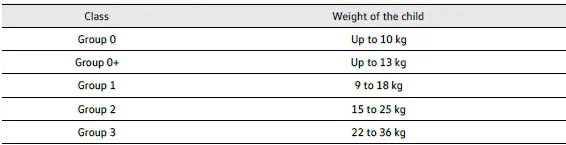
Weight class 0/0+: rear-facing infant safety seats → fig. 1 from group 0/0+ or 0/1 are best suited from birth to about 18 months.
Weight class 1: After reaching the weight limit, child restraints from group 1 (up to about four years) and group 1/2 (up to approximately seven years) with an integrated safety belt system are the most suitable.
Weight classes 2/3: groups 2 and 3 contain child restraints with backrests and booster seats without backrests.
Because of their integrated safety belts and side bolsters, child restraints with a backrest provide better protection than booster seats without a backrest. Therefore, Volkswagen recommends using child restraints with a backrest
Child restraints in group 2 are suitable for children up to about 7 years old. Child restraints in group 3 are suitable for children older than about 7 years old.
When using a child restraint from Group 2 or a child restraint with a backrest for children taller than 100 cm(a pprox.
3 ft, 3 in), also use the fourth child restraint attachment point, if available, for the safety belt. Follow the child restraint user manual.
Not all children across the board fit into the child restraints in their weight group. Also, not all seats fit in every vehicle. Therefore, always check if the child fits into the seat correctly and if the child seat can be secured in your Volkswagen ID.3 vehicle.
Child restraints according to approval categories
Child restraints can be in the "universal", "semi-universal", "vehicle-specific" (all in accordance with regulationE CE -R 44) or "i-Size" (in accordance with regulation ECE-R 129) approval category.
Universal: Child restraints with "universal" approval are approved for installation in all vehicles. A list of models is not needed. With universal approval for ISOFIX, also secure the child restraint with a top tether safety belt.
Semi-universal: In addition to the standard requirements for universal approval, "semi-universal" approval requires safety equipment for securing the child restraint that requires additional tests. Child restraints with "semiuniversal" approval have a model list that must contain the vehicle in which the seat will be used.
Vehicle-specific: vehicle-specific approval requires a separate dynamic test of the child restraint in the vehicle for each vehicle model. Child restraints with "vehicle-specific" approval also have a model list.
i-Size: Child restraints with "i-Size" approval must conform to the requirements for installation and safety that are contained in the ECE -R 129 regulation. You can obtain information about which child restraints have an i-Size certification for this vehicle from the child restraint manufacturers.
- Installing and using child restraints
- Securing systems
- Attaching a child restraint with ISOFIX or i-Size
- Securing the child restraint with the upper strap (top tether)
- Securing a child restraint with a safety belt
Installing and using child restraints
Country-specific specifications
There are different standards and requirements in different countries for using child restraints and their attachment options. Transporting children on the front passenger's seat is not permitted in all countries. Laws and regulations take precedence over the descriptions in this Owner's Manual.
Notes on installing a child restraint
Note the following information when installing a child restraint. They are applicable to child restraints with every securing system.
Read and follow the instructions from the child restraint manufacturer→
 .
It is best to install the child restraints on the rear seat behind the front passenger seat so that children can exit the vehicle on the side that is away from traffic.
Switch off the front passenger's front airbag before installing a backward-facing child seat in the front passenger seat.
If installing on the front passenger's seat, move the seat all the way back and move it into the highest position possible. Bring the backrest into the upright position (→ Mechanical front seat) .
Always leave sufficient free space around the child restraint. Adjust the position of the seat in front of it if possible.
Always make sure the driver and front passenger are using a correct seating position (→ Seating position) .
The backrest of the child seat should be positioned as close as possible to the backrest on the vehicle seat. Adjust the angle of the vehicle seat so that the child restraint contacts it fully. If the child restraint comes into contact with the head restraint when installed and prevents it from fitting correctly, move the head restraint all the way up or remove it and store it securely in the vehicle .
Once the child restraint is correctly installed, the settings for that seat must no longer be changed. If the seat settings have been changed, the installation of the child restraint must be checked and, if necessary, adjusted.
If a child restraint is installed on a seat, functions such as the massage function (→ Massage feature) or seat heating (→ Seat air conditioning) must not be used on that seat.
Airbag label

Fig. 1 On the sun visor: airbag label (general example).
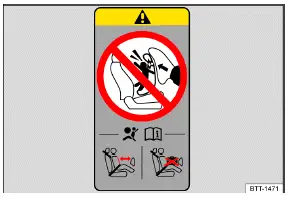
Fig. 2 On the B-pillar: airbag label (general example).
Labels with important information about the passenger's front airbag are located in the vehicle. The content depends on the country and may vary. The labels may be located in the following places:
On the driver's and front passenger's sun visors→ fig. 1 .
On the B-pillar on the passenger's side → fig. 2 .
Always following the warnings before installing a rear-facing child restraint → .
Dangers when transporting children on the front passenger's seat
If a rear-facing child restraint is used, the front passenger's front airbag can cause life-threatening injuries or death if it deploys →  .
Rear-facing child restraints may only be used on the front passenger seat if the front passenger's front airbag is switched off . The yellow PASSENGER AIR BAG  indicator light is permanently on in the driver's line of sight to indicate that the front passenger's front airbag is switched off (→ Indicator light standard airbag system) .
It is not possible to switch off the front passenger's front airbag in all countries (→ Airbag system) .
Do not deactivate the front passenger's front airbag when using af orward-facing child seat. When installing a child restraint, makes sure it is as far from the front passenger's airbag as possible. If the front passenger's airbag deploys, it can cause serious injuries → .
Not all child seats are allowed to be used in the front passenger seat. The child restraint must be specially authorized by the manufacturer for use on the front passenger seat in vehicles with front and side airbags. Your Volkswagen dealership has a list of permitted child seats.
DANGER
Read and heed the important safety instructions for the front passenger's front airbag (→ Airbag system) .
DANGER
Using a rear-facing child restraint on the front passenger seat results in increased risk of life-threatening or serious injuries or death for the child in the event of a collision.
Never use a rear-facing child restraint on the front passenger seat if the front passenger's front airbag is switched on.
Deactivate the front passenger's front airbag if you wish to install a child restraint on the front passenger seat. If the front passenger's front airbag cannot be deactivated, you cannot use rear-facing child restraints.
Position the front passenger seat as far back as possible to create the greatest possible distance to the front passenger's front airbag.
Move the seat backrest into the upright position.
Use only child restraints that are approved by the child restraint manufacturer for use on the front passenger seat with front and side airbags.
WARNING
There is a risk of injury if the child restraint is installed incorrectly.
Always refer to and follow the installation instructions and warnings from the child restraint manufacturer.
WARNING
There is a risk of injury if a front-facing child restraint is used on the front passenger seat.
Position the front passenger seat as far back as possible to create the greatest possible distance to the front passenger's front airbag.
Move the seat backrest into the upright position.
Use only child restraints that are approved by the child restraint manufacturer for use on the front passenger seat with front and side airbags.
WARNING
If the Side Curtain Protection or side airbag deploys, this can cause injuries.
Make sure that children are not within the deployment zone of the airbag .
Do not place any objects within the deployment zone of the airbag.
Securing systems
Different securing systems are used for safe installation of child restraints depending on the country.
Only use the securing systems described here to secure child restraints in the Volkswagen ID.3 vehicle.
Overview of securing systems
ISOFIX: ISOFIX is a standardized securing system to quickly and securely install child restraints in a vehicle. The ISOFIX fastener creates a fixed connection between the child restraint and the vehicle body.
The child restraint has two fixed fastening brackets or arms. The attachment arms snap into the ISOFIX universal lower anchorages located between the seat cushion and the rear seat backrest (→ Child restraint with LATCH/UAS or i-Size) . Supplement the ISOFIX fastener with a top tether safety belt or a support bracket, if necessary.
Three-point safety belt. If available, it is better to secure child restraints to the ISOFIX fastener using a three-point safety belt (→ Child restraint with a safety belt) .
Additional fasteners:
Top Tether: the upper belt is guided over the rear seat backrest and secured to the anchorage point on the rear side of the rear seats using a hook (→ Child restraint with the upper strap (top tether)) . Top tether anchorages are labeled with an anchor symbol.
Support base: some child restraints are supported with a support base on the vehicle floor. The support base reduces the risk of the child restraint tipping forward in the event of a collision. Only use child restraints with a support base on the front passenger seat and the outer rear positions of the bench seat →
 .
Recommended securing systems for child restraints
Volkswagen recommends securing child restraints as follows:
Rear-facing child restraint:
ISOFIX/i-Size and top tether.
ISOFIX/i-Size and support bracket.
Forward-facing child restraint from group 1 and i-Size child restraint for children up to 105 cm( approx. 3 ft 5 in) tall:
ISOFIX/i-Size and top tether.
ISOFIX/i-Size and support bracket.
Forward-facing child restraint from group 2/3 and i-Size child restraint for children taller than 100 cm( approx.
3 ft 3 in):
ISOFIX/i-Size and, if necessary, top tether.
ISOFIX/i-Size and, if necessary, support bracket.
WARNING
Unsecured or improperly secured children may suffer serious injury or death in the event of sudden driving or braking maneuvers or an accident.
Observe the specifications of the child restraint manufacturer for fastening the child restraint in the vehicle and securing the child in the child restraint.
WARNING
Incorrect use of the support base can cause severe or fatal injuries.
Make sure the support base is installed correctly and securely.
Always refer to and follow the installation instructions and warnings from the child restraint manufacturer.
WARNING
Anchorage points for child restraint systems are designed so that they will only withstand the loads generated by correctly adjusted child restraint systems. The anchorage points must never be used for safety belts, items of equipment or other objects in or on the vehicle.
Attaching a child restraint with ISOFIX or i-Size
Overview of ISOFIX or i-Size child restraint installation
The designation of the ISOFIX or i-Size anchorage points depends on the equipment installed and the country.
The following table shows the installation options for ISOFIX or i-Size child restraints at the ISOFIX anchorage points at separate locations in the vehicle.
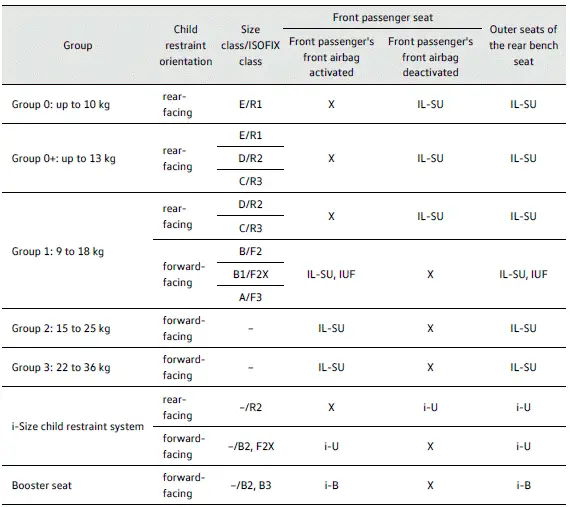
Size class: the size class specification corresponds to the body weight permitted for the child restraint. For child restraints approved as "universal" or "semi-universal", the size class is specified on the ECE seal of approval. The size class specification is listed on the child restraint.
X: seating location is not suitable for fastening an ISOFIX or i-Size child restraint classified in this group.
IL-SU: Suitable seat for installing an ISOFIX child restraint with this "semi-universal" approval. Note the vehicle list provided by the child restraint manufacturer.
IUF: Suitable seat for installing an ISOFIX child restraint with this "universal" approval.
i-U: suitable seat for fitting a forward-facing or rear-facing i-Size child restraint with "universal" approval.
i-UF: suitable seat for fitting a forward-facing i-Size child restraint with "universal" approval.
i-B: suitable seat for fitting a forward-facing ISOFIX booster seat in Group 2/3 and also for a forward-facing i-Size child restraint for children approx. 100 to 150 cm (approx. 3 ft 3 in to 4 ft 11 in) tall.
Attaching child restraints with ISOFIX or i-Size
The installation location of the lower anchorage point is indicated either by an ISOFIX or an i-Size symbol.
 Designation of the ISOFIX anchorage points for child restraints on the rear bench seat.
 Designation of the i-Size anchorage points for child restraints on the rear bench seat and the front passenger seat.
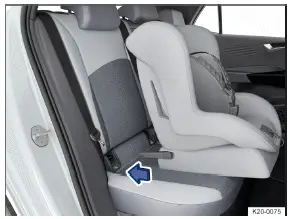
Fig. 1 Fitting a child restraint with arms (general example).
Pay attention to and follow the information (→ Child restraints) .
If necessary, fold down the protective caps for the ISOFIX or i-Size anchorage points.
Push the child restraint arms in the direction of the arrow and onto the ISOFIX or i-Size anchor points→ fig. 1 .
The child restraint must engage securely and audibly.
Pull on both sides of the child restraint to check that the child restraint is securely locked in place.
If the child restraint is equipped with a support foot, this support foot must be positioned securely on the Volkswagen ID.3 floor.
Securing the child restraint with the upper strap (top tether)
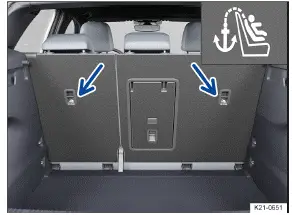
Fig. 1 On the rear side of the rear bench seat: Top tether anchorages for the top tether safety belt.
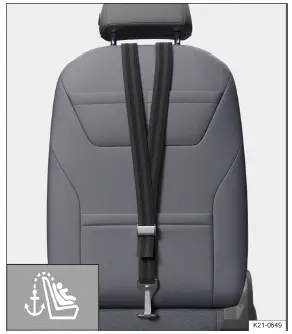
Fig. 2 On the back of the front passenger seat (depending on country of use): attached top tether safety belt.
ISOFIX child restraints with "universal" approval must also be fastened to the ISOFIX anchor points using an upper strap (Top Tether).
Fasten the top tether safety belt only to the top tether anchorages designed for this purpose. The anchorages suitable for top tethers are labeled with a symbol and may have the lettering "TOP TETHER" → fig. 1 or → fig. 2 .
Fastening the top tether safety belt
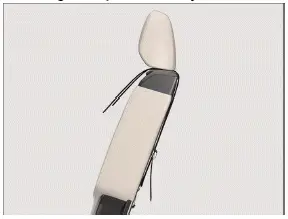
Fig. 3 On the rear side of the outer rear bench seats or the front passenger seat: attached top tether safety belt.

Fig. 4 On the backrest of the top sport seat (with opening) on the passenger's side: belt guide for the top tether safety belt (general example).
Opening for the belt guide of the top tether safety belt.
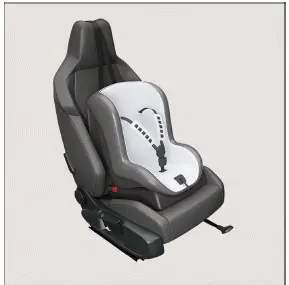
Fig. 5 On the backrest of the top sport seat (without opening) on the passenger's side: belt guide for the top tether safety belt (general example).
Pay attention to and follow the information (→ Child restraints) .
Remove the luggage compartment cover if necessary.
Place the child restraint in the center of the vehicle seat surface.
Push the child restraint arms in the direction of the arrow onto the ISOFIX anchorages (→ Child restraint with LATCH/UAS or i-Size) . The child restraint must engage securely and audibly.
If necessary, push the head restraint upwards and guide the top tether safety belt of the child restraint to the rear under the head restraint.
Or: if necessary, remove the head restraint and guide the top tether safety belt of the child restraint to the rear over the backrest.
Only applies to top sport seat with opening: Guide the upper strap through the opening in the backrest→ fig. 4 1 .
Only applies to top sport seat without opening :Guide the upper strap over the head restraint→ fig. 5 .
Hook the top tether safety belt of the child restraint into the appropriate anchorage marked with "top tether" → fig. 3 .
Tighten the top tether safety belt so that the child restraint is upright on the rear seat backrest.
WARNING
If the top tether safety belt is not secured properly or is not secured to an anchorage intended for this purpose, the child restraint may become loose and cause serious injuries.
Always only fasten a top tether safety belt of a child restraint to a top tether anchorage.
Fasten the top tether safety belt only to the top tether anchorages designed for this purpose. Never fasten a child restraint top tether safety belt to a tie-down.
WARNING
Objects in the rear pockets of the front passenger seat may damage the top tether safety belt in an accident. Serious injuries may result.
Do not keep objects in the rear pockets of the front passenger seat if you are using the top tether safety belt.
Depending on the country of use and the vehicle equipment, there may be two or three top tether anchorage points in the luggage compartment behind the rear seat backrest.
Securing a child restraint with a safety belt
If you would like to use a child restraint in your Volkswagen ID.3 vehicle from the "universal" approval category( u), make sure that it is permitted for the seating position where you would like to use it. You can find the necessary information on the orange ECE approval seal on the child restraint. Refer to the installation options in the following table.
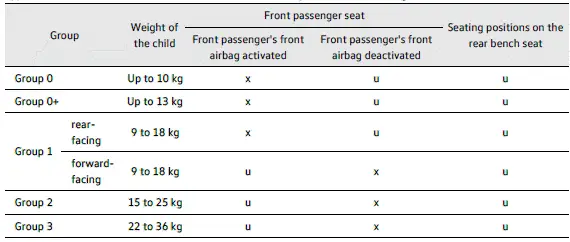
u: universal; x: seat is not suitable for installing a child restraint classified in this group.
Securing a child restraint with a safety belt in Volkswagen ID.3
Pay attention to and follow the information (→ Child restraints) .
Route the safety belt according to the instructions provided by the child restraint manufacturer and guide the belt through the child restraint.
Make sure the safety belt is not twisted.
Insert the buckle tongue into the safety belt buckle belonging to the corresponding seat, until the safety belt buckle latches into place.
Child restraints from the "semi-universal" approval category, where the child restraint is secured by the safety belt and a support foot, must not be secured on the center rear bench seat.