Correct seating position
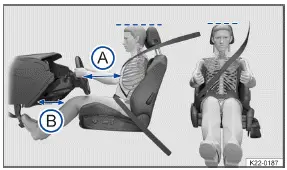
Fig. 1 Correct distance between the driver and the steering wheel, correct safety belt position and correct head restraint adjustment (general example).
The correct seating positions for the driver and passengers are specified in the information that follows.
If individuals cannot achieve the correct seating position due to physical conditions, contact an authorized Volkswagen dealer or authorized Volkswagen Service Facility for more information about possible special modifications. The safety belt and airbags only provide the optimum protection when vehicle occupants are seated in a correct seating position. Volkswagen recommends contacting an authorized Volkswagen dealer or authorized Volkswagen Service Facility.
For your safety and to reduce the risk of injuries in the event of a sudden braking maneuver or accident, Volkswagen recommends the following seating positions:
The following applies to all vehicle occupants:
Adjust the head restraint so that the upper edge of the head restraint is in line with the upper portion of the head as much as possible, but not lower than eye level. Position the back of the head as close as possible to the head restraint → fig. 1 .
For shorter individuals, slide the head restraint all the way downward, even if the head is then below the upper edge of the head restraint.
For taller individuals, move the head restraint upward all the way.
Always keep both feet in the footwell.
Adjust and fasten the safety belts correctly .
The following additional points apply to the driver:
Adjust the forward/back position of the driver seat so that you can press the pedals while your legs are slightly bent and there is at least 10 cm (around 4 inches) of space between the instrument panel and your knees → fig. (1) (B) .
Adjust the driver seat so that the top point of the steering wheel can be reached.
Position the seat backrest in an upright position, so that your back rests completely on the seat backrest.
Adjust the seat so that the distance between the steering wheel and your chest is at least 25 cm(a round 10 inches)
→ fig. (1) (A) and you can hold the steering wheel firmly at the sides with both hands and your elbows slightly bent.
When adjusted, the steering wheel must always face your chest and not be directed toward your face.
The following additional points apply to the front passenger:
Position the seat backrest in an upright position, so that your back rests completely on the seat backrest.
Move the front passenger seat back as far as possible so that the airbag can provide optimum protection if it deploys.
Introduction
Safety belts of Volkswagen ID.3 that are fastened correctly hold vehicle occupants in the correct position during braking maneuvers or in a collision, in order to provide the maximum protection.
WARNING
The risk of serious and fatal injuries may increase if the safety belts are not worn or are worn incorrectly.
Before every trip, everyone in the vehicle must seat themselves correctly, fasten the safety belt that belongs to the seat they are using, and keep it fastened while the vehicle is in motion.
Secure children before and during every journey in the vehicle with a child restraint system that is appropriate for their weight and height and with the safety belt used correctly .
Always insert the buckle tongue into the belt buckle that belongs to that seat and let it engage securely. Using a buckle from another seat reduces the protection provided by the safety belt and can cause serious injuries.
Never unfasten the safety belt while the vehicle is in motion.
Secure only one person with a safety belt.
Never allow children or infants to ride on anyone's lap and never strap children or infants to another person with the same safety belt.
Do not wear extremely bulky, loose clothing in the vehicle, such as a coat over a sports jacket, because this could impair the fit and function of the safety belt.
WARNING
The risk of serious and fatal injuries increases if the safety belts are damaged. If the belt webbing or other parts of the safety belt are damaged, the safety belts could tear during a collision or sudden breaking maneuver.
Never allow safety belts to become caught in the door or the seat mechanisms because the belts could be damaged.
If there is damage to the belt fabric, the belt connections, the automatic belt retractor or the buckle, have the affected safety belt or belt fastening element replaced immediately by an authorized Volkswagen dealer or authorized Volkswagen Service Facility. The authorized Volkswagen dealer or authorized Volkswagen Service Facility must use the correct parts for the vehicle, equipment and model year. Volkswagen recommends contacting an authorized Volkswagen dealer or authorized Volkswagen Service Facility.
Never try to repair, modify, or remove the safety belts or belt fastening elements yourself. Have all repairs to safety belts, belt retractors and buckle components performed only by an authorized Volkswagen dealer or authorized Volkswagen Service Facility. The authorized Volkswagen dealer or authorized Volkswagen Service Facility must only replace the safety belt with a safety belt approved for the seat. Volkswagen recommends contacting an authorized Volkswagen dealer or authorized Volkswagen Service Facility.
Have safety belts that are stretched during a collision replaced by an authorized Volkswagen dealer or authorized Volkswagen Service Facility. Volkswagen recommends contacting an authorized Volkswagen dealer or authorized Volkswagen Service Facility. It may be necessary to replace them even if there is no visible damage. Check the safety belts' anchorage as well.
WARNING
Incorrect handling of the safety belts increases the risk of severe or fatal injuries.
Check the safety belts and associated components regularly to ensure they function correctly.
Always keep the safety belts clean.
Never allow foreign objects or fluid to enter the openings in the safety belt latches and belt buckles. This could impair the function of the safety belt latch openings, belt buckles and safety belts.
Never pinch the safety belt. Never damage the safety belt or allow it to rub against any objects with sharp edges.
- Fasten seat belts reminder
- Fastening and unfastening the safety belts
- Safety belt positioning
Fasten seat belts reminder
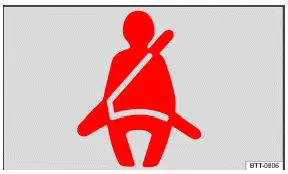
Fig. 1 In the instrument cluster display: warning light for the fasten seat belts reminder.
Fasten safety belts reminder for the front seats
If the Volkswagen ID.3 safety belts are not fastened when you begin driving, at a speed of over approx. 25 km/h, or if the safety belts are unfastened during a journey, a warning chime sounds for 126 seconds when the driver or front passenger seat is occupied by an adult. The red  warning light in the instrument cluster display will also blink.
When the ignition is switched on, the red  warning light only turns off after all vehicle occupants have fastened their safety belts.
Fasten seat belts reminder for the rear seats (depending on the country and the vehicle equipment)
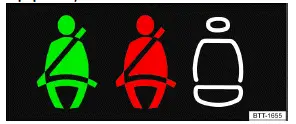
Fig. 2 In the instrument cluster display: Fasten seat belts reminder for the rear seats (general example).
When the Volkswagen ID.3 ignition is switched on, the fasten safety belts reminder for the rear seats→ fig. 2 in the instrument cluster display shows the driver whether possible adult passengers in the rear seats have their safety belts fastened.
 When the symbol is green, this indicates that the passenger in this seat has fastened "their" safety belt.
 When the symbol is red, this indicates that the passenger in this seat has not fastened "their" safety belt.
 When the symbol is white, this indicates that this seat of Volkswagen ID.3 is not occupied.
If a rear seat safety belt is unfastened during the journey, the symbol for that seat  is permanently red. The red warning light in the instrument cluster display will also blink. If driving at speeds faster than approx. 25 km/h (approx.
15 mph), a warning chime will also sound for 126 seconds.
WARNING
The fasten seat belts reminder is designed to recognize adult vehicle occupants. A seat occupied by a light person, particularly by children, may not necessarily be recognized. The fasten seat belts reminder does not react, or has limited reactions when a child seat or seat cushion is in use. This may result in failure to detect that lighter people and children do not have their safety belt fastened. They could suffer serious or fatal injuries in an accident.
Always ensure that all vehicle occupants, especially children, have their seat belt correctly fastened.
Fastening and unfastening the safety belts
Fastening the safety belt
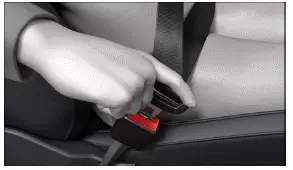
Fig. 1 Inserting the buckle tongue into the safety belt buckle (general example).
Assume the correct seating position in Volkswagen ID.3 (→ Seating position) .
Grab the belt and pull it evenly over the chest and pelvis. Do not twist the belt while doing this (→ Safety belt positioning) .
Insert the buckle tongue securely in the safety belt buckle for that seat→ fig. 1 .
Pull on the safety belt to make sure the buckle tongue is latched correctly in the safety belt buckle.
Unfastening the safety belt
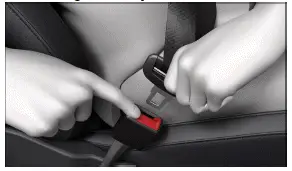
Fig. 2 Releasing the buckle tongue from the safety belt buckle (general example).
Only unfasten the safety belt while the vehicle is stationary (→ Safety belt positioning) .
Press the red button in the safety belt buckle → fig. 2 .
The buckle tongue will pop out.
Guide the belt back by hand so that the belt rolls up easily, the belt does not twist, and the trim panel is not damaged.
Twisted safety belt
If the safety belt is difficult to pull out of the belt guide, the safety belt may have been pulled out too quickly when positioning the belt and may have become twisted within the side trim panel:
Slowly and carefully pull the safety belt out completely by the belt buckle.
Untwist any twisted sections of the safety belt and guide the belt back slowly by hand.
If you cannot untwist the safety belt, fasten the safety belt anyway.
The twist must not be in a section of the belt that rests directly on the body.
Go to an authorized Volkswagen dealer or authorized Volkswagen Service Facility immediately to have the belt untwisted. Volkswagen recommends contacting an authorized Volkswagen dealer or authorized Volkswagen Service Facility.
Safety belt positioning
Volkswagen ID.3 Safety belts only offer the optimum protection during a collision and reduce the risk of serious injury or death if they are fastened and positioned correctly. The correct safety belt position also holds the vehicle occupant in place so that the airbags can provide their maximum protection if they deploy. Therefore, all vehicle occupants should always fasten their own safety belts and make sure they are positioned correctly → fig. 1 .
Correct safety belt positioning
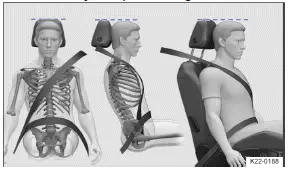
Fig. 1 Correct safety belt positioning and correct head restraint adjustment (general example).
The shoulder belt section of the safety belt must always be positioned over the center of the shoulder and never across the neck, above the arm, under the arm, or behind the back.
The lap section of the safety belt must always lie across the lap and never over the stomach.
The safety belt must always rest flat and securely on the body. Retighten the belt if necessary.
Correct safety belt positioning for pregnant women

Fig. 2 Correct safety belt positioning for pregnant women (general example).
For pregnant women, the safety belt must rest evenly across the chest and as low and flat as possible on the lap, so that no pressure is applied to the lower abdomen. This should be done throughout the entire pregnancy → fig. 2 .
Adjusting the safety belt position to body size
The belt positioning can be adjusted with the following equipment:
Height-adjustable front seats (→ Seating position) .
WARNING
Incorrect safety belt positioning can cause serious injuries in the event of an accident or during sudden braking or driving maneuvers.
Ensure your safety belt is positioned correctly.
Place the backrest in an upright position and position your safety belt correctly for your size to maximize the protective function of the safety belt.
Place the shoulder portion of the safety belt over the center of your shoulder, and never under your arm or across your neck.
Lay the safety belt flat and securely on the upper part of the body and pelvis. Retighten the belt if necessary.
Ensure the lap section of the safety belt lies across your lap and never over your stomach.
Throughout your pregnancy, ensure the safety belt rests evenly across your chest and as low and flat as possible on your lap. This will prevent pressure being applied to your lower abdomen.
Do not twist the safety belt while securing or wearing it.
Never hold the safety belt away from the body with your hand.
Do not guide the safety belt over hard or breakable objects, such as eyeglasses, pens, or keys.
Do not modify how the safety belt is routed using belt clips, retaining loops, or similar objects.
Persons who cannot achieve the optimum belt routing due to physical conditions should contact an authorized Volkswagen dealer or authorized Volkswagen Service Facility about possible special modifications that can be used to achieve the best possible protection with the safety belt and airbags. Volkswagen recommends contacting an authorized Volkswagen dealer or authorized Volkswagen Service Facility.