Specifications & Consumer information

In this manual: Specifications & Consumer information
About this Owner's Manual — 1Illustrated index — 1Symbols in the instrument cluster — 1Warning and information texts — 1Introduction to the instrument cluster — 1ID. Light — 1Service menu/ Service display — 1Limits of the Driver Alert System — 1Correct seating position — 1Automatic safety belt retractor, safety belt pretensioner, safety belt load limiter — 1Indicator light — 1Installation locations and deployment zones of the airbags — 1Switching the Front Passenger's Front Airbag On and Off — 1Types of child restraints — 1Securing yourself and the vehicle — 1Emergency equipment — 1Information Call, Roadside Assistance Call and Emergency Call Service — 1Troubleshooting — 1Legally required eCall Emergency System — 1Vehicle key functions — 1Unlocking or locking using Keyless Access — 1Child safety lock — 1Anti-theft alarm system — 1Interior monitoring and towing protection — 1Opening and closing the trunk lid — 1Opening and closing the windows — 1Power window pinch protection — 1Adjusting the steering wheel position — 1Manually adjusting front seats — 1Adjusting the head restraints — 1Removing and installing the head restraints — 1Center armrest — 1Memory function — 1Massage feature — 1Switching the turn signals on and off — 1Switching the lights on and off — 1Switching the high beam headlights on and off — 1Switching the poor weather lights on and off — 1Switching on and off the rear fog light — 1Switching the parking light on and off — 1Entry and exit lighting (orientation lighting) — 1Headlight range control — 1Interior/reading lights, ambient lighting — 1Operating the windshield wiper lever — 1Rain/light sensor — 1General safety precautions — 1Overview of the Climatronic — 1Overview of seat heating — 1Operating the stationary air conditioning — 1Programming the stationary air conditioning — 1Functions of the electric drivetrain — 1Steering information — 1Information on the pedals — 1Information on the brakes — 1Switching the ignition on and off — 1Activating the vehicle's drive system — 1Exiting a vehicle while the vehicle's drive system is active — 1Deactivating the vehicle's drive system — 1Driving mode selector — 1Brake energy recuperation — 1Selecting the driving mode — 1Standard behavior of the driving mode and the vehicle systems — 1Eco tips — 1Operating the vehicle in different countries and continents — 1Limits of the sensor system — 1Operating the cruise control system — 1Operating the speed limiter — 1System Limitations of the Predictive Control — 1Driving with predictive control — 1Eco assist — 1Special driving situations — 1System Limitations of ACC — 1Switching ACC on and off — 1Adjusting the ACC settings — 1System Limitations of Predictive Cruise Control — 1Driving with predictive cruise control — 1Warning levels and braking support — 1System Limitations of Front Assist — 1Oncoming vehicle braking when turning — 1Lane Assist system limitations — 1Driving with Lane Assist — 1Operating Travel Assist — 1Using assisted lane changing — 1Driving with Emergency Assist — 1Side Assist system limitations — 1Driving with Side Assist — 1Parking — 1Electronic parking brake — 1Auto Hold — 1Safety instructions — 1Automatic braking intervention — 1Switching Park Distance Control (PDC) on and off — 1Parking (Rear View Camera system with parking mode selection) — 1Changing the camera perspective — 1Searching for parking spaces — 1Calibrating the parking process — 1Displaying and editing parking spaces — 1Driving into or out of a parking space — 1Rear Traffic Alert — 1Information about braking assistance systems — 1Switching ASR Sport on and off — 1Sockets in the vehicle — 1Cyber security — 1Downloading and installing an Over-the-Air Update — 1V2X limitations — 1Activating and deactivating V2X — 1Traffic hazard alert — 1USB port — 1Bluetooth interface — 1Setting up the Internet connection — 1Activating and deactivating a Wi-Fi hotspot — 1Apple CarPlay — 1Android Auto — 1MirrorLink — 1Introduction to online services — 1Viewing and enabling functions — 1Safety instructions — 1Overview of Infotainment system — 1Brands, licenses, copyright — 1Functions and radio symbols — 1Setting a 360º range display and Electric Vehicle Route Planner — 1Stowing luggage and cargo — 1Mounting the bicycle rack mount — 1Information on the roof rack — 1Warning signs for the high-voltage system — 1Handling the high-voltage battery — 1Charging — 1Placement — 1Information on bulb replacement — 1Replacing bulbs in LED headlights — 1Fuses in the hood space — 1Ground jump-start point — 1Instructions for towing — 1Safety precautions for working in the hood space — 1Preparing the vehicle for work in the hood space — 1Operating fluids and operating equipment — 1Charging, replacing, disconnecting, or connecting the 12 V vehicle battery — 1Handling tires — 1Preparing Your Vehicle — 1Maintenance procedures and digital maintenance schedule — 1Information about operating conditions — 1Scope of service — 1Vehicle care information — 1Washing the vehicle — 1Accessories and replacement parts — 1Sensors and Cameras — 1Repairs and technical modifications — 1Airbag system repairs and situations that can affect the system function — 1Mobile phone usage in the vehicle — 1Data Storage and Data Protection Information — 1Event data recorder (crash data recorder) — 1Labels and signs — 1Fluids in the air conditioning system — 1Infotainment system and aerials — 1Disposal of old batteries and electronic devices — 1Product recycling — 1Old vehicle return and scrap disposal — 1Useful information on vehicles with N1 type approval (light commercial vehicle) — 1Radar Sensors — 1Specifications & Consumer information — 1
19steps
~114min
4/5difficulty
Done 0 of 19

Weight

The values for the curb weight in the following tables apply to a vehicle ready for operation. This includes a driver weighing 75 kg (approx. 165 lbs), fluids and tools and a replacement tire if applicable. Optional equipment and retrofitted equipment will increase the specified curb weight and reduce the possible load.

The load consists of the following weight:

  • Passengers.

  • All luggage inside and outside the Volkswagen ID.3 vehicle.

  • Attachments.

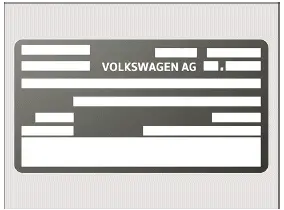
The permitted total vehicle weight and the gross axle weight rating must never be exceeded. The permissible values are indicated on the safety compliance label or on the identification label on the B-pillar on the driver's side (→ Safety certificate) (→ Identification label) .

Performance

These values apply only in ideal road and weather conditions.

The performance was determined without equipment that limits performance, such as add-on parts.

Incline angle

The incline angle is the specification up to which the vehicle is able to drive uphill on an angle with its own power.

This can depend on the road conditions, the weather conditions, and the engine power, among other things. The values apply to a vehicle that is in motion and not to a vehicle that starts to drive form a stationary position.

A rising difference in altitude (incline) on a 100 m (approx. 300 ft) stretch is given in percentage or degrees (100% = 45 degrees).

  • Structure of the vehicle identification number (VIN)
  • Position of the vehicle identification number
  • Dimensions

Structure of the vehicle identification number (VIN)

The Volkswagen ID.3 vehicle identification number (VIN, VIN ) consists of 17 characters. These characters can be sorted into seven groups.

The structure is explained using the following examples of vehicle identification numbers.

Volkswagen ID.3. Structure of the vehicle identification number (VIN)
  1. Vehicle manufacturer identification:

WVW

Volkswagen Passenger Vehicles

WVG

Volkswagen Passenger Vehicles

1VW

Volkswagen Group of America Inc., Volkswagen de México, S.A. de C.V

3VW

Volkswagen de México, S.A. de C.V

XW8

LLC Volkswagen Group Rus (Volkswagen/Skoda Kaluga)

MFB

Garuda Matraman Motor (Indonesia)

  1. Filler characters: The filler characters may vary depending on manufacturer, or contain information on the body shape and transmission type.

  2. Vehicle class, depending on model:

3H

Arteon

5T

Touran

6R

Polo

AC

T-Roc convertible

BV

Golf

CB

Passat

CA

Atlas

CR

Touareg

Depending on the manufacturer, digits 7 to 9 can also contain information on the fuel type( 7) and vehicle class (8 and 9).

  1. Filler characters or check digits: The filler characters or check digits may vary depending on the manufacturer.

  2. VIN index, depending on model year:

M

2021

N

2022

P

2023

R

2024

  1. Production location, plant where the Volkswagen ID.3 vehicle was manufactured:

C

Volkswagen plant in Chattanooga

D

Volkswagen plant in Bratislava

E

Volkswagen plant in Emden

K

Volkswagen plant in Osnabrück Or: Volkswagen plant in Kaluga

M

Volkswagen plant in Puebla

P

Volkswagen plant in Zwickau

T

Volkswagen plant in Pune

U

Volkswagen plant in Uitenhage

V

Volkswagen plant in Palmela

W

Volkswagen plant in Wolfsburg

Y

Volkswagen plant in Pamplona

The letter assignment for the production site may vary depending on the Volkswagen ID.3 vehicle or be assigned twice.

  1. Sequential production number for each model year.

Position of the vehicle identification number
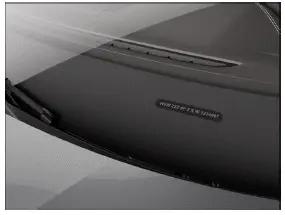
Volkswagen ID.3. Fig. 1 In the windshield: vehicle identification number (VIN)
Fig. 1 In the windshield: vehicle identification number (VIN)

Depending on the country, the type approval number, such as the EU operating license, may be specified.

  1. Manufacturer code.

  2. Type approval.

  3. Volkswagen ID.3 Vehicle Identification number.

  4. Gross Vehicle Weight Rating.

Gross combination weight rating (towing vehicle and trailer).

Front Gross Axle Weight Rating.

Rear Gross Axle Weight Rating.

  1. Type approval number, differs according to country.

  2. Vehicle model

  3. Manufacturer's address.

  4. Engine code.

Volkswagen ID.3. Fig. 2 Identification label (general example): version 2.
Fig. 2 Identification label (general example): version 2.

Depending on the country, the type approval number, such as the EU operating license, may be specified.

  1. Manufacturer code.

  2. Type approval.

  3. Volkswagen ID.3 Vehicle Identification number.

  4. Gross Vehicle Weight Rating.

  5. Gross combination weight rating (towing vehicle and trailer).

  6. Front Gross Axle Weight Rating.

  7. Rear Gross Axle Weight Rating.

Depending on the country and model, the model plate may be visible in the lower section of the door pillar when the driver's for front passenger door is open. Vehicles exported to some countries do not have a model plate.

Safety certificate
Volkswagen ID.3. Fig. 1 Safety certificate (general example).
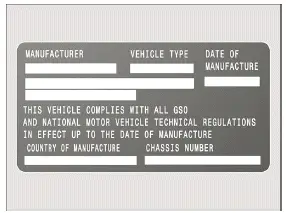
Fig. 1 Safety certificate (general example).

Volkswagen ID.3. Fig. 2 Safety certificate (general example).
Fig. 2 Safety certificate (general example).

A safety certificate on the driver door pillar displays the following information:

  • Vehicle model

  • Manufacturer.

  • Date of manufacture.

  • Country of manufacture.

  • Vehicle Identification number.

Dimensions
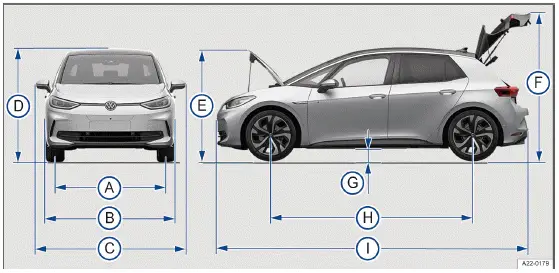
Volkswagen ID.3. Fig. 1 Vehicle dimensions
Fig. 1 Vehicle dimensions

The information in the table applies for the standard model with standard equipment.

For other wheel rims, tire sizes, options, differing model designs and retrofitted accessories, as well as special vehicles and vehicles in other countries, these values can differ.

Information about how the weight specifications are compiled can be found in section (→ Technical data) .
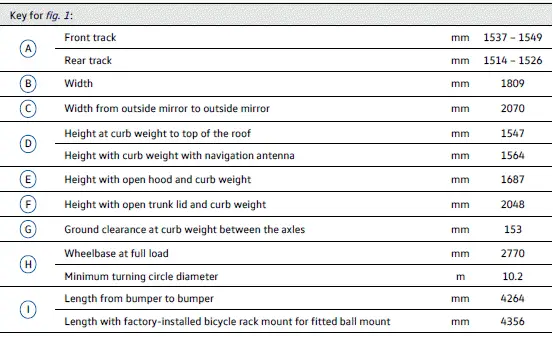
Volkswagen ID.3. Vehicle dimensions

110 kW, 45 (55) kWh, rear-wheel drive, electric motor

Engine overview

Volkswagen ID.3. Engine overview

Weight specifications and axle loads
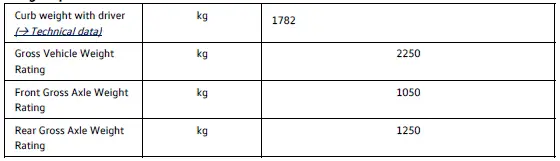
Volkswagen ID.3. Weight specifications and axle loads

Trailer tongue weight rating

The maximum permissible trailer tongue weight rating for the bicycle rack mount is 55 kg or 75 kg depending on the Volkswagen ID.3 vehicle equipment. Note the information on the sign next to the mount for the bicycle rack mount behind the license plate holder

Carrying load for rear carrier systems

Carrying load for rear carrier systems

Engine overview

Volkswagen ID.3. Engine overview

Weight specifications and axle loads

Volkswagen ID.3. Weight specifications and axle loads

Trailer tongue weight rating

The maximum permissible trailer tongue weight rating for the bicycle rack mount is 55 kg or 75 kg depending on the Volkswagen ID.3 vehicle equipment. Note the information on the sign next to the mount for the bicycle rack mount behind the license plate holder.

Carrying load for rear carrier systems

150 kW, 77 (82) kWh, rear-wheel drive, electric motor

Engine overview

Volkswagen ID.3. Engine overview

Weight specifications and axle loads
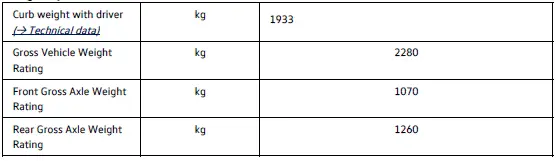
Volkswagen ID.3. Weight specifications and axle loads

Trailer tongue weight rating

The maximum permissible trailer tongue weight rating for the bicycle rack mount is 55 kg or 75 kg depending on the Volkswagen ID.3 vehicle equipment. Note the information on the sign next to the mount for the bicycle rack mount behind the license plate holder.

Carrying load for rear carrier systems