Limits of the sensor system

In this manual: Limits of the sensor system
About this Owner's Manual — 1Illustrated index — 1Symbols in the instrument cluster — 1Warning and information texts — 1Introduction to the instrument cluster — 1ID. Light — 1Service menu/ Service display — 1Limits of the Driver Alert System — 1Correct seating position — 1Automatic safety belt retractor, safety belt pretensioner, safety belt load limiter — 1Indicator light — 1Installation locations and deployment zones of the airbags — 1Switching the Front Passenger's Front Airbag On and Off — 1Types of child restraints — 1Securing yourself and the vehicle — 1Emergency equipment — 1Information Call, Roadside Assistance Call and Emergency Call Service — 1Troubleshooting — 1Legally required eCall Emergency System — 1Vehicle key functions — 1Unlocking or locking using Keyless Access — 1Child safety lock — 1Anti-theft alarm system — 1Interior monitoring and towing protection — 1Opening and closing the trunk lid — 1Opening and closing the windows — 1Power window pinch protection — 1Adjusting the steering wheel position — 1Manually adjusting front seats — 1Adjusting the head restraints — 1Removing and installing the head restraints — 1Center armrest — 1Memory function — 1Massage feature — 1Switching the turn signals on and off — 1Switching the lights on and off — 1Switching the high beam headlights on and off — 1Switching the poor weather lights on and off — 1Switching on and off the rear fog light — 1Switching the parking light on and off — 1Entry and exit lighting (orientation lighting) — 1Headlight range control — 1Interior/reading lights, ambient lighting — 1Operating the windshield wiper lever — 1Rain/light sensor — 1General safety precautions — 1Overview of the Climatronic — 1Overview of seat heating — 1Operating the stationary air conditioning — 1Programming the stationary air conditioning — 1Functions of the electric drivetrain — 1Steering information — 1Information on the pedals — 1Information on the brakes — 1Switching the ignition on and off — 1Activating the vehicle's drive system — 1Exiting a vehicle while the vehicle's drive system is active — 1Deactivating the vehicle's drive system — 1Driving mode selector — 1Brake energy recuperation — 1Selecting the driving mode — 1Standard behavior of the driving mode and the vehicle systems — 1Eco tips — 1Operating the vehicle in different countries and continents — 1Limits of the sensor system — 1Operating the cruise control system — 1Operating the speed limiter — 1System Limitations of the Predictive Control — 1Driving with predictive control — 1Eco assist — 1Special driving situations — 1System Limitations of ACC — 1Switching ACC on and off — 1Adjusting the ACC settings — 1System Limitations of Predictive Cruise Control — 1Driving with predictive cruise control — 1Warning levels and braking support — 1System Limitations of Front Assist — 1Oncoming vehicle braking when turning — 1Lane Assist system limitations — 1Driving with Lane Assist — 1Operating Travel Assist — 1Using assisted lane changing — 1Driving with Emergency Assist — 1Side Assist system limitations — 1Driving with Side Assist — 1Parking — 1Electronic parking brake — 1Auto Hold — 1Safety instructions — 1Automatic braking intervention — 1Switching Park Distance Control (PDC) on and off — 1Parking (Rear View Camera system with parking mode selection) — 1Changing the camera perspective — 1Searching for parking spaces — 1Calibrating the parking process — 1Displaying and editing parking spaces — 1Driving into or out of a parking space — 1Rear Traffic Alert — 1Information about braking assistance systems — 1Switching ASR Sport on and off — 1Sockets in the vehicle — 1Cyber security — 1Downloading and installing an Over-the-Air Update — 1V2X limitations — 1Activating and deactivating V2X — 1Traffic hazard alert — 1USB port — 1Bluetooth interface — 1Setting up the Internet connection — 1Activating and deactivating a Wi-Fi hotspot — 1Apple CarPlay — 1Android Auto — 1MirrorLink — 1Introduction to online services — 1Viewing and enabling functions — 1Safety instructions — 1Overview of Infotainment system — 1Brands, licenses, copyright — 1Functions and radio symbols — 1Setting a 360º range display and Electric Vehicle Route Planner — 1Stowing luggage and cargo — 1Mounting the bicycle rack mount — 1Information on the roof rack — 1Warning signs for the high-voltage system — 1Handling the high-voltage battery — 1Charging — 1Placement — 1Information on bulb replacement — 1Replacing bulbs in LED headlights — 1Fuses in the hood space — 1Ground jump-start point — 1Instructions for towing — 1Safety precautions for working in the hood space — 1Preparing the vehicle for work in the hood space — 1Operating fluids and operating equipment — 1Charging, replacing, disconnecting, or connecting the 12 V vehicle battery — 1Handling tires — 1Preparing Your Vehicle — 1Maintenance procedures and digital maintenance schedule — 1Information about operating conditions — 1Scope of service — 1Vehicle care information — 1Washing the vehicle — 1Accessories and replacement parts — 1Sensors and Cameras — 1Repairs and technical modifications — 1Airbag system repairs and situations that can affect the system function — 1Mobile phone usage in the vehicle — 1Data Storage and Data Protection Information — 1Event data recorder (crash data recorder) — 1Labels and signs — 1Fluids in the air conditioning system — 1Infotainment system and aerials — 1Disposal of old batteries and electronic devices — 1Product recycling — 1Old vehicle return and scrap disposal — 1Useful information on vehicles with N1 type approval (light commercial vehicle) — 1Radar Sensors — 1Specifications & Consumer information — 1
~4min read

Limits of the radar sensor

Driver assistance systems that use radar sensors may not respond, may offer a delayed response or may respond in an unexpected way in the following situations:

  • When driving in poor weather conditions, such as heavy rain, snow or heavy spray.

  • When driving through construction zones, tunnels or toll stations.

  • When driving on winding roads, for example, mountain roads

  • In front of bumps or dips in the road

  • When driving off-road

  • When driving in parking ramps

  • When driving on roads with embedded metal objects, such as railroad tracks

  • When driving on gravel roads

  • In complex driving situations, such as traffic islands.

  • Following a violent impact affecting components within the range of the radar sensors, e.g. following a rear-end collision.

  • If the radar sensors are obscured, dirty, misaligned or damaged.

Limits of the camera behind the windshield

Driver assistance systems that use the camera behind the windshield may not respond, may offer a delayed response or may respond in an unexpected way in the following situations:

  • In front of bumps or dips in the road

  • When driving in construction zones

  • When driving off-road

  • When driving in poor weather conditions, such as heavy rain, snow, fog or heavy spray and poor road conditions.

  • In low-lying sun, darkness or if there is glare from oncoming Volkswagen ID.3 vehicles.

  • If the camera is not available due to long exposure to direct sunlight or high ambient temperatures.

  • If the camera field of view is covered, dirty or damaged.

  • If the camera is misaligned.

Delayed reaction

If the sensor system is exposed to environmental conditions that limit its function, the driver assistance systems may only be able to detect this with a delay. Therefore, the display that indicates that functions are impaired may be delayed when you first start driving or while driving.

Limits in certain driving situations

Volkswagen ID.3. Fig. 1 Driving around curves.
Fig. 1 Driving around curves.

The sensor system always measures straight ahead. Therefore, on tight curves, vehicles may be detected by mistake or Volkswagen ID.3 vehicles driving ahead may not be detected.
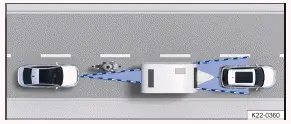
Volkswagen ID.3. Fig. 2 Narrow vehicle.
Fig. 2 Narrow vehicle.

Volkswagen ID.3 Vehicles that are driving close to your vehicle but outside the sensor range, such as motorcycles, cannot be detected.

Volkswagen ID.3. Fig. 3 Changing lanes.
Fig. 3 Changing lanes.

Vehicles that change to your lane close in front of your Volkswagen ID.3 vehicle cannot be detected. This also applies to vehicles with attachments exceeding the vehicle dimensions.

Specific system limitations

In addition to the limits of the sensor system, every driver assistance system has additional system limitations linked to their function. Please also note these:

  • Predictive speed limiter (→ Speed limiter with predictive control) .

  • Eco assist (→ Eco assist) .

  • Adaptive Cruise Control (ACC) (→ Adaptive Cruise Control (ACC)) .

  • Predictive cruise control (→ Predictive cruise control) .

  • Autonomous Emergency Braking (Front Assist) (→ Autonomous Emergency Braking (Front Assist)) .

  • Lane Assist (→ Lane Keeping System (Lane Assist)) .

  • Comfort drive Travel Assist (→ Comfort drive Travel Assist) .

  • Emergency Assist (→ Emergency Assist) .

  • Lane Change System (Side Assist) (→ Lane Change System (Side Assist)) .

Introduction

The cruise control system helps to maintain a set speed.

Speed range

The cruise control system is available at speeds above approximately 20 km/h when driving forward.

Driving with the Cruise Control System

You can override the stored speed at any time, for example, to pass another Volkswagen ID.3 vehicle. The regulation function is paused while the vehicle accelerates and then resumes the stored speed.

Displays

If the cruise control system is switched on, the instrument cluster display indicates the saved speed and the status of the cruise control system.

The following indicator lights may turn on depending on the driving situation and the instrument cluster version: Cruise control system is switched on, speed regulation active.

If the cruise control system is not regulating the speed, the indicator lights are small or grey.

If no speed is stored, the instrument cluster display shows instead of the speed.

Driving downhill

The Volkswagen ID.3 vehicle cannot maintain the saved speed in all driving situations. Always be ready to apply the brakes.

  1. Use the electric drivetrain recuperation when traveling downhill for extended periods.

    This relieves the strain on the brakes.

WARNING

If it is not possible to drive safely with enough distance and a constant speed, using the cruise control system may cause accidents and serious or fatal injuries.

  • Always adapt your speed and distance to vehicles driving ahead based on the visual, weather, road, and traffic conditions. The driver is always responsible for the speed.

  • Never use the cruise control system when visibility is poor, when there is not enough distance, or when roads are steep, winding, flooded, or slippery, for example from snow, ice, moisture, or gravel.

  • Never use the cruise control system when driving off-road or on unpaved roads.