Manually adjusting front seats
The information that follows describes all possible controls. Depending on the seat version, the number of controls may vary.
The controls on the front passenger seat are a mirror image of those for the driver seat.
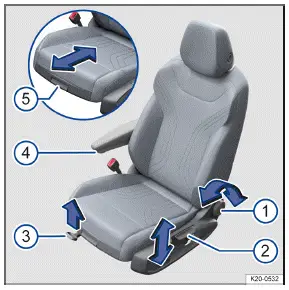
Fig. 1 On the driver seat: Controls.
To adjust the backrest, turn the handwheel with nothing resting on the backrest.
If necessary, move the lever upward or downward multiple times to adjust the height of the seat.
Pull the lever to slide the front seat forward or backward. The front seat must lock into place after the lever is released.
Press the button to the side or down to adjust the armrest up or down.
If the armrest is not being used, it can be folded up without pressing the button.
Only with electric seats, depending on the Volkswagen ID.3 vehicle equipment: Lift the grip to move the seat cushion forward or backward.
- Adjusting power front seats
- Folding the rear bench seat backrest forward or backward
Adjusting power front seats
The electric controls differ depending on the country and Volkswagen ID.3 vehicle equipment and may vary according to the seat design.
The controls on the front passenger seat are a mirror image of those for the driver seat.
A seat may have both manual and power controls.

Fig. 1 Switch on the driver seat: Adjusting the front seat forward/back, the height and angle of the seat surface, and the front seat backrest.
Press the switch in the direction of the arrow:
Slide the seat forward or backward.
Adjust the angle of the seat surface.
Adjust the height of the seat.
Adjust the angle of the backrest.
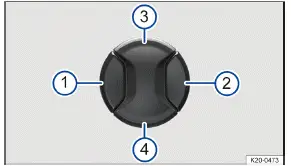
Fig. 2 Switch on the driver seat: Adjusting the lumbar support.
Press the switch in the direction you would like the lumbar support to move.
Move the curvature of the lumbar support forward.
Move the curvature of the lumbar support backward.
Raise the curvature of the lumbar support.
Move the curvature of the lumbar support down.
WARNING
Careless or unintended use of the power front seats can cause serious injuries.
The power front seats can also be adjusted when the ignition is switched off. Never leave children or people requiring assistance in the Volkswagen ID.3 vehicle.
In case of an emergency, interrupt the power adjustment by pressing another switch.
NOTICE
Incorrect usage may damage the electric components in the front seats.
Do not kneel on the front seats and do not otherwise concentrate pressure on specific points of the seat cushion and backrest.
If the 12 V vehicle battery charge level is too low, the seat may not be able to be adjusted with the power controls.
Switching on the Volkswagen ID.3 vehicle's drive system cancels a seat adjustment that is taking place.
Introduction
The following information describes the various options for adjusting the rear seats. Always make sure the seats are adjusted to the correct position (→ Seating position) .
WARNING
Incorrectly positioned rear seats increase the risk of serious injuries if an accident occurs.
Before every journey, ensure that the rear seats are positioned so that all passengers are sitting upright and have their safety belts fastened correctly.
Only adjust the rear seats when there is no one within the range of movement of the seats.
WARNING
If you adjust the rear seats while driving, you will adopt the wrong sitting position. In addition, the rear seats may move unexpectedly during the journey. This will increase the risk of serious injuries if an accident occurs.
Only adjust the rear seats when the Volkswagen ID.3 vehicle is stationary.
WARNING
Incorrect use of the rear center armrest may cause serious injuries.
The rear center armrest must always be folded up during journeys.
If the center armrest is folded down, the center rear bench seat must never be used by either adults or children.
Never allow an adult or child to ride on the center armrest.
NOTICE
Objects in the luggage compartment may get into the space between the seat and the luggage compartment floor when the rear seat is adjusted. This may cause damage.
Remove all objects located between the seat and luggage compartment floor before you move the rear seat.
NOTICE
Objects with sharp edges can damage the seats.
Never touch the seats with sharp-edged objects. Sharp-edged objects, such as zippers, rivets on clothing, or belts, can cause surface damage. Open hook and loop fasteners can also cause damage.
Folding the rear bench seat backrest forward or backward
The seat backrest is divided. Each part of the rear seat backrest can be folded forward individually to enlarge the luggage compartment.
Folding the rear seat backrest forward and down with the release button
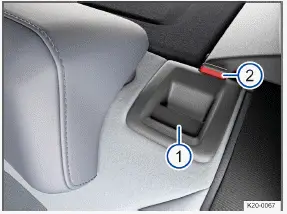
Fig. 1 In the rear seat backrest: release button.
Move the head restraints all the way down.
Pull the release button → fig. 1 (1) forward while folding the rear seat backrest forward and down.
The corresponding backrest part of the rear seat backrest is released when the red marking→ fig. 1 (2) can be seen.
Folding the rear seat backrest up and back
Fold the rear seat backrest to the back and push firmly into the catch until it securely engages→
 .
The red marking → fig. 1 (2) must no longer be visible.
WARNING
Folding and unfolding the rear seat backrest in an uncontrolled or careless manner may cause severe injury.
Always take care that no people or animals are in the way of the rear seat backrest when folding it forward and down.
Never fold the rear seat backrest forward or back while driving.
Make sure the safety belt is not pinched or damaged when folding the rear seat backrest back.
Keep hands, fingers, feet and other body parts away from the rear seat backrest when folding forward or back.
Each rear seat backrest must always be securely engaged to ensure that the safety belts in the rear seats can provide the maximum protection. Take extra care especially with the middle seat in the rear bench seat. If a seat on the rear bench is used without the rear seat backrest being engaged, the vehicle occupant will move forward with the rear seat backrest in the event of sudden braking and driving maneuvers or a collision.
A red marking → fig. 1 (2) indicates that the rear seat backrest is not engaged. Always check that the red marker is not visible when the rear seat backrest is in the upright position.
● Never allow people to sit in a rear seat if that rear seat backrest is folded forward or is not engaged.
NOTICE
Folding and unfolding the rear seat backrest in an uncontrolled or careless manner may cause damage to the Volkswagen ID.3 vehicle or other objects.
Before folding the rear seat backrest forward, always adjust the front seats so that the head restraint or padding on the rear seat backrest does not press against the front seats.
Before folding the rear seat backrest forward, always take care that there are no objects in its path.
Introduction
The information that follows describes how the head restraints can be adjusted and removed. Always make sure the seats are adjusted to the correct position (→ Seating position) .
All seats are equipped with head restraints. The head restraints are specially approved for the relevant seat and should not be installed in another seat in the Volkswagen ID.3 vehicle.
The center rear head restraint (depending on the vehicle equipment) is only intended for the center seat on the rear bench seat. Therefore do not install this head restraint in any other position.
There are notches in the head restraint supports so that they can be locked in different positions. Only head restraints which are correctly mounted can lock into the notches within the adjustable range. To prevent the head restraints from being removed unintentionally after mounting, there are stops at the top and bottom of the adjustable range.
Correct head restraint adjustment
Adjust the head restraint so that the upper edge of the head restraint is in line with the upper portion of the head as much as possible, but not lower than eye level. Position the back of the head as close as possible to the head restraint.
Head restraint adjustment for shorter persons
Slide the head restraint all the way down, even if the head is then below the upper edge of the head restraint. When the head restraint is in the lowest position, there may be a small gap between the head restraint and the backrest.
Head restraint adjustment for taller persons
Move the head restraint up all the way.
WARNING
Driving with head restraint that have been removed or adjusted incorrectly increases the risk of serious or fatal injuries in the event of an accident or sudden driving and braking maneuvers.
If a person is sitting in a seat, always drive with the head restraint correctly installed and adjusted on that seat.
If a person is sitting in a seat, adjust the head restraint according to their height.
Never adjust the head restraint while driving.
NOTICE
Removing and fitting the head restraints incorrectly may cause damage.
When removing and installing the head restraint, make sure the head restraint does not hit the headliner, the front seat backrest, or other Volkswagen ID.3 vehicle components.