COOLING SYSTEM
At the factory, the engine cooling system is filled with long-life coolant that does not need to be replaced. It consists of water and special additive G11 (based on antifreeze with corrosion inhibitor). This mixture provides reliable protection against freezing and rust, prevents the formation of calcium deposits, and significantly raises the boiling point of the coolant.
When topping up or replacing the coolant, the mixture must consist of clean water and G11 or a special additive meeting specification TL-VW 774 A (indicated on the container packaging).
 Coolant and additives are poisonous. Store them in their original containers and keep them out of reach of children.
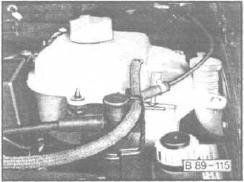
Coolant level check procedure
Maintaining the correct coolant level is necessary for the cooling system to operate properly.
Check the coolant level only with the engine switched off. It is not necessary to remove the expansion tank cap. The tank is transparent.
With a cold engine, the coolant level in the expansion tank must be at the very end of the level mark arrow.
With a hot engine, the level deviates slightly from normal. The expansion tank contains a sensor.
If the coolant level drops, the corresponding warning lamp on the instrument panel will start flashing.
Coolant consumption
Under normal operating conditions, the cooling system practically does not require additional maintenance.
Leakage is possible only if the system is depressurized. Consumption occurs at high temperature and boiling of the fluid, when it is forced out under pressure through the valve in the expansion tank cap.
Possible causes of overheating may be:
- restricted access of cooling air to the radiator, for example the radiator grille is blocked (leaves, dirt, insects) or additional lamps are installed near the air intakes; - reduced boiling point due to incorrect preparation of the coolant mixture (incorrect proportions). See the section "Topping up the coolant"; - the vehicle climbs a long hill in hot weather in low gears at high engine speed.
If you cannot find the cause of coolant overheating yourself, contact a service station, otherwise you may damage the engine.
Topping up the coolant
Switch off the engine and wait until it cools down. Place a rag over the expansion tank cap, turn it counterclockwise one or two turns to release the pressure, then fully unscrew it.
The cooling system is under pressure. To maintain constant corrosion protection, prevent calcium deposits, and keep the maximum boiling point, never dilute the coolant with plain water, even in warm weather.
The additive proportion must be at least 40% (frost protection down to -25 °C).
If coolant leaks and the level drops to a critical state, top it up, otherwise the engine may be damaged.
Winter operation
The coolant filled at the factory is long-life and does not freeze at air temperatures down to -25 °C. However, to be sure, it is advisable to check its frost protection before the first frosts and, if necessary, add G11 or coolant meeting specification TL-VW 774 A.
If the vehicle is operated in a colder climate, increase the proportion of G11 additive, but not above 60% (frost protection -40 °C), since overdosing may lower the freezing point and generally worsen the coolant properties.
Vehicles intended for export to cold-climate countries are filled at the factory with coolant providing frost protection down to -35 °C.
Test yourself
A quick Audi 80 quiz: every answer comes with an explanation and a link to the manual page.