Jump-starting
The cable cross-section of the jump leads should be at least 16 mm² (diameter approx. 5 mm) for petrol engines up to approx. 2.5 l displacement. For diesel engines or petrol engines above approx. 2.5 l displacement, the cable cross-section should be at least 25 mm². The vehicle with the discharged battery is always the deciding factor. The cable cross-section is usually stated on the packaging of the jump leads. When buying new, jump leads with insulated clamps and a 25 mm² cross-section are recommended, as they are also suitable for engines with smaller displacement.
Both batteries must have a voltage of 12 volts.
A discharged battery can freeze at as little as -10 °C.
A frozen battery must be thawed before the jump leads are connected.
The discharged battery must be properly connected to the vehicle electrical system.
Check the electrolyte level of the discharged battery and, if necessary, top up with distilled water.
Position the vehicles so far apart that there is no metallic contact. Otherwise, current could flow as soon as the positive terminals are connected.
On both vehicles, apply the parking brake.
Place the manual transmission in neutral and the automatic transmission in park position "P".
Switch off all electrical consumers.
As a rule, let the engine of the donor vehicle run at idle speed during the starting process.
This prevents damage to the alternator from voltage spikes during starting.
Avoid open flames near the battery during jump starting, as flammable gases can escape from the battery.
Make sure the jump leads are not damaged by moving parts such as the cooling fan.
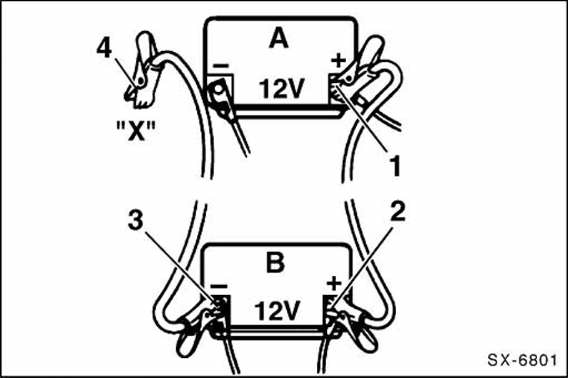
Connect the jump leads in the following order:
Clamp the red cable to the positive terminal of the discharged battery (a).
Clamp the other end of the red cable to the positive terminal of the donor battery (b).
Clamp the black cable to the negative terminal of the donor battery.
Connect the other end of the black cable to a good ground point (x) on the receiving vehicle.
A metal part bolted to the engine block is most suitable. Under unfavorable conditions, connecting the cable to the negative terminal of the discharged battery could cause sparks and ignition of hydrogen gas, resulting in a battery explosion.
Start and run the engine of the receiving vehicle (discharged battery). Do not operate the starter motor continuously for more than 10 seconds, as the high current draw will heat the terminal clamps and cables.
Therefore, allow a cooling-off period of at least 1/2 minute between attempts.
Do not lean over the batteries - risk of burns from acid!
After jump starting, disconnect the jump leads in the reverse order: first disconnect the black cable (-) from the receiving vehicle, then disconnect it from the donor vehicle.
Disconnect the red cable first from the power-supplying vehicle and then from the receiving vehicle.
Test yourself
A quick Fiat Bravo quiz: every answer comes with an explanation and a link to the manual page.