Check Engine Warning Lamp
<MODELS WITH OBD-II SYSTEM>
The Malfunction Indicator Lamp (MIL) illuminates to warn the driver of an engine malfunction. However, the MIL will turn off automatically after 3 consecutive driving cycles in which the malfunction is not detected. Immediately after the ignition is turned on (ignition key in the "ON" position and engine not running), the MIL will remain illuminated continuously to show that it is functioning normally.
Fuel injection system components that will illuminate the MIL if they malfunction:
• Catalytic converter
• Fuel system
• Manifold Absolute Pressure (MAP) sensor
• Intake Air Temperature (IAT) sensor
• Engine Coolant Temperature (ECT) sensor
• Throttle Position Sensor (TPS)
• Upstream Heated Oxygen Sensor (Upstream HO2S)
• Upstream HO2S heater
• Downstream Heated Oxygen Sensor (Downstream HO2S)
• Downstream HO2S heater
• Injector
• Cylinder misfire
• Crankshaft Position (CKP) sensor
• Camshaft Position (CMP) sensor
• Evaporative Emission Control System (EVAP)
• Vehicle Speed Sensor (VSS)
• Idle Speed Actuator (ISA)
• Power supply system
• Engine Control Module (ECM)
• M/T / A/T coding data
• Acceleration Sensor
• MIL request signal circuit
• Power Stage
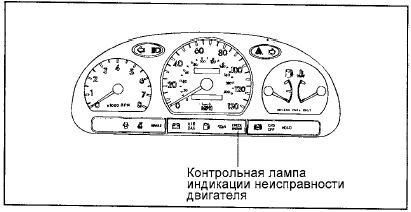
<MODELS WITHOUT OBD II>
The Malfunction Indicator Lamp (MIL) illuminates to warn the driver of an engine malfunction. However, the MIL will turn off automatically after 3 consecutive driving cycles in which the malfunction is not detected.
Immediately after the ignition is turned on (ignition key in the "ON" position and engine not running), the MIL will remain illuminated continuously to show that it is functioning normally.
Fuel injection system components that will illuminate the MIL if they malfunction:
• Heated Oxygen Sensor (HO2S)
• Manifold Absolute Pressure (MAP) sensor
• Throttle Position Sensor (TPS)
• Engine Coolant Temperature (ECT) sensor
• Idle Speed Actuator (ISA)
• Injectors
• Engine Control Module (ECM)
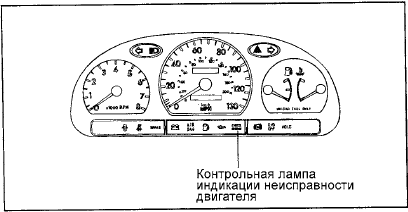
<INSPECTION>
1. Turn the ignition switch to the "ON" position and check that the MIL illuminates for approximately 5 seconds and then turns off.
2. If the MIL does not illuminate, check the wiring for an open circuit, the fuse, and the MIL bulb for burnout.
SELF-DIAGNOSIS
The Engine Control Module monitors input and output signals (some continuously, others only under specific conditions).
If the Engine Control Module detects a malfunction (a continuous or intermittent fault in the system), it will record the corresponding trouble code in memory and send a signal to the standard diagnostic connector.
Diagnostic results (trouble codes) can be read using the MIL or the HI-SCAN (Pro) tester.
Trouble codes will be stored in the Engine Control Module memory only while battery power is supplied. Trouble codes can be erased by disconnecting the battery negative terminal or the Engine Control Module connector, or by using the HI-SCAN (Pro) tester.
If a sensor connector is disconnected with the ignition switched on, the Engine Control Module will detect this as a malfunction and the corresponding trouble code will be stored in memory.
In this case, clear the Engine Control Module memory by disconnecting the negative (-) battery terminal for 15 seconds or longer.
Test yourself
A quick Hyundai Elantra CN7 quiz: every answer comes with an explanation and a link to the manual page.