Cooling System
Everything described for gasoline engines is generally also applicable to diesel engines. Therefore, this subsection covers only the differences in removal and installation of certain components. This applies, for example, to the water pump, which on diesel engines is driven by the timing belt, meaning the timing belt must be removed to replace the pump.
Water Pump Removal and Installation
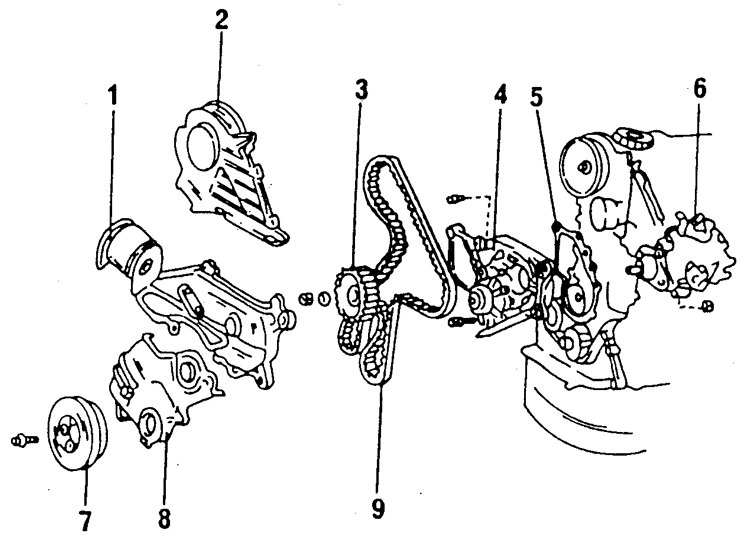
Water Pump – Removal and Installation
1. Right engine mount bracket
2. Upper timing belt cover
3. High-pressure fuel pump drive gear
4. Water pump
5. Gasket
6. High-pressure fuel pump
7. Crankshaft pulley
8. Lower timing belt cover
9. Timing belt
In addition to the timing belt, the high-pressure fuel pump must also be removed to provide access to the water pump.
PROCEDURE
1. Drain the coolant from the cooling system.
2. Remove the high-pressure fuel pump as described in subsection 3.2.20.
3. Remove the timing belt center cover.
4. Remove the water pump. It is secured with seven bolts. Note the bolt locations, as they are of different lengths. Remove the gasket.
5. Installation is performed in reverse order. Be sure to install a new gasket. Tighten the bolts to 18 N·m.
6. Install the fuel pump and timing belt as described in subsection 3.2.20 and subsection 3.2.2. Adjust the tension of the generator V-belt and fill the cooling system with coolant.
Thermostat
GENERAL
The thermostat is located in the coolant inlet connection, so before removing the thermostat, drain the coolant to a level below the connection. The thermostat is checked the same way as on the gasoline engine. The thermostat opening temperature is 80–82 °C, and at 95 °C the thermostat must be fully open. In this case, the pin must protrude 8 mm from the thermostat.
Test yourself
A quick Toyota Corolla quiz: every answer comes with an explanation and a link to the manual page.