All-Wheel Drive Concepts
Part-Time All-Wheel Drive
Until recently, the concept of an "all-wheel-drive vehicle" was almost inseparably linked with the concept of an "off-road vehicle". The concept of all-wheel drive in the latter was quite simple: an additional drive was simply connected to the standard drive (engine at front, rear-wheel drive), namely, another drive line led to the front axle via a transfer case and an additional driveshaft.
Trips were usually made with the standard drive, and the front drive was engaged only when road conditions required it. This design with part-time all-wheel drive is still common in off-road vehicles (SUVs).
Disadvantage of this system: during driving on hard surfaces, all-wheel drive must be disengaged, because when cornering the front wheels travel a longer path than the rear wheels. The differing wheel rotation speeds lead to steering difficulties.
Permanent All-Wheel Drive
Therefore, if the idea of permanent all-wheel drive, acting constantly on all four wheels, is to be realized, a device preventing wheel slip must be created. This problem is solved by the so-called center differential.
Differentials have been known in automotive engineering for a long time. They distribute torque between the right and left drive wheels.
Forces must also be balanced there, because, as is known, the outer wheel travels a longer distance than the inner wheel when cornering. The axle differential takes on the role of balancer. It allows torque to be transmitted to both drive wheels depending on the angular speed of each of them.
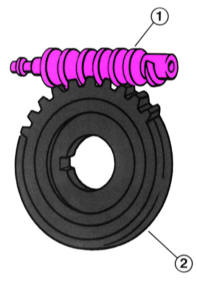
The design of the Torsen differential is based on the principle of the worm gear. The worm gear can be designed so that it has a larger or smaller locking ratio.
1 – worm, 2 – worm wheel.
In winter, for example, it happens that a wheel standing on ice spins, while the opposite wheel on a rough surface transmits no force and therefore stands still. One thing is clear: such a differential is unsuitable as a center differential, because the opposite effect must be achieved. Force must be transmitted where the wheels can move the vehicle, namely where the road surface has good grip. And since the driver never knows this in advance, distribution must occur automatically.
After various development stages, including a manually locked center differential, the all-wheel-drive Audi quattro models today are equipped with the so-called Torsen differential.
Test yourself
A quick Audi 80 quiz: every answer comes with an explanation and a link to the manual page.