Engines
Audi 80 models are equipped with five gasoline engines. The engine range extends from economical 4-cylinder engines to comfortable and powerful versions, such as the inline 5-cylinder and V6 engines. In particular:
2.0-liter 4-cylinder engine, 66 kW (90 L hp)
2.0-liter 4-cylinder engine, 85 kW (115 L hp)
2.3-liter inline 5-cylinder engine, 98 kW (133 L hp)
2.6-liter V6 engine, 110 kW (150 L hp)
2.8-liter V6 engine, 128 kW (174 L hp)
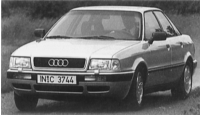
Although its exterior has changed little, the current Audi 80 has become much more mature compared with its predecessor. The shortcoming that was often criticized earlier – the too-small trunk – has now been completely eliminated. In addition, the Audi now has a new rear axle, providing the vehicle with significantly more stable handling during driving.
4-cylinder engines
Both 4-cylinder engines fitted to the Audi 80 have a displacement of 2 L. This 2-liter 4-cylinder engine is well known from numerous predecessor model series. Its origins date back to 1972 (when its displacement was still 1.3 and 1.5 L).
The displacement was increased to 2 L in 1988 based on the unit that by then had been enlarged to 1.8 L. The additional cubic centimeters benefit primarily the torque.
Each time the displacement was increased, other innovations were added; this time, a temperature-responsive tensioner pulley that keeps the timing belt tension constant at different engine temperatures. This measure extended the service life of the timing belt. Something almost self-evident: the valves are actuated by maintenance-free hydraulic tappets.
The two 4-cylinder engines differ mainly in their fuel preparation: while the 4-cylinder engine with 66 kW (90 L hp) runs on regular unleaded AI-92 gasoline, supplied through a single injector (central injection), the 85 kW (115 L hp) version is equipped with Digifant injection. In this case, AI-95 gasoline (Euro Super) is supplied to each cylinder through its own injector. Knock-controlled ignition timing (explained in the Ignition System chapter) makes it possible to run the engine on AI-92 gasoline as well, without any adverse consequences for the engine.
5-cylinder engine
The reliable and undemanding 2.3-liter inline 5-cylinder engine has undergone constant technical improvements over the years. For example, it is equipped with the aforementioned temperature-responsive tensioner pulley, which keeps the camshaft timing belt tension constant.
This 5-cylinder engine with KE-III-Jetronic injection and program-controlled ignition system monitors the combustion process by means of a knock sensor installed on each cylinder, so that this power unit optimally uses unleaded AI-95 gasoline at a compression ratio of 10.0:1. AI-92 (regular) gasoline may be used as an alternative.
The 5-cylinder engine reaches its maximum output of 98 kW (133 L hp) at 5500 rpm and its maximum torque of 186 N•m at 4000 rpm. The wide torque curve provides strong performance at low and medium engine speeds.
V6 Engine
2.8 L
The V-type 6-cylinder engine is equipped with an electronic MPI fuel injection system with an air mass meter, which controls the mixture quality for each cylinder individually, and therefore reduces fuel consumption and lowers harmful substances in the exhaust gas. Two knock sensors monitor the combustion process in the cylinders and perform selective knock control. This prevents the negative effects that can occur when fuel with too low an octane rating is used.
An interesting feature of this engine is the so-called variable-length intake manifold, which provides high torque over a wide speed range. Six valves in the variable-length intake manifold are actuated by vacuum and controlled depending on engine speed: up to 4000 rpm they form long runners for high torque. Above 4000 rpm, short runners provide greater power. The V6 Audi engine reaches its maximum torque of 245 N•m at 3000 rpm on AI-95 gasoline. When using AI-98 (Euro Super Plus) it produces 250 N•m. In the wide speed range from 2000 rpm to 5000 rpm, the driver has at least 220 N•m of torque available.
The ignition system of the V6 engine does not use a mechanical ignition distributor.
2.6 L
First used on the Audi 80: V-type 6-cylinder engine.
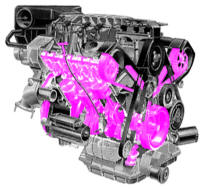
The exhaust gas flows from the left and right cylinder banks go to two separately operating catalytic converters. Two heated lambda sensors provide separate exhaust gas control for each cylinder bank.
The 2.6-liter 6-cylinder engine was introduced in August 1992 as a slightly simplified version. A modified injection system (MPFI) uses a different method of measuring air. This engine also has no variable-length intake manifold. But with 110 kW at 5750 rpm and 225 N•m at 3500 rpm, there is no lack of power.
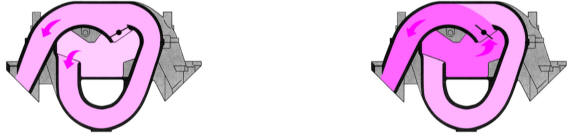
Operation of the variable-length intake manifold: left, air intake path at engine speeds below 4000 rpm; right, air intake path at engine speeds above this value.
Test yourself
A quick Audi 80 quiz: every answer comes with an explanation and a link to the manual page.