Regular Maintenance
Reliability and safety are impossible without care and maintenance. Otherwise, do not be surprised by problems with the vehicle. Where and when to take preventive measures is described in the detailed maintenance instructions prepared by Audi.
Maintenance Intervals
The following maintenance requirements apply to your Audi 80:
Vehicle inspection with exhaust emissions check – once a year.
Vehicle inspection with additional work every 30,000 and 60,000 km.
Oil change if the vehicle is driven more than 15,000 km per year, thereby exceeding the annual inspection interval. For those who drive large annual distances (more than 15,000 km) and use workshop services for regular inspections, unfavorable overlaps may occur. At 20,000 km per year, the oil change must be performed before the annual inspection. For those who drive 25,000 km per year, it is better to carry out the 30,000 km inspection after the annual interval has expired. Those who do all work themselves may decide as needed what and when to do.
Audi drivers must replace the brake fluid every two years.
Do-It-Yourself Maintenance Plan
The maintenance plan described in this manual is based on Audi recommendations, and the sequence of individual items has been arranged specifically for those who prefer to do the work themselves.
Who can carry out the work?
Warranty service
You can carry out almost all maintenance work on the Audi 80 yourself. The "Traffic light for the DIY mechanic" will indicate the correct approach:
For the DIY mechanic, the way is clear. You can perform this work yourself, using the knowledge in this manual, and thus save money.
The work is not difficult, but in most cases you may not have the necessary tools on hand.
Stop, here it is better to let a workshop do the work. Special tools or equipment are required. The time spent does not justify itself, because the workshop works significantly faster, or the work requires special, more in-depth knowledge.
If your Audi 80 is less than one year old, or the engine has been replaced, the manufacturer requires that maintenance work be carried out on schedule at one of the authorized Audi workshops. Otherwise, support may be refused even in justified warranty cases. Anyone who wishes to use the benefits of the "Mobility guarantee" must visit a workshop at least once a year.
Diagnostics at an Audi workshop
Fault finding is often the most expensive item on the workshop bill, especially when it concerns faults that occur only intermittently. Therefore, what could be more reliable than checking the vehicle's "nerve connections" to find out about the problem immediately and in full depth?
Operating principle
The numerous control units installed in Audi vehicles are capable of self-diagnosis. These include the control units for the injection system, the ignition system (models with 5-cylinder engine), the anti-lock braking system, EDS (electronic differential lock), the airbag and air conditioning. Such a control unit is able to diagnose faults if it has a fault memory built in, which records all malfunctions occurring during vehicle operation.
The control unit can be connected to the workshop diagnostic equipment by plugging into the central connector for the diagnostic socket on the central distribution box of the vehicle.
How it works
The correct use of the fault memory readout should proceed as follows: the driver brings the Audi to the workshop, and before any work begins, the vehicle is connected to the diagnostic equipment. A complete fault report is printed from it, containing the fault memory data of all self-diagnosing control units.
The test is carried out by the technician following the program by performing the corresponding instructions on the display. The final result is the precise identification of the components and assemblies that require repair.
Actuator diagnostics
A decisive factor for quick and correct repair is the function of the diagnostic equipment that Audi calls actuator diagnostics. This means the following: electrical functions, such as activation of the fuel pump relay, the solenoid valve for the activated charcoal canister or the idle speed stabilization valve, can be controlled by the diagnostic equipment.
In this way it can be determined with certainty whether the cause lies in faulty wiring or whether the control unit itself is not functioning (its operation, which is not drowned out by engine noise, can usually be heard clearly). This considerably simplifies fault finding.
Fault memory readout
During maintenance, reading the fault memory is part of the scope of work. In this way the workshop can obtain an overview of possible malfunctions in the electronic components of the vehicle without having to question the customer in detail.
A person who performs maintenance on their own may omit this item during work, since they observe the vehicle during everyday operation, meaning they should have noticed possible malfunctions.
Self-diagnosis
The times when motorists, as with the Volkswagen "Beetle", could carry out all work on the vehicle themselves have long since passed. But this does not at all mean that independent repair of one's own vehicle is completely impossible. Quite the opposite. It is only necessary to slightly change the working method and use modern equipment.
For example, the results of a fault memory readout performed by a workshop can well be used for work at home. The following example should illustrate this idea.
Example
An 85 hp engine with Digifant injection shows insufficient power under full load. Insidiously, it is not always低power but only from time to time.
As experienced home mechanics, we have already checked the vehicle item by item, as listed in this manual in the section Digifant injection system fault table.
In a normal case we would surely have found the fault already, but the fact that it appears only from time to time makes the search difficult.
This example clearly shows the distinct advantage of the fault memory, because it also stores faults that occur sporadically.
Fault memory readout result: fault in the throttle position sensor (loose contact).
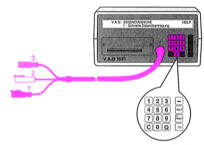
The fault memory of the various control units is read out with this diagnostic tester. This allows a quick assessment and diagnosis of the relevant control unit and its information sensors. In addition, the information stored in the fault memory can be erased with this tester.
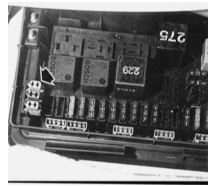
The fuse box (central electrical distribution panel) contains plug connections (marked by arrows) to which the diagnostic tester V-A-G 1551 can be connected.
Test yourself
A quick Audi 80 quiz: every answer comes with an explanation and a link to the manual page.