Adding Oil
The difference between the upper and lower dipstick marks is 1 L. The oil level must not fall below the lower mark. If the oil is only a quarter liter below the required amount, the engine is still not in danger. However, if the oil level is even lower and the vehicle is driven aggressively, the oil pressure may drop to a dangerous level, which is immediately indicated by the oil pressure warning buzzer.
Too much oil in the engine is also undesirable. At high engine speeds, oil can enter the combustion chambers through the crankcase ventilation system. For the catalytic converter, excess oil in the exhaust gases is as dangerous as unburned fuel, since it can cause damage. However, if the oil level is normal, there is no such risk.
When the oil should be topped up depends on driving style:
With moderate driving, it is sufficient to add oil when the level drops to the lower mark.
With aggressive driving, it is recommended to add oil if the level is in the lower third or quarter of the range between the two marks. A larger quantity of oil can perform its cooling function better.
Oil in small quantities costs more than in three- or five-liter canisters. However, such canisters are usually not very convenient for adding oil on the road. In addition, they take up space in the trunk. For precise oil addition, a one-liter bottle with a screw cap is more suitable.
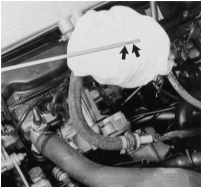
To check the oil level, pull the oil dipstick out of the guide tube on the left side of the engine. The oil level must be between the MAX and MIN marks, that is, in the area of the ribbed surface (indicated by arrows) on the tip of the dipstick. The amount to add between both marks is 1 L. The measurement will be accurate only when the vehicle is standing on a level surface.
Test yourself
A quick Audi 80 quiz: every answer comes with an explanation and a link to the manual page.