i-SHIFT Transmission (Automated Manual Transmission) - Shifting Gears
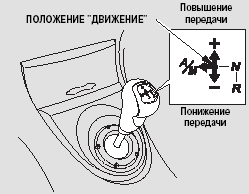
The shift lever can be in one of three positions: "Neutral", "Reverse" and "Drive". To start the engine, the shift lever must be in the neutral position and the brake pedal must be depressed. The brake pedal must also be depressed when moving the lever from neutral to the drive or reverse position.
If a brief stop is required while driving, leave any gear engaged, firmly depress the brake pedal and release the accelerator pedal.
This will prevent unexpected and dangerous vehicle movement.
Before starting to drive, check that the shift lever position indicator shows the correct lever position. You must depress the brake pedal, otherwise you will not be able to engage a gear, and the shift lever position indicator will flash as a warning.
To select automatic mode, move the lever from the Drive position to the left, to the A/M position.
To switch to manual shift mode, move the lever up or down from the Drive position. Moving the lever to the A/M position also switches to manual shift mode.
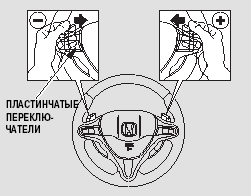
If the shift lever is in the Drive position, pull either paddle shifter toward you to switch to manual shift mode.

WARNING
Do not move the shift lever unless you need to change gears.
Accidentally moving the lever may cause it to unexpectedly shift to neutral or switch between manual and automatic modes.
You can move the shift lever even with the ignition switched off, but gears will not change.
Do not hold the vehicle on a slope by pressing the accelerator pedal. This may damage the clutch or other transmission components.
Do not depress the brake and accelerator pedals at the same time. This may damage the clutch or other transmission components.
Before starting to drive, make sure the required gear is shown on the shift lever position indicator (upper display).
If the vehicle is stopped on an uphill slope, engage first gear before switching off the engine. When stopped on a downhill slope, engage reverse gear.
If a problem occurs with the transmission while driving, the i-SHIFT transmission warning indicator on the instrument panel will illuminate. For more information, refer to page 336.
Neutral (N) - Before starting the engine, depress the brake pedal and move the shift lever to the neutral position. If the shift lever is not in the neutral position or the brake pedal is not depressed, the engine will not start. When shifting from neutral to any gear, depress the brake pedal and release the accelerator pedal.
When starting the vehicle from a standstill, release the parking brake, slowly release the service brake pedal, and then gradually depress the accelerator pedal.
The transmission is designed to assist the driver when starting at very low speed, so you can start moving on a level road without pressing the accelerator pedal hard.
This method is not effective on uphill slopes, so apply the parking brake before starting to drive.
If you try to move the shift lever from neutral to Drive or Reverse without depressing the brake pedal, the shift lever position indicator will flash and you will not be able to engage the gear. However, the system will allow the vehicle to start moving if the driver depresses and releases the brake pedal within 25 seconds.
If the engine has stalled and needs to be restarted, engage neutral (for jump-starting from another vehicle's battery, refer to page 456).
If you cannot shift from neutral into any gear, the shift lever position indicator on the upper display will flash.
This means that, regardless of the lever position, the transmission is actually in neutral. In this case, return the lever to the neutral position, wait briefly, then move the lever to the required position with the brake pedal depressed.
If the driver opens a door with the shift lever in Drive or Reverse and the engine running, a continuous audible warning will sound and the shift lever position indicator will flash.
WARNING
Do not move the shift lever to neutral while the vehicle is moving. You will lose engine braking and may lose control of the vehicle.
Reverse (R) - Wait until the vehicle has come to a complete stop before engaging reverse gear. Engaging reverse before the vehicle has stopped risks damaging the transmission.
Your vehicle is equipped with a lockout that prevents shifting into reverse from any forward gear. Reverse will not engage at speeds above 3 km/h, whether shifting accidentally from neutral or from any forward gear.
To avoid damaging the transmission, do not attempt to engage reverse while the vehicle is moving.
Before moving in reverse, make sure the "R" symbol is displayed on the shift lever position indicator.
Test yourself
A quick Honda Civic quiz: every answer comes with an explanation and a link to the manual page.