Vehicle Stability Assist (VSA)
The Vehicle Stability Assist (VSA) system helps maintain directional stability by correcting oversteer or understeer of the vehicle. In addition, this system functions as a traction control system, reducing or completely eliminating wheel spin of the drive wheels when accelerating on slippery or loose-surfaced roads.
The system operates by independently controlling the brakes of individual wheels and by automatically adjusting engine output.
When the VSA system is active, you may feel that the vehicle's response to the accelerator pedal differs slightly from normal driving. Unusual sounds may also be heard while the system is operating. The VSA indicator blinks while the VSA system is operating.
The VSA system cannot maintain directional stability of the vehicle under all driving conditions and does not provide complete control of the vehicle's brake system. The driver therefore remains fully responsible for driving safety and must not exceed a safe speed when maneuvering or cornering.
If the VSA system is turned off and you attempt to accelerate sharply from a standstill, the vehicle may pull to one side, and it will be difficult to return the steering wheel to the center position.

VSA (Vehicle Stability Assist) Indicator
The VSA indicator blinks when the Vehicle Stability Assist system is active, that is, when it is controlling the vehicle to maintain directional stability.

Vehicle Stability Assist Warning Light
The VSA warning light (see page 81) comes on and stays lit without blinking when there is a problem with the Vehicle Stability Assist system.
The VSA system active indicator also comes on together with the VSA warning light. If the VSA warning light comes on while driving, pull over to a safe place on the side of the road and turn off the engine. Restore the system to its initial state by restarting the engine.
If the VSA warning light does not go off shortly after starting the engine, or comes on again while driving, have the vehicle inspected and repaired at an authorized dealer service center.
If the warning light does not come on briefly when the ignition switch is turned to the ON (II) position, the VSA system is most likely malfunctioning. Have the vehicle inspected and repaired at an authorized dealer service station as soon as possible.
When the VSA system is not operating, the vehicle can continue to be driven, steer normally, and brake normally; however, the traction control and vehicle stability control functions will not operate.
VSA OFF Switch
Under certain adverse conditions, such as when the vehicle is stuck in wet soil or slush, turning off the VSA system may make it easier to free the vehicle. When the VSA system is turned off, the traction control system is also turned off.
Turn off the system only if attempts to free the vehicle with the VSA system on have been unsuccessful.
Once the vehicle has been freed, turn the VSA system back on immediately. Driving with traction control turned off and the VSA system deactivated is not recommended.
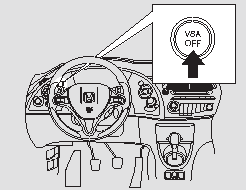
The switch is located next to the side ventilation grille on the driver's side.
Press it to turn the VSA system on or off.
The VSA OFF indicator, when lit continuously, reminds you that the Vehicle Stability Assist system has been turned off by the driver.
The VSA system turns on each time the engine is started, regardless of whether it was turned off by the driver before.
Effect of Tire Size on Vehicle Stability Assist Operation
Installing wheels and tires that are not specified for the vehicle may cause the Vehicle Stability Assist system to malfunction. When replacing tires, make sure they are the same type and size as the original tires (page 414).
When replacing summer tires with winter tires, also make sure they are the same size as the original tires supplied with the vehicle. When operating the vehicle in winter conditions, observe the same precautions as when driving a vehicle not equipped with a dynamic stability control system.
Test yourself
A quick Honda Civic quiz: every answer comes with an explanation and a link to the manual page.