Failure of gasoline engine control system components (sensors, ECM, injectors, etc.) may cause fuel supply interruptions or incorrect fuel delivery under various engine operating conditions. The following symptoms may occur:
Engine does not start or is difficult to start.
Idle speed is unstable.
Poor engine performance
If you encounter any of the above conditions, first perform a basic diagnosis, including basic engine checks (ignition system fault, incorrect engine adjustment, etc.). Then inspect the gasoline engine control system components with the GRS.MALFUNCTION INDICATOR LAMP (MIL) [OBD] The malfunction indicator lamp illuminates to notify the driver that a malfunction has occurred and the vehicle requires service. However, the MIL automatically turns off after 3 consecutive driving cycles without the same malfunction. Immediately after the ignition switch is turned ON (engine not started), the MIL illuminates continuously to indicate that the MIL is operating properly. The MIL illuminates to indicate malfunctions of the following items:
CATALYTIC CONVERTER
Fuel system
MANIFOLD ABSOLUTE PRESSURE SENSOR (MAP)
INTAKE AIR TEMPERATURE SENSOR
Engine Coolant Temperature Sensor
ETC motor module (TPS + ETC motor)
Heated oxygen sensor (upstream)
Heated oxygen sensor heater (upstream)
Heated oxygen sensor (downstream)
Heated oxygen sensor heater (downstream)
INJECTOR
misfire
CRANKSHAFT POSITION SENSOR (CKP)
CAMSHAFT POSITION SENSOR
Evaporative Emission Control System
Vehicle speed sensor
POWER SOURCE
PCM/PCM
TM coding
WITH ACCELERATION SENSOR
MIL request signal
Power level
[NO OBD] The malfunction indicator lamp illuminates to notify the driver that a malfunction has occurred and the vehicle requires service. However, the MIL automatically turns off after 3 consecutive driving cycles without the same malfunction. Immediately after the ignition switch is turned ON (engine not started), the MIL illuminates continuously to indicate that the MIL is operating properly. The MIL illuminates to indicate failures of the following items:
HEATED OXYGEN SENSOR (HO2S)
MANIFOLD ABSOLUTE PRESSURE SENSOR (MAP)
ENGINE COOLANT TEMPERATURE SENSOR (ECTS)
ETC motor module (TPS + ETC motor)
INJECTORS
ECM
[MONITOR]
After turning the ignition switch ON, make sure the warning lamp illuminates for about 5 seconds, then turns off.
If the lamp does not illuminate, check the circuit for an open circuit, a blown fuse, or a burned-out bulb.
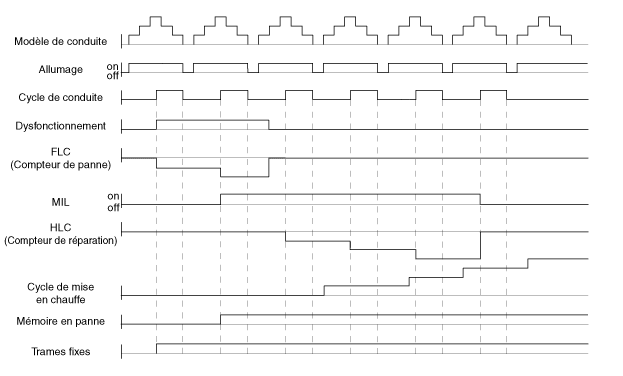
The ECM self-diagnosis monitors input/output signals (some signals continuously, others only under specific conditions). When the ECM detects a malfunction, it stores the diagnostic trouble code (DTC) for the symptom and transmits a signal over the data communication line. The diagnosis can be read using the MIL or GDS. As long as battery voltage is maintained, DTCs are stored in the ECM memory. However, DTCs are erased once the battery terminal or ECM connector is disconnected or when the GDS is used to clear them.RELATIONSHIP BETWEEN TROUBLE CODE AND DRIVING MODE IN EOBD SYSTEM
When the same malfunction is detected during two consecutive driving cycles, the MIL automatically illuminates.
The MIL automatically turns off if the malfunction is not detected during 3 consecutive driving cycles.
The diagnostic trouble code (DTC) is stored in the ECM memory when a malfunction is detected during two consecutive driving cycles. The MIL illuminates if the malfunction is detected during the second driving cycle. When a misfire is detected, the trouble code is stored and the MIL illuminates immediately after detection.
The diagnostic trouble code (DTC) is automatically erased from the ECM memory if the same malfunction is not detected during 40 warm-up cycles.
?
Test yourself
A quick Hyundai i20 quiz: every answer comes with an explanation and a link to the manual page.