Labels on the tyre sidewalls
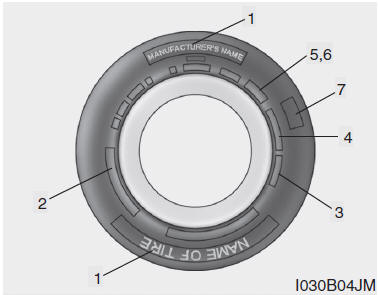
This information identifies and describes the basic characteristics of the tyre and also provides the Tyre Identification Number (TIN) for certification of safety standards. The TIN can be used to identify the tyre in the event of a recall.
1. Manufacturer's name or trademark
The manufacturer's name or brand is indicated.
2. Tyre size designation
Each tyre shows its own dimensions on the sidewall. When replacing tyres, it is necessary to know them in order to choose the correct ones. The meaning of the letters and numbers that define tyre dimensions is explained below.
Example of tyre dimensions: (These codes are given for example only and may differ from those of your vehicle.)
175/50R15 75H
175 - Tyre width in millimetres.
50 - Aspect ratio. Height of the tyre section as a percentage of its width.
R - Tyre construction code (Radial).
15 - Wheel diameter in inches.
75 - Load index, numerical code associated with the maximum load the tyre can carry.
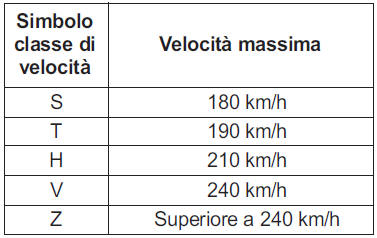
H - Speed rating symbol.
See the speed rating table for further information.
Wheel size designation Wheels are also marked with important information that is required when replacing them. The meaning of the letters and numbers that define wheel dimensions is explained below.
Example of wheel dimensions:
5,5JX15
5,5 - Wheel width in inches.
J - Wheel rim flange profile designation.
15 - Wheel diameter in inches.
Tyre speed ratings The table below lists the different speed ratings of most tyres currently used on passenger cars. The speed rating is an integral part of the tyre size marking on the sidewall. This symbol corresponds to the maximum speed at which the tyre is designed to be used safely.
3. Checking tyre service life (TIN: Tyre Identification Number)
Tyres (including the spare) with a manufacturing date older than 6 years must be replaced with new tyres. The manufacturing date can be identified on the tyre sidewall (often only on the inner side of the wheel), where the DOT code is shown. The DOT code is a tyre serial number made up of a combination of numbers and English letters. The manufacturing date is indicated by the last four digits (characters) of the DOT code.
DOT : XXXX XXXX OOOO
The first part of the DOT code indicates the plant code number, the tyre size and the tread pattern type, while the last four digits indicate the week and year of production.
Example: DOT XXXX XXXX 1616 indicates that the tyre was produced in week 16 of 2016.
WARNING - Tyre age Over time, tyres tend to deteriorate even if they are not used.Regardless of the degree of tread wear, it is generally recommended to replace tyres after six (6) years of normal service.
The ageing process can be accelerated by heat in hot climates, or by frequent heavy loading. Failure to observe this warning may result in sudden tyre failure, which could lead to loss of control of the vehicle and therefore an accident, with serious or fatal consequences.4. Tyre ply composition and materials
The information provided is the number of plies or layers of rubber-coated fabric in the tyre. In addition, tyre manufacturers are required to indicate the materials used, including steel, nylon, polyester, etc. The letter "R" indicates radial ply construction; the letter "D" indicates diagonal or bias ply construction, while the letter "B" indicates belted tyre.
5. Maximum permissible inflation pressure
This is the maximum air pressure that can be put into a tyre. Never exceed the maximum permissible inflation pressure. For the inflation pressure to be observed, refer to the tyre label.
6. Maximum load capacity
This is the maximum load in kilograms that a tyre can carry. When replacing tyres, always make sure the new ones have the same load index as the original ones.
7. Uniform Tire Quality Grading: treadwear, traction and temperature
Quality grades can be found, where applicable, on the tyre sidewall between the shoulder and the section of maximum width.
Example:
TREADWEAR 400
TRACTION A
TEMPERATURE A
Treadwear The treadwear grade is a comparative ratio based on the wear rate of the tyre when tested under controlled conditions defined by specific government test standards. For example, a tyre graded 150 wears 1.5 times as well as one graded 100 in the government-specified test.
The relative performance of tyres depends on their actual conditions of use. However, performance may differ from the norm due to variations in usage, different maintenance and different road and climate characteristics.
These grades are stamped on the sidewalls of passenger car tyres.
The tyres fitted as standard or optional equipment on this vehicle may vary in grade.
Traction - AA, A, B and C The traction grades, from highest to lowest, are AA, A, B and C.
These grades represent the tyre's ability to stop on wet pavement, measured under controlled conditions on asphalt and concrete test surfaces prescribed by government standards. A tyre marked C may have poor traction performance.
WARNING The traction grade assigned to this tyre is based on straight-line braking tests carried out at constant speed, so it does not take into account special situations such as acceleration, cornering, hydroplaning or other extreme conditions.Temperature - A, B and C The temperature grades are A (the highest), B and C. These grades represent the tyre's resistance to the generation of heat and its ability to dissipate heat when tested under specified controlled conditions in indoor laboratory tests.
High temperatures can cause the tyre material to degenerate and reduce its service life; excessive temperatures can also lead to sudden tyre failure.
Grades A and B represent the highest performance levels found in laboratory tests compared with the minimum legal requirements.
WARNING - Tyre temperature The temperature grade for a tyre refers to a tyre that is correctly inflated and not overloaded.Excessive speed, insufficient inflation pressure, or excessive load, whether occurring separately or together, may cause the temperature to rise and possibly lead to sudden tire failure. This may result in loss of vehicle control and serious injury, including fatal injury.
Test yourself
A quick Kia Picanto JA quiz: every answer comes with an explanation and a link to the manual page.