Wheel Alignment Adjustment
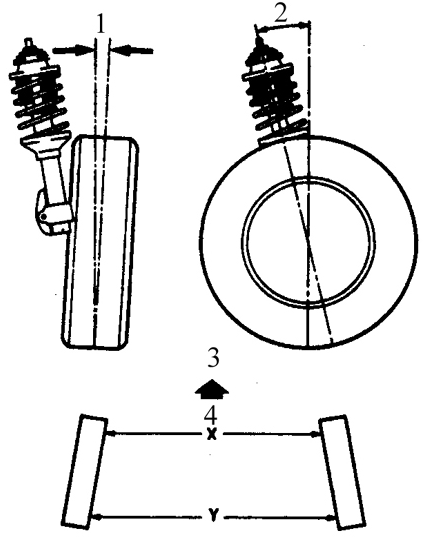
Front Wheel Camber, Caster and Toe Angles
1. Camber angle
2. Caster angle
3. Front of vehicle
4. Toe-in (Y–X)
Wheel alignment is the adjustment of the wheel alignment angles relative to the suspension and the road. If the wheels are not properly aligned, this affects vehicle handling and increases tire wear. For the front wheels, toe, camber and caster angles are usually adjusted.
Camber and toe can be adjusted on models produced from 1996. On models produced up to 1995, only toe adjustment is possible. On the rear wheels, only toe can be adjusted. The other alignment angles should be measured in order to detect bent or worn suspension components.
Toe/camber adjustment is a very precise operation. Proper wheel alignment requires complex and expensive equipment. For this reason, it is recommended that you contact a specialist for toe/camber adjustment. The following is a general description of the wheel alignment angles, so that you have a general understanding of them and can better understand this subject when you visit a repair shop.
Toe is the angle at which the wheels are turned inward. The purpose of toe adjustment is to make the wheels parallel. On a vehicle with zero toe angle, the distance between the front edges of the wheels will be the same as the distance between the rear edges of the wheels. In practice, the toe value is usually a few millimeters. On the front wheels, the toe angle is adjusted by changing the position of the tie rod ends. On the rear wheels, it is controlled by the length of the rear toe links (N2). Incorrect toe adjustment will cause abnormal tire wear by forcing the tires to scrub against the road surface.
Camber is the inclination of the wheel from vertical, when viewed from the front or rear of the vehicle. If the top of the wheel is tilted outward, camber is positive (+).
If the top of the wheel is tilted inward, camber is negative (–). The amount of inclination is measured in degrees from vertical, and this value is called the camber angle. The camber angle determines how much of the tread contacts the road. This angle is also needed to compensate for changes in suspension geometry during cornering and when driving on uneven roads. Camber is adjusted using special tools designed for camber adjustment.
Caster angle is the inclination of the steering pivot axis from vertical. Backward inclination is called positive caster, and forward inclination is called negative caster.
Test yourself
A quick Toyota Corolla quiz: every answer comes with an explanation and a link to the manual page.