The idling speed is controlled by the ETCS (Electronic Throttle Control System). The ETCS is comprised of: 1) the one valve type throttle body; 2) the throttle actuator, which operates the throttle valve; 3) the Throttle Position (TP) sensor, which detects the opening angle of the throttle valve; 4) the Accelerator Pedal Position (APP) sensor, which detects the accelerator pedal position; and 5) the ECM, which controls the ETCS. Based on the target idling speed, the ECM controls the throttle actuator to provide the proper throttle valve opening angle.
DTC No.
DTC Detection Condition
Trouble Area
P0505
Idling speed continues to vary greatly from target idling speed (2 trip detection logic)
ETCS
Intake system
PCV hose connections
EGR valve
ECM
MONITOR DESCRIPTION
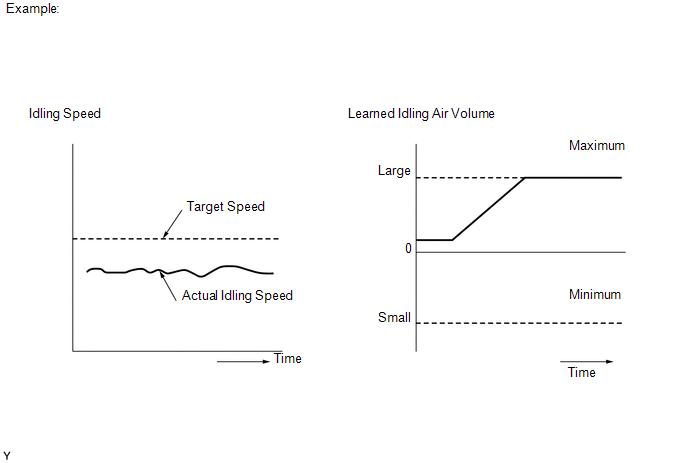
The ECM monitors the idling speed and idling air flow volume to conduct Idle Speed Control (ISC). The ECM determines that the ISC system is malfunctioning if the following conditions are met:
The difference between the target engine idling speed and actual engine idling speed exceeds the threshold and the IAC flow rate learned value is stuck at the upper or lower limit for 5 seconds or more.
After driving at a vehicle speed of 10 km/h or more, the difference between the target and actual engine idling speed exceeds the threshold 5 times or more during a driving cycle, and then the system determines that the IAC flow rate learned value is stuck at the upper or lower limit, or that the IAC flow rate learned value has been changed by an amount that exceeds the threshold.
MONITOR STRATEGY
Related DTCs
P0505: ISC function
Required Sensors/Components (Main)
ETCS
Required Sensors/Components (Related)
Crankshaft position sensor, Engine coolant temperature sensor, and Vehicle speed sensor
Less than -100 rpm, or more than 150 rpm (A/C off and NSW off)
Less than -100 rpm, or more than 200 rpm (A/C on or NSW on)
B. IAC flow rate learned value
2.48 L/sec. or less, or 11.0 L/sec. or more for 5 seconds or more
2. Both of following conditions C and D met
-
C. Frequency that both of following conditions (a) and (b) met
5 times or more
(a) Engine speed - Target engine speed
Less than -100 rpm, or more than 150 rpm (A/C off and NSW off)
Less than -100 rpm, or more than 200 rpm (A/C on or NSW on)
(b) Vehicle condition
Stopped after being driven at 10 km/h or more
D. Either condition is met
(c) or (d)
(c) IAC flow rate learned value
2.48 L/sec. or less, or 11.0 L/sec. or more
(d) Amount of change of IAC flow rate learned value
+2.86 L/sec. or more, or -4.69 L/sec. or less
CONFIRMATION DRIVING PATTERN
Connect the Techstream to the DLC3.
Turn the ignition switch to ON and turn the Techstream on.
Clear DTCs (even if no DTCs are stored, perform the clear DTC operation).
Turn the ignition switch off and wait for at least 30 seconds.
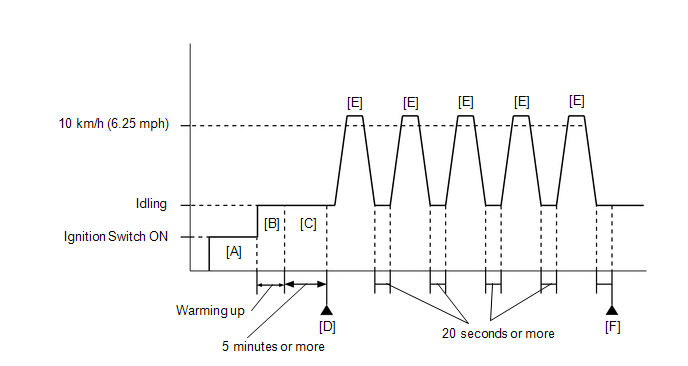
Turn the ignition switch to ON and turn the Techstream on [A].
Start the engine and warm it up until the engine coolant temperature is 75 °C or higher with all the accessories switched off [B].
Idle the engine for 5 minutes or more [C].
HINT:
In order to keep the idling stable, turn off the A/C and all other electric loads and do not perform any shift operations.
Either the following menus: Powertrain / Engine and ECT / Trouble Codes [D].
Read the pending DTCs.
HINT:
If a pending DTC is output, the system is malfunctioning.
If a pending DTC is not output, perform the following procedure.
Enter the following menus: Powertrain / Engine and ECT / Utility / All Readiness.
Input the DTC: P0505.
Check the DTC judgment result.
Techstream Display
Description
NORMAL
DTC judgment completed
System normal
ABNORMAL
DTC judgment completed
System abnormal
INCOMPLETE
DTC judgment not completed
Perform driving pattern after confirming DTC enabling conditions
N/A
Unable to perform DTC judgment
Number of DTCs which do not fulfill DTC preconditions has reached ECU memory limit
HINT:
If the judgment result shows NORMAL, the system is normal.
If the judgment result shows ABNORMAL, the system has a malfunction.
If the judgment result shows INCOMPLETE or N/A, repeat step [D] 4 times, allowing 20 seconds or more between each repetition, and then check the DTC judgment result [F].
Accelerate the vehicle to 10 km/h or more, and then idle the engine for 20 seconds or more [E].
Repeat step [E] 5 times.
Enter the following menus: Powertrain / Engine and ECT / Trouble Codes [F].
Read the pending DTCs.
HINT:
If a pending DTC is output, the system is malfunctioning.
If a pending DTC is not output, perform the following procedure.
Enter the following menus: Powertrain / Engine and ECT / Utility / All Readiness.
Input the DTC: P0505.
Check the DTC judgment result.
Techstream Display
Description
NORMAL
DTC judgment completed
System normal
ABNORMAL
DTC judgment completed
System abnormal
INCOMPLETE
DTC judgment not completed
Perform driving pattern after confirming DTC enabling conditions
N/A
Unable to perform DTC judgment
Number of DTCs which do not fulfill DTC preconditions has reached ECU memory limit
HINT:
If the judgment result shows NORMAL, the system is normal.
If the judgment result shows ABNORMAL, the system has a malfunction.
If the test result is INCOMPLETE or N/A and no pending DTC is output, perform a universal trip and check for permanent DTCs (See page ).
HINT:
If a permanent DTC is output, the system is malfunctioning.
If no permanent DTC is output, the system is normal.
HINT:
The following conditions may also cause DTC P0505 to be set:
The floor carpet overlapping slightly onto the accelerator pedal, causing the accelerator pedal to be slightly depressed and therefore the throttle valve position to be slightly open.
The accelerator pedal being not fully released.
Read freeze frame data using the Techstream. Freeze frame data records the engine condition when malfunctions are detected. When troubleshooting, freeze frame data can help determine if the vehicle was moving or stationary, if the engine was warmed up or not, if the air-fuel ratio was lean or rich, and other data from the time the malfunction occurred.
PROCEDURE
CHECK ANY OTHER DTCS OUTPUT (IN ADDITION TO DTC P0505)
(a) Connect the Techstream to the DLC3.
(b) Turn the ignition switch to ON.
(c) Turn the Techstream on.
(d) Enter the following menus: Powertrain / Engine and ECT / Trouble Codes.
(e) Read DTCs.
Result
Result
Proceed to
P0505 is output
A
P0505 and other DTCs are output
B
HINT:
If any DTCs other than P0505 are output, troubleshoot those DTCs first.
B
GO TO DTC CHART
A
CHECK PCV HOSE CONNECTIONS
(a) Check the PCV hose connections.
OK:
PCV hose is connected correctly and is not damaged.
NG
REPAIR OR REPLACE PCV HOSE
OK
CHECK INTAKE SYSTEM
(a) Check the intake system for vacuum leak (See page ).
OK:
No leak in intake system.
HINT:
Perform "Inspection After Repair" after repairing or replacing the intake system (See page ).
NG
REPAIR OR REPLACE INTAKE SYSTEM
OK
INSPECT THROTTLE WITH MOTOR BODYASSEMBLY (THROTTLE VALVE)
(a) Check for contamination between the throttle valve and housing, and check that the throttle valve moves smoothly.
OK:
Throttle valve is not contaminated with foreign objects and moves smoothly.
HINT:
Perform "Inspection After Repair" after replacing the throttle with motor body assembly (See page ).
NG
REPLACE THROTTLE WITH MOTOR BODYASSEMBLY
OK
PERFORM ACTIVE TEST USING TECHSTREAM (CONTROL THE EGR STEP POSITION)
(a) Connect the Techstream to the DLC3.
(b) Start the engine and warm it up until the engine coolant temperature reaches 75 °C or higher.
HINT:
When performing the Active Test, make sure the shift lever is in P or N.
The A/C switch and all accessory switches should be off.
(c) Turn the Techstream on.
(d) Enter the following menus: Powertrain / Engine and ECT / Active Test / Control the EGR Step Position.
(e) Confirm the Throttle Idle Position is ON and check the engine idling condition and MAP values in the Data List while performing the Active Test.
HINT:
Do not leave the EGR valve open for 10 seconds or more during the Active Test.
Be sure to return the EGR valve to step 0 when the Active Test is completed.
OK:
MAP and idling condition change in response to EGR step position as follows.
Standard:
-
EGR Step Position (Active Test)
0 Steps
0 to 30 Steps
Idling condition
Steady idling
Idling changes from steady to rough idling or engine stall
MAP
(Data List)
20 to 40 kPa (150 to 300 mmHg)
MAP value is at least +10 kPa (75 mmHg) higher than when EGR valve is fully closed
OK
GO TO STEP 7
NG
INSPECT EGR VALVE ASSEMBLY
(a) Remove the EGR valve assembly (See page ).
(b) Check if the EGR valve is stuck open.
OK:
EGR valve is tightly closed.
HINT:
Perform "Inspection After Repair" after repairing or replacing the EGR valve assembly (See page ).
NG
REPLACE EGR VALVE ASSEMBLY
OK
REPLACE ECM
(a) Replace the ECM (See page ).
NEXT
CONFIRM WHETHER MALFUNCTION HAS BEEN SUCCESSFULLY REPAIRED
(a) Connect the Techstream to the DLC3.
(b) Turn the ignition switch ON.
(c) Turn the Techstream on.
(d) Clear the DTC (See page ).
(e) Turn the ignition switch off.
(f) Turn the ignition switch ON and turn the Techstream on.
(g) Start the engine and warm it up.
(h) Drive the vehicle in accordance with the driving pattern described in the Confirmation Driving Pattern.
(i) Enter the following menus: Powertrain / Engine and ECT / Utility / All Readiness.
(j) Input the DTC: P0505.
(k) Check the DTC judgment result.
Techstream Display
Description
NORMAL
DTC judgment completed
System normal
ABNORMAL
DTC judgment completed
System abnormal
INCOMPLETE
DTC judgment not completed
Perform driving pattern after confirming DTC enabling conditions
N/A
Unable to perform DTC judgment
Number of DTCs which do not fulfill DTC preconditions has reached ECU's memory limit
 ).

