Adaptive Cruise Control ACC (cruise control)* - Function
Adaptive Cruise Control (ACC) in the Volvo S80 (2nd generation, 2013–2016) combines cruise control and distance control for greater comfort and safety. This section describes how the system works, its warnings and its interaction with the radar sensor. It also describes typical areas of use, warnings and the limitations of the system. Recommendations for use on downhill gradients or when towing a trailer support safe use.
It consists of a cruise control system and a distance-keeping function that works together with it.
Function overview
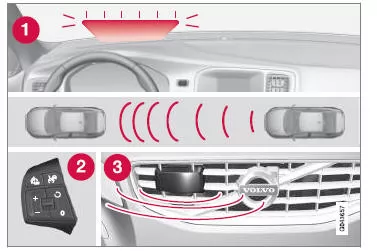
Function overview 4.
- Warning lamp - driver braking required
- Steering wheel control buttons
- Radar sensor
4 Caution! The illustration is schematic. Details may differ depending on the vehicle model.
WARNINGAdaptive cruise control is not a collision avoidance system. The driver must intervene if the system does not detect a vehicle ahead.
Adaptive cruise control does not brake for people or animals, small vehicles such as bicycles and motorcycles, low trailers or towing vehicles, oncoming vehicles, slow-moving or stationary vehicles, or objects.
Do not use adaptive cruise control in, for example, city traffic, heavy traffic, at intersections, on slippery roads, with standing water or mud on the road surface, in heavy rain or snow, in poor visibility, on winding roads, or on motorway entry and exit ramps.
The distance to the vehicle ahead is measured mainly by a radar sensor. The cruise control regulates speed by using throttle input and braking.
It is normal for the brakes to make faint noises when adaptive cruise control applies them.
WARNINGThe brake pedal moves when adaptive cruise control is braking. Do not rest your foot on the brake pedal, as it could become trapped.
Adaptive cruise control aims to follow the vehicle ahead in the same lane at a time gap set by the driver.
If the radar sensor does not detect a vehicle ahead, the vehicle instead maintains the speed set and stored by the driver. This also applies when the speed of the vehicle ahead exceeds the stored speed.
Adaptive cruise control aims to regulate speed "smoothly". In situations that require rapid braking, however, the driver must brake manually. This applies to large differences in speed or when the vehicle ahead brakes hard. Due to radar sensor limitations, the vehicle may brake unexpectedly or may not brake at all.
Adaptive Cruise Control can follow another vehicle only at speeds between 30 km/h and 200 km/h. If the speed drops below 30 km/h or the engine speed becomes too low, ACC switches to standby mode and automatic braking is deactivated. The driver must then maintain a safe distance to the vehicle ahead.
Warning lamp - driver braking required
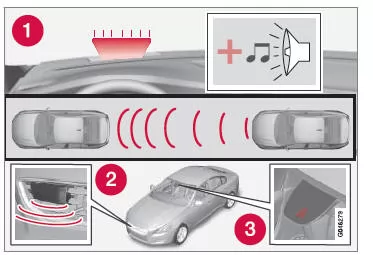
1. Warning lamp and warning tone of the Collision Warning System6.
If the vehicle needs to brake harder than ACC is able to, and the driver does not brake, ACC alerts the driver with the warning lamp and warning tone of the Collision Warning System that immediate intervention is required.
CAUTIONThe warning lamp may be difficult to see in strong sunlight or when wearing sunglasses.
WARNINGACC only warns about vehicles detected by the radar unit. A warning may therefore be late or may not occur at all. Do not wait for a warning; brake when necessary.
5 Traffic Jam Assist (p. 212) (in vehicles with automatic transmission) supports the speed range 0-200 km/h.
6 Note! The illustration is schematic. Details may vary depending on the vehicle model.
Steep grades and/or heavy loads
Please note that ACC is designed primarily for driving on level roads. It may have difficulty maintaining the correct distance to the vehicle ahead when driving on steep downhill grades, with a heavy load, or when towing a trailer. In these situations, stay especially alert and ready to brake.
Related information
- Adaptive cruise control - ACC*
- Adaptive cruise control* - Switching off
- Adaptive cruise control* - Overtaking another vehicle
Adaptive Cruise Control (ACC) in the Volvo S80 (2nd gen) combines cruise control and distance control for relaxed driving. It automatically adjusts the speed to vehicles ahead and maintains the set distance.
Thanks to the radar sensor and intelligent control, the system works precisely. The driver must still remain attentive at all times and intervene when necessary. This makes every journey safer and more comfortable.
Volvo once again demonstrates that state-of-the-art technology and the highest safety standards go together perfectly.
Test yourself
A quick Volvo S80 quiz: every answer comes with an explanation and a link to the manual page.