Adaptive Cruise Control* - Switching cruise control functions. Radar sensor. Radar sensor - Limitations. Adaptive Cruise Control* - Troubleshooting
In the Volvo S80 (2nd generation, 2013–2016), cruise control can be flexibly switched between adaptive and standard function. This section explains the operation, the symbols in the instrument cluster and the safety aspects when changing modes, so that you always keep control of speed and distance. Special attention is given to the radar sensor, how it works and its limitations. Maintenance information and guidance on malfunctions help ensure safe use of the system.
Adaptive cruise control* - Switching between cruise control functions
Switching from ACC to CC
The instrument cluster displays a symbol to indicate that cruise control is switched on:
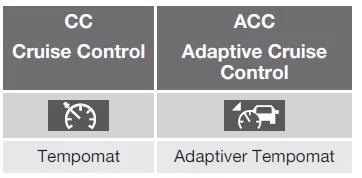
Pressing a button deactivates the adaptive part (distance control) of cruise control, after which the vehicle only maintains the stored speed.
- Press and hold the steering wheel button
 : The instrument cluster symbol changes fromto
 .
> Standard cruise control CC (Cruise Control) is now activated.
After switching from ACC to CC, the vehicle no longer brakes automatically - it only maintains the set speed.
Switching from CC to ACC
Switch off cruise control by pressing the button once or twice as described in the switch-off instructions. The next time the system is switched on, adaptive cruise control will be activated.Switch off with the -button according to the switch-off instructions. The adaptive cruise control will then be activated the next time the system is switched on.
Related information
- Adaptive cruise control - ACC*
- Adaptive Cruise Control ACC (cruise control)* - Overview
- Adaptive Cruise Control ACC (cruise control)* - Function
Radar sensor
The radar sensor's task is to detect smaller and larger vehicles traveling in the same direction and in the same lane.
The radar sensor is used for the following functions:
- Distance alert*
- Adaptive Cruise Control ACC*
- Collision warning with full auto brake and detection of cyclists and pedestrians*
If there is visible damage to the grille, or if the radar sensor may be damaged:
- Contact a workshop - a Volvo Authorized Workshop is recommended.
The function may be partially or fully unavailable, or may malfunction, if the grille, the radar sensor or its bracket is damaged or loose.
Modifying the radar sensor may make its use illegal.
Related information
- Radar sensor - Limitations
- Adaptive cruise control - ACC*
- Collision warning*
- Distance warning
Radar sensor - Limitations
A radar sensor is subject to certain limitations, including due to its restricted field of view.
The ability of adaptive cruise control to detect a vehicle ahead is significantly reduced when:
- the speed of the vehicle ahead differs considerably from your own
- the radar sensor is blocked, e.g. by heavy rain, slush or other debris in front of the radar sensor.
Keep the area in front of the radar sensor clean - see subheading "Maintenance"
Field of view
The radar sensor has a limited field of view.
In certain situations, another vehicle is not detected at all or is detected later than expected.
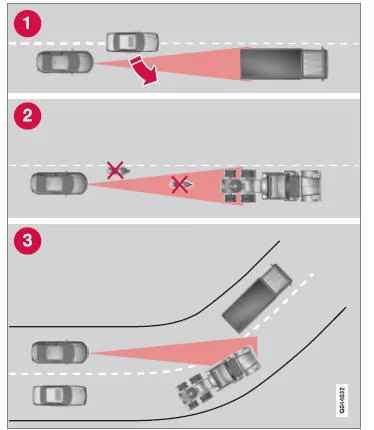
ACC field of view
- The radar sensor may detect vehicles at short range late, e.g. a vehicle that cuts in between your vehicle and a vehicle ahead.
- Small vehicles, such as motorcycles or vehicles that do not drive in the center of the lane, may not be detected.
- On curves, the radar sensor may detect the wrong vehicles or lose sight of a detected vehicle.
The driver must always monitor traffic conditions and intervene if adaptive cruise control does not maintain the appropriate speed or distance.
Adaptive cruise control cannot cope with all traffic, weather and road conditions.
Adaptive cruise control has certain limitations of which the driver must be aware. Read all relevant sections of the owner's manual before use.
The driver is always responsible for maintaining the correct distance and speed, even when adaptive cruise control is in use.
WARNINGAccessories or other items, such as auxiliary headlights, must not be mounted in front of the grille.
WARNINGAdaptive cruise control is not a collision avoidance system. The driver must intervene if the system does not detect a vehicle ahead.
Adaptive cruise control does not brake for people or animals, small vehicles such as bicycles and motorcycles, oncoming, slow-moving or stationary vehicles and objects.
Do not use adaptive cruise control in, for example, city traffic, heavy traffic, at intersections, on slippery roads, with standing water or mud on the road surface, in heavy rain or snow, in poor visibility, on winding roads, or on motorway entry and exit ramps.
Related information
- Adaptive cruise control - ACC*
- Collision warning*
- Distance warning
Adaptive cruise control* - Troubleshooting
If the message Radar blocked See manual appears in the instrument cluster, the radar sensor of adaptive cruise control cannot detect vehicles ahead.
This message means that neither the distance alert nor the collision warning with auto brake is functioning.
The following table shows examples of possible causes for the message and suitable measures:
| Cause | Action |
| The radar surface in the grille is dirty or covered with ice or snow. | Remove dirt, ice and snow from the radar surface in the grille. |
| Heavy rain or snow blocks the radar signals. | No action required. The radar sometimes does not function in heavy precipitation. |
| Water or snow is thrown up from the road surface and blocks the radar signals. | No action required. The radar sometimes does not function on wet or snow-covered roads. |
| The radar surface has been cleaned, but the message is still displayed. | Wait briefly. It may take several minutes for the radar to detect that it is no longer blocked. |
Related information
- Adaptive Cruise Control ACC (cruise control)* - Overview
- Adaptive Cruise Control ACC (cruise control)* - Function
- Adaptive Cruise Control ACC (cruise control)* - Symbols and messages
The adaptive cruise control (ACC) in the Volvo S80 (2nd gen) lets you switch between ACC and conventional cruise control (CC) for flexible driving. The radar sensor detects vehicles in the same lane and maintains the set distance as long as conditions are optimal.
Observe the limitations of the system, especially in heavy rain or snow, or when the radar sensor is covered. Cleaning the sensor regularly ensures that the system works reliably.
Volvo combines state-of-the-art technology with the highest safety standards and gives the driver clear information on using cruise control safely.
Test yourself
A quick Volvo S80 quiz: every answer comes with an explanation and a link to the manual page.