Collision warning* - Function. Collision warning* - Cyclist detection. Collision warning* - Pedestrian detection
The collision warning system in the Volvo S80 (2nd generation, 2013–2016) combines warnings and automatic braking to avoid collisions or reduce their severity. This section explains how the system works in three stages and how it interacts with other driver assistance systems. Special notes cover cyclist and pedestrian detection, the limitations of the sensors and the driver's responsibility. This supports the safe use of the system.
Collision warning* - Function
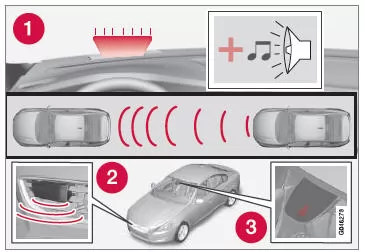
Function overview18.
- Audio-visual warning signal when there is a risk of collision.
- Radar sensor19
- Camera Sensor
The collision warning system with automatic braking performs three steps in the following order:
- Collision warning
- Brake support19
- Automatic braking19
Collision warning and City Safety complement each other.
1 - Collision warning
First, the driver is warned of an imminent collision.
The collision warning system can detect pedestrians, cyclists and vehicles that are standing still or moving in the same direction as the own vehicle.
If there is a risk of collision with a pedestrian, cyclist or vehicle, the driver is alerted by a flashing red warning signal and an audible signal (1).
2 - Brake support19
If the risk of collision continues to increase after the collision warning, brake support is activated.
This means the brake system is prepared for rapid braking by applying the brakes lightly, which may be felt as a slight jolt.
If the brake pedal is pressed quickly enough, braking is carried out with full braking force.
Brake support increases the braking force if the system determines that the driver's braking maneuver is not sufficient to prevent a collision.
3 - Automatic braking19
During the last step, the automatic braking function is activated.
If the driver has not yet initiated an evasive maneuver in this situation and a collision is unavoidable, the automatic braking function takes effect, regardless of whether the driver is braking or not. The vehicle is then braked with full braking force to reduce the impact speed - or it is braked with limited braking force if this is sufficient to avoid a collision. For cyclists, the warning and full braking intervention may occur very late or not at all.
18 Caution! The illustration is schematic - details may vary depending on the vehicle model.
19 Only with Level 2 system.
WARNINGThe collision warning system does not work in all driving situations, nor in all traffic, weather and road conditions.
The collision warning system does not react to vehicles or bicycles traveling in a different direction than your own vehicle, nor to animals.
The warning is only activated when there is a high risk of collision. This section "Function" and the section "Limitations" describe limitations that the driver must be aware of before using the collision warning with automatic braking.
Warnings and braking maneuvers for pedestrians and cyclists are switched off at speeds above 80 km/h.
Warnings and braking maneuvers for pedestrians and cyclists do not work in darkness or in tunnels - even when street lighting is switched on.
The automatic braking function can prevent a collision or reduce the impact speed. To ensure full braking force, the driver should always also apply the brake - even if the vehicle's automatic braking is braking.
Never wait for a collision warning! The driver is always responsible for maintaining the correct distance and the correct speed - including when using the collision warning system with automatic braking.
Related information
- Collision warning system
Collision warning* - Cyclist detection
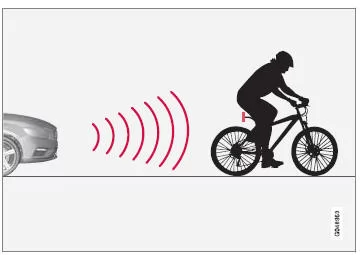
The function only "detects" cyclists traveling in the same direction, i.e., from behind.
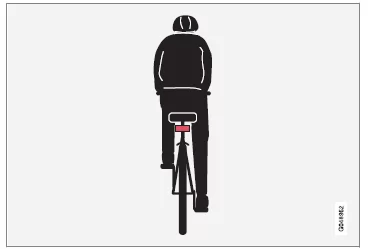
Example of a cyclist that the system can detect optimally - clear body and bicycle outline, seen directly from behind and in the centerline of the vehicle.
For optimal system performance, the system function that detects a cyclist must receive as clear information about the body and bicycle outline as possible - this means the system must be able to identify the bicycle, head, arms, shoulders, legs, upper and lower body, and a normal human movement pattern.
If large parts of the body or bicycle are not visible to the camera, the system cannot detect the cyclist.
- For the function to detect a cyclist, the cyclist must be an adult and sitting on an adult bicycle.
- The bicycle must be fitted with a clearly visible and approved21 red rear reflector mounted at least 70 cm above the road.
- The function can only detect cyclists from behind and traveling in the same direction - not diagonally from behind, not from the side.
- Cyclists traveling in an imaginary extension of the left or right side line of the vehicle may be detected late or not at all.
- The function's ability to detect cyclists at dawn and dusk is limited - just as it is for the human eye.
- The function's ability to detect cyclists is switched off when driving in the dark and in tunnels - even when street lighting is switched on.
- Cyclist detection works best when the City Safety function is activated, see City Safety
The collision warning with automatic braking & cyclist detection serves only as an aid.
What the function does not detect:
- All cyclists in all situations, e.g., cyclists who are partially hidden.
- Cyclists approaching from the side or wearing loose clothing that hides body contours.
- Bicycles without a red rear reflector.
- Bicycles loaded with large objects.
The driver is always responsible for ensuring that the vehicle is driven correctly and with a safe following distance adapted to the speed.
Related information
- Collision warning system
21 The reflector must meet the recommendations and requirements of the responsible traffic authority.
Collision warning* - Pedestrian detection

Examples of pedestrians that the system detects as having clear body outlines.
For optimal system performance, the system function that detects pedestrians must receive as clear information about the body outline as possible - this means the system must be able to identify the head, arms, shoulders, legs, upper and lower body, and a normal human movement pattern.
If large parts of the body are not visible to the camera, the system cannot detect a pedestrian.
- For a pedestrian to be detected, they must be fully visible and at least 80 cm
tall. - The camera sensor's ability to see pedestrians at dawn and dusk is limited - just as it is for the human eye.
- The camera sensor's ability to detect pedestrians is switched off when driving in the dark and in tunnels - even when street lighting is switched on.
The "Collision warning with automatic braking and pedestrian and cyclist detection" serves only as an aid. The function does not detect all pedestrians in all situations and does not detect, for example:
- Partially hidden pedestrians, persons wearing clothing that does not reveal body contours, or persons under 80 cm tall.
- Pedestrians carrying large objects.
The driver is always responsible for ensuring that the vehicle is driven correctly and with a safe following distance adapted to the speed.
Related information
- Collision warning system
The Collision Warning with Auto Brake on the Volvo S80 (2nd gen) works in several stages: warning, brake assistance and automatic braking. These functions help avoid a collision or reduce the impact speed if the driver does not react in time.
The system detects vehicles, pedestrians and cyclists traveling in the same direction, but it does not work in all weather and lighting conditions. Drivers should know these limits and always remain attentive.
FAQ
How does Auto Brake assist?
It brakes with full or sufficient force when a collision appears unavoidable and the driver does not intervene.
When does cyclist detection work?
Only for cyclists approaching from behind with a clearly visible outline and a reflective rear reflector.
Test yourself
A quick Volvo S80 quiz: every answer comes with an explanation and a link to the manual page.