Adaptive Cruise Control ACC (cruise control)* - Traffic Jam Assist
Queue Assist in the Volvo S80 (2nd generation, 2013–2016) extends ACC for stop-and-go traffic and operates at low speeds too. This section describes functions such as automatic restart and application of the parking brake after a longer standstill. It also explains situations in which the driver must intervene themselves, such as when stationary vehicles are detected at higher speeds. Notes on safe use complete the information.
Queue Assist is an extended function of the adaptive cruise control and operates at speeds below 30 km/h.
In vehicles with automatic transmission, the adaptive cruise control is supplemented by the Queue Assist function (also referred to as "Queue Assist").
Queue Assist has the following functions:
- Extended speed range - also below 30 km/h and at standstill
- Target change
- Deactivation of automatic braking at standstill
- Automatic parking brake application.
Please note that the lowest programmable speed for the adaptive cruise control (ACC) is 30 km/h. Although it can follow another vehicle down to a standstill, a speed lower than 30 km/h cannot be selected.
Extended speed range
CAUTIONFor the adaptive cruise control to be switched on, the driver's door must be closed and the driver must have fastened the seat belt.
With automatic transmission, the adaptive cruise control can follow another vehicle in the speed range 0–200 km/h.
CAUTIONAt speeds below 30 km/h, the adaptive cruise control can only be switched on when a vehicle is driving ahead at an appropriate distance.
During brief stops in stop-and-go traffic or at traffic lights, driving resumes automatically if the vehicle has been stopped for no longer than approx. 3 seconds. If the vehicle ahead takes longer to start moving again, the adaptive cruise control (ACC) switches off and changes to standby mode with automatic braking.
The driver must then reactivate it as follows:
- Using the steering wheel button
 press.
or
- Press the accelerator pedal fully down.
> The adaptive cruise control then follows the vehicle ahead again.
The Queue Assist function holds the vehicle at standstill for a maximum of 4 minutes. After that, the parking brake is applied and the adaptive cruise control is switched off.
- Before the adaptive cruise control can be switched on again, you must release the parking brake.
Target change
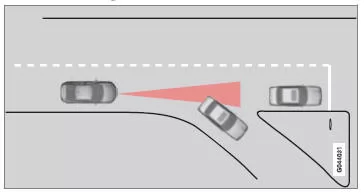
If the target vehicle ahead suddenly turns off, there may be a stationary vehicle further ahead.
If the adaptive cruise control is following another vehicle at speeds below 30 km/h and the target changes from a moving vehicle to a stationary vehicle, the adaptive cruise control brakes for the stationary vehicle.
WARNINGIf the adaptive cruise control is following another vehicle at speeds above 30 km/h and the target changes from a moving vehicle to a stationary vehicle, the adaptive cruise control ignores the stationary vehicle and instead selects the stored speed.
- The driver must intervene and brake.
Automatic standby mode on target change
The adaptive cruise control switches off and changes to standby mode:
- when the speed falls below 5 km/h and the adaptive cruise control is uncertain whether the target object is a stationary vehicle or another object, e.g. a road speed bump.
- when the speed falls below 5 km/h and the vehicle ahead turns off, so that the adaptive cruise control no longer has a vehicle to follow.
Cancellation of automatic braking at standstill
In certain situations, Queue Assist cancels the automatic braking at standstill. This means the brakes are released and the vehicle may roll - the driver must therefore brake themselves to hold the vehicle.
In the following situations, Queue Assist releases the automatic brake hold and switches the adaptive cruise control to standby mode:
- the driver places their foot on the brake pedal
- the parking brake is applied
- the selector lever is moved to position P, N or R
- the driver places the adaptive cruise control (ACC) in standby mode.
Automatic parking brake application
In certain situations, Queue Assist applies the parking brake to keep the vehicle stationary.
This occurs when:
- the driver opens the door or unfastens the seat belt
- ESC is switched from Normal to Sport mode
- Queue Assist has held the vehicle stationary for more than 4 minutes
- the engine is switched off
- the brakes have overheated.
Related information
- Adaptive cruise control - ACC*
- Adaptive Cruise Control ACC (cruise control)* - Overview
- Adaptive Cruise Control ACC (cruise control)* - Function
Queue Assist in the Volvo S80 (2nd gen) extends the functions of ACC and provides comfort and safety, even at low speeds and when stationary. The vehicle follows traffic automatically and supports the driver in stop-and-go situations.
Particularly useful functions include automatic restart after short stops and automatic application of the parking brake during longer standstill periods. This allows the driver to stay relaxed even in traffic jams.
Volvo clearly demonstrates how modern driver assistance systems can enhance driving comfort, even in demanding traffic situations.
Test yourself
A quick Volvo S80 quiz: every answer comes with an explanation and a link to the manual page.