Brake Hydraulic System Repair
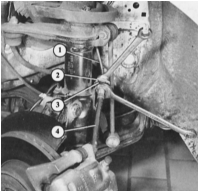
If the brake line (1) and brake hoses (4) with stamped fasteners (3) are connected to chassis components or the body, the spring hose retainer (2) must not be missing. In the illustration, the connection is loosened with a 14 mm open-end wrench and the brake line wrench (top).
Brake fluid is aggressive toward the body paint finish. Therefore, do not place rags soaked in brake fluid or tools contaminated with brake fluid on body panels.
When removing a brake hose or brake line from the master cylinder, brake fluid will gradually leak out. You can prevent this as follows: before removing the bolted connections, loosen the bleeder screw in the corresponding circuit.
Attach a hose to it and direct it into a container. Now fully depress the brake pedal and secure it in this position with a suitable wooden block. This closes the outlets in the brake master cylinder, and brake fluid no longer flows out.
To remove and install the brake line, you will need the brake line wrench shown in the illustration below. You will also need a 14 mm open-end wrench to hold the brake hoses.
After repairing the brake hydraulic system, it must be bled. It is often sufficient to bleed only the brake circuit in which the work was performed.
Removing the Brake Line
PROCEDURE
Unscrew the brake line fitting. To do this, hold the opposite nut of the connection, for example on the brake hose.
If the nut has seized to the tube so that the tube turns with the nut, the tube must be replaced. Thin-walled tubes break easily.
If the corresponding section of tube must be replaced, the following method can be used to loosen the line connections:
Saw through the brake line near the bolted connection, then unscrew the union nut with a hex wrench.
Insert the brake line into the clips.
Bleed the brake system.
Removing the Brake Hoses
PROCEDURE
First unscrew the fitting of the corresponding brake line. Make sure the line does not twist.
If the brake hose is secured to the body with a stamped bracket, it is protected against slipping by a sheet-metal clip. During assembly, be sure to install this so-called hose retainer.
When installing the hose, first tighten it on the end that has the external thread.
Then tighten the other connection.
The brake hose must not be twisted. A colored stripe or rubber bead serves as a check.
Bleed the brake system.
Immediately after the repair, check that the hose does not rub against anything during spring movements.
Repeat this check after a relatively long drive.
Test yourself
A quick Audi 80 quiz: every answer comes with an explanation and a link to the manual page.