Tunnel detection*. High/low beam. Automatic high beam*
The Volvo S80 (2nd generation, 2013–2016) is equipped with modern lighting systems that adapt automatically to changing light conditions. For example, tunnel detection automatically switches from daytime running lights to low beam when entering a tunnel, improving visibility and safety. This section also explains the functions of high beam, flash-to-pass and automatic high beam (AHB). It describes how the system works, when it should be overridden manually and which safety aspects must be observed when using it, especially in difficult weather conditions.
Tunnel detection*
Tunnel detection switches the lighting from daytime running lights to low beam when the vehicle enters a tunnel. About 20 seconds after the vehicle has left the tunnel, the system switches back to daytime running lights.
The tunnel detection function is available in vehicles with a rain sensor*. The sensor detects a tunnel entrance and switches the lighting from daytime running lights to low beam. About 20 seconds after the vehicle has left the tunnel, the system switches back to daytime running lights. If the vehicle enters another tunnel within this time, the low beam remains on. This prevents excessive lighting changes.
Note that for tunnel detection to work, the light switch rotary control must be in position .
Related information
- High/low beam
- Switch panel lighting
High/low beam
In the rotary control position  of the light switch, and with the vehicle electrical system in ignition position II or with the engine running, the low beam is activated automatically in poor light conditions.
In rotary control position of the light switch, the low beam is always on when the engine is running or when ignition position II is active.

Steering column lever and light switch rotary control.
 Flash-to-pass position
 High beam position
Low beam
In rotary control position the low beam is switched on automatically at dusk or when daylight is too weak.
The low beam is also switched on automatically when the windshield wipers or the rear fog light are activated.
In rotary control position the low beam is always on when the engine is running or when ignition position II is active.
Headlight Flash
Pull the steering column lever slightly towards the steering wheel into the flash-to-pass position. The high beam stays on until the lever is released.
High beam
High beam can be activated when the rotary control is in position18 oris set. Activate/deactivate high beam.
To do so, move the steering column lever towards the steering wheel to the end position and release it.
When high beam is activated, the symbol lights up in the instrument cluster.
Auxiliary lighting*
If the vehicle has auxiliary headlights, the driver can set in the MY CAR menu system whether they are deactivated or switched on and off together with the high beam19. See MY CAR.
Related information
- Active xenon headlights*
- Automatic high beam*
- Switch panel lighting
- Headlights - adjust light pattern
- Tunnel detection*
18 When low beam is switched on.
19 Additional headlights must be connected to the electrical system by a workshop. Volvo recommends that you contact a Volvo authorized dealer.
Automatic high beam*
The Automatic High Beam function detects the headlights of oncoming vehicles and the taillights of vehicles ahead, and switches the lights from high beam to low beam. The high beam switches back on when the detected light is no longer present.
Automatic High Beam - AHB
The Automatic High Beam (Active High Beam, AHB) function uses a camera sensor at the upper edge of the windshield to detect the headlights of oncoming vehicles and the taillights of vehicles ahead, and then switches from high beam to low beam. The function can also take street lighting into account.
About one second after the camera sensor no longer detects the headlights of oncoming traffic or the taillights of vehicles ahead, the lights switch back to high beam.
Activation/Deactivation
AHB can be activated when the light switch rotary control is set to(unless the function has been deactivated in the MY CAR menu system; see MY CAR).
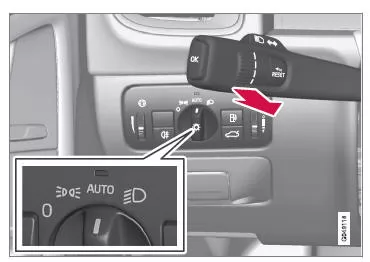
Steering column lever and light switch rotary control in position AUTO.
The function can be activated in darkness and at vehicle speeds from 20 km/h.
Activate/deactivate AHB by moving the left steering column lever toward the steering wheel to its end position and releasing it. Deactivating while high beam is on causes the lights to switch directly to low beam.
Vehicle with analog instrument cluster
When AHB is activated, the symbol lights up in the information display of the instrument cluster.
When high beam is on, the symbol also lights uplights up in the instrument cluster.
Vehicle with digital instrument cluster
When AHB is activated, the symbolin the information display of the instrument cluster with a white glow.
When high beam is on, the symbol lights up with a blue glow.
Manual operation
CAUTIONKeep the area of the windshield in front of the camera sensor free of ice, snow, condensation and dirt.
Nothing may be stuck or mounted on the windshield in front of the camera sensor, as this could impair or prevent the function of one or more systems that depend on the camera.
If the message Active high beam temporarily unavailable switch manually appears in the instrument cluster information display, the switch between high and low beam must be made manually. The light switch rotary control may still be in positionThe same applies if the message Windshield sensors disturbed. See manual and the symbol appear. The symbolgoes out when these messages appear.
AHB may be temporarily unavailable, for example in situations with dense fog or heavy rain. When AHB is available again, or the windshield sensors are no longer blocked, the message goes out automatically and the symbollights up.
AHB is an aid that allows the optimal light setting to be used in favorable conditions.
The driver is always responsible for switching manually between low beam and high beam whenever traffic or weather conditions require it.
IMPORTANTExample situations in which manual switching between high beam and low beam may be required:
- Heavy rain or dense fog
- In freezing wet conditions
- Snow flurries or slush
- Moonlight
- Driving through poorly lit towns
- Insufficient lighting of road users ahead
- Pedestrians on or beside the road
- Highly reflective objects, such as road signs close to the road
- Oncoming traffic lights obscured by, e.g., road barriers
- Traffic on merging roads
- On inclines or declines
- On tight curves.
For more information on the limitations of the camera sensor, see Collision Warning* - Limitations of the camera sensor.
Related information
- High/low beam
- Switch panel lighting
The tunnel detection and automatic high beam of the Volvo S80 (2nd gen) underline the high technical standard of this sedan. Both systems intelligently adapt the lighting to the surroundings and support the driver in different light conditions.
This allows you to enjoy a safe and relaxed driving experience even in darkness or difficult visibility conditions. These well-thought-out functions show how Volvo combines safety and comfort at the highest level.
FAQ
When does tunnel detection switch the lights?
Tunnel detection automatically switches from daytime running lights to low beam when entering a tunnel, and back after the tunnel has been left.
How does automatic high beam work?
It detects light sources from other vehicles and automatically switches from high beam to low beam to avoid glare.
Test yourself
A quick Volvo S80 quiz: every answer comes with an explanation and a link to the manual page.