Changing and balancing wheels
When changing wheels, it is not advisable to reverse the rotation direction of the tires, as the tires only adapt to the changed direction with temporarily greater wear. Some tires have a direction of travel specified by an arrow on the sidewall. This direction of travel must always be observed.
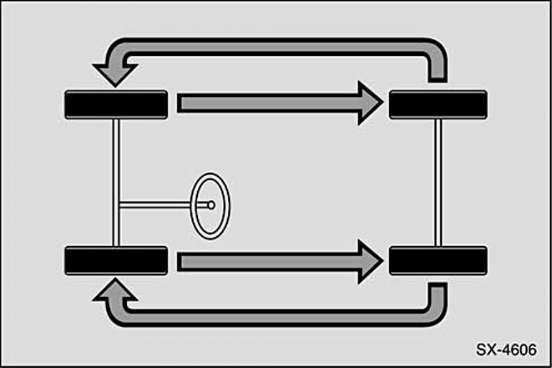
If the front tires are noticeably more worn, it is advisable to swap the front wheels with the rear wheels.
This way, all 4 tires have approximately the same service life.
Do not replace tires individually; replace them at least per axle.
Always fit the tires with the greater tread depth at the rear.
Note: for safety reasons, always replace the rubber valve when renewing or removing tubeless tires.
Before removal, mark the wheel and wheel hub with chalk -1- so that the wheel can be refitted in the same position.
Loosen the wheel bolts while the vehicle is on the ground. Apply the parking brake or engage 1st gear so the vehicle cannot roll away.
To protect against the wheel seizing, lightly grease the centering seat of the wheel disc on the front and rear wheel hubs with rolling bearing grease each time the respective wheel is removed.
Clean dirty bolts and threads. Lightly grease the conical seat of the wheel bolts with rolling bearing grease.
Do not grease or oil the threads of the wheel bolts.
Tighten the wheel bolts crosswise in several passes. Always use a torque wrench to tighten the wheel bolts. This ensures the wheel bolts are tightened evenly. The tightening torque for all wheel bolts is 90 N·m.
Standard wheels are balanced at the factory.
Balancing is necessary to compensate for uneven weight distribution and material inaccuracies.
While driving, an imbalance shows up as vibration and shimmy. At higher speeds, the steering wheel begins to shake.
This shaking usually occurs only within a certain speed range and disappears again at lower and higher speeds.
Such imbalance vibrations can eventually cause damage to the wheel bearings, steering gear and shock absorbers.
Balance the wheels after every tyre repair, as wear and repair change the weight and material distribution of the tyre.
Test yourself
A quick Fiat Bravo quiz: every answer comes with an explanation and a link to the manual page.