Check brake pad thickness
Mark the wheel to the wheel rim with paint so that the balanced wheel can be refitted in the same position. Loosen the wheel bolts.
Raise the vehicle and remove the wheels.
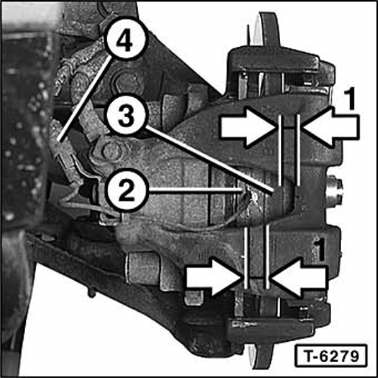
Remove the front or rear wheels. Visually check the thickness of the brake pads - 1 - , without the metal backing plate - 2 - , from above through the caliper housing. 3 - Brake disc.
If in doubt, remove the brake pads and measure the pad thickness with a vernier caliper.
The wear limit of the disc brake pads has been reached when the friction material is only 1.5 mm thick.
Note: as a rule of thumb, 1 mm of brake pad corresponds to a mileage of at least 1000 km. This rule of thumb applies under unfavourable conditions.
Under normal conditions the pads last much longer. With a disc brake pad thickness of 5.0 mm (without backing plate), the remaining service life of the brake pads is therefore still at least 3500 km.
Visually check the wear sensor cable for damage; the plug connection - 4 - for the cable must be latched in place.

Remove the rear wheels. On vehicles with brake shoes on the rear brakes, there is a hole in the brake drums for checking the brake lining thickness. Shine a lamp into the opening.
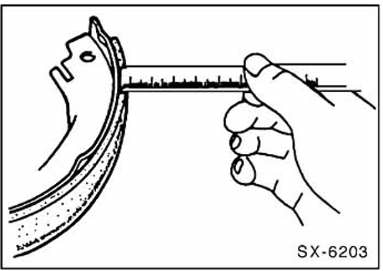
If in doubt, remove the brake drum and measure the brake lining thickness.
The wear limit has been reached when the brake lining is 1.5 mm thick at its thinnest point.
When the wear limit is reached, replace the brake pads. As a rule, always replace all pads on one axle.
Position the wheels so that the marks made during removal line up. Do not grease or oil the wheel bolts. Fit the wheels.
Lower the vehicle and tighten the wheel bolts crosswise to 90 N·m.
Test yourself
A quick Fiat Bravo quiz: every answer comes with an explanation and a link to the manual page.