Replacing brake fluid
Special tools required:
Ring spanner for bleed screws.
Wear part required:
About 0.7 litres of new brake fluid of specification DOT 4 or "Tutela Top 4 270 C" from Fiat.
Brake fluid absorbs atmospheric moisture through the pores of the brake hoses and through the reservoir vent opening. As a result, the boiling point of the brake fluid drops over the operating life of the vehicle. Under heavy brake use, vapour bubbles can then form in the brake lines, which seriously impairs the function of the braking system.
The brake fluid should be replaced every 2 years, preferably in spring.Observe the precautions when handling brake fluid, see page 183.
Use a suction bottle to draw brake fluid out of the brake fluid reservoir down to a level of approx. 10 mm.
Fill the reservoir completely with new brake fluid.
Bleeding sequence: start with a front brake caliper, then bleed the diagonally opposite rear wheel cylinder. Repeat on the other side of the vehicle.
Push a clean hose onto the bleed valve of the 1st wheel cylinder and place a suitable container underneath; see also the illustrations in the chapter "Bleeding the brake system", page 184.
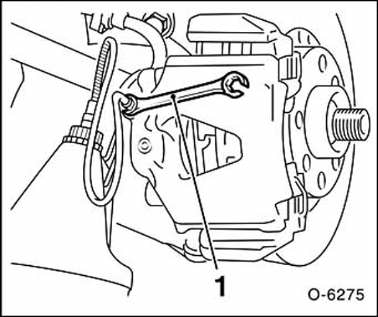
Have an assistant depress the brake pedal several times until resistance builds up. Keep the brake pedal depressed, open the bleed valve with the ring spanner - 1 - at the same time and let the brake fluid flow out through the clear hose. Close the bleed valve when the pedal reaches the floor pan, then let the foot come off the pedal.
Repeat this procedure (approx. 10 times) until only new brake fluid comes out.
New brake fluid can be recognized by its lighter color.
Carefully close the bleeder valve, fit the dust cap, and top up the reservoir with new brake fluid.
Pump out the old brake fluid from the other wheel brake cylinders in the same way. Observe the sequence.
Take old brake fluid to a local hazardous waste disposal site.
Warning: never store old brake fluid in drinking containers, and keep it out of reach of children. Risk of poisoning.
Are the bleeder screws tightened?
Is there enough brake fluid in the reservoir?
With the engine running, check for leaks. To do this, depress the brake pedal with 200 to 300 N (equivalent to 20 to 30 kg) for approx. 10 sec.
The brake pedal must not give way.
Check all connections for leaks.
Then carry out several braking tests on a road with light traffic.
Test yourself
A quick Fiat Bravo quiz: every answer comes with an explanation and a link to the manual page.