Engine Oil Change
The following special tool is required for the engine oil change:
If oil is not extracted: a pit or a hydraulic workshop jack with support stands.
A special tool for loosening the oil filter (oil filter wrench, strap wrench or Hazet tool 2172).
An oil drain pan with a capacity of at least 5 litres (only if oil is not extracted).
Only if oil is not extracted: aluminium or copper sealing washer for the oil drain plug (sometimes supplied with the oil filter).
Oil filter cartridge.
Depending on engine, 3.8 to 5.0 litres of engine oil.
Use only engine oil approved by Fiat, see page 65.
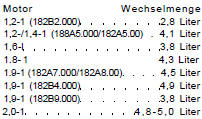
The quantity difference between the MIN and MAX marks on the dipstick is approx. 1 litre.
Change engine oil every 10,000 km on diesel engines and every 20,000 km on petrol engines. If the vehicle is driven very little, change the oil once a year.
The filter cartridge is replaced at the same time.
Under severe operating conditions such as short-distance driving, frequent cold starts and dusty roads, engine oil and oil filter should be changed at shorter intervals.
Caution: used oil, oil filters and oil-soaked rags must in all cases be taken to used oil collection points. Oil retailers accept the corresponding quantity of used oil free of charge, so keep the receipt and oil container for later used oil return! In addition, municipal authorities can tell you where the nearest used oil collection point is.
Under no circumstances may used oil and oil filters simply be poured away or disposed of with household waste. Otherwise serious environmental damage, such as contamination of groundwater, is unavoidable. Drain engine oilBring engine to operating temperature (oil temperature +60 °C); this requires driving approximately 10 km.
Raise vehicle level on a jack.
Remove oil filler cap from top of engine.
Place a container under the oil pan to catch the used oil.
1.8 / 2.0 l petrol engine and diesel engine: remove cover below oil pan from engine underbody shield.

Drain plug - 1 - Unscrew from the underside of the oil pan and drain all old oil. 2 - Oil filter.
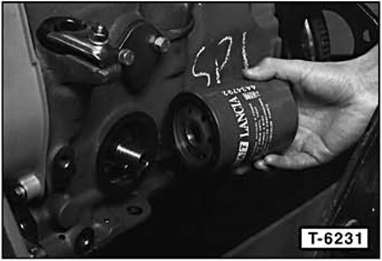
Remove the oil filter. The oil filter is located at the front of the engine block; the illustration shows the 1.6 L engine. On other engines the filter is mounted on a separate flange. A special tool is available for loosening it, for example Hazet 2172, or a strap wrench.
A pointed drift can also be driven into the side of the oil filter; however, oil will then run out, so place a container underneath.
Wipe the oil filter sealing surface on the flange with a rag. Remove any remaining filter gasket.
Lightly coat the rubber sealing ring of the new oil filter with engine oil. Observe any notes printed on the oil filter.
Screw on the new oil filter by hand only.
Once the filter gasket contacts the engine block, tighten the filter a further at least 1/2 turn.
Install the drain plug with a new sealing ring, tighten firmly but do not overtighten. Tightening torque: 25 N·m; 1.6 L engine only: 50 N·m.
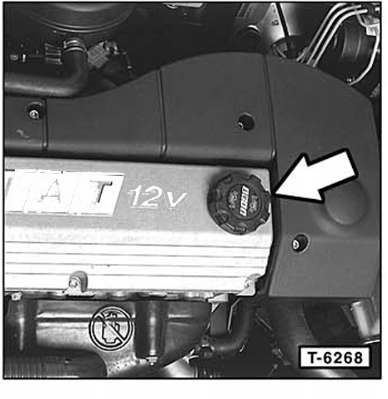
Pour in the quantity of new oil specified for the model at the filler neck of the cylinder head cover (arrow).
Reinstall the cap.
The illustration shows the 1.4 L engine.
Caution: Overfilling engine oil will damage the catalytic converter.
Start the engine and let it run until the oil pressure warning lamp goes out (approx. 5 seconds).
Switch off the engine.
After waiting 5 minutes, check the oil level with the dipstick.
After a test drive, check the drain plug and oil filter for leaks, and retighten carefully if necessary.
1.8/2.0 L petrol engine and diesel engine: Fit the cover below the oil pan into the engine undertray.
Switch off the engine at operating temperature and check the oil level again after approx. 2 minutes; correct if necessary.
To better monitor the operating conditions of the engine, always use oil of the same type and, if possible, the same brand at each oil change.
It is therefore advisable to attach a information label to the engine at every oil change, showing the brand and viscosity of the oil.
Indiscriminately alternating between different oil types is unfavorable.
Engine oils of the same type but different brands should preferably not be mixed. Engine oils of the same type and brand but different viscosity may be topped up without problems if needed during seasonal changeover.
Test yourself
A quick Fiat Bravo quiz: every answer comes with an explanation and a link to the manual page.