Cylinder Compression Pressure Test
The results of the cylinder compression pressure test allow the general condition of the upper engine components (pistons, piston rings, valves, cylinder head gasket, etc.) to be determined and their degree of wear to be assessed qualitatively. Importantly, analysis of the information obtained from the test allows the range of possible causes of low compression to be narrowed, pinpointing the fault to malfunctions of specific components, be it piston rings, valves, their seats, or the head gasket.
PROCEDURE
The engine must be warmed up to normal operating temperature, and the battery must be fully charged.
1. Begin by cleaning the spark plug wells (blow them out with compressed air; an ordinary bicycle pump works well as the air source in this case). The main objective is to prevent debris from entering the cylinders during the measurements.
2. Remove all spark plugs from the engine (see Chapter Tune-Up and Routine Maintenance).
3. Hold the throttle valve in the fully open position.
4. Disconnect the high-tension lead of the ignition coil from its terminal on the distributor cap and ground it to the engine block (use a jumper wire with alligator clips). The fuel pump circuit must also be disabled (see Chapter Fuel and Exhaust Systems).
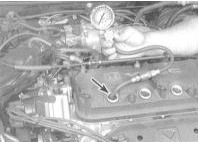
5. Install the compression gauge into the spark plug hole of the first cylinder.
6. Crank the engine for at least seven strokes and read the gauge. On a serviceable engine, pressure should build up fairly quickly. Low pressure on the first stroke, followed by a gradual increase on subsequent strokes, indicates worn piston rings. If pressure does not rise with further cranking, this may indicate valve leakage or a leaking cylinder head gasket (cracks in the head are also possible). Deposits on the valve face sealing surfaces may also reduce compression pressure. Record the maximum gauge reading.
7. Repeat the procedure for the remaining cylinders. Compare the results with the specified values (see Specifications).
8. If the measurement results are excessively low, add a small amount of engine oil (two to three teaspoons) into each cylinder through the spark plug hole and repeat the test.
9. If adding oil increases the pressure, this indicates worn piston rings. If compression does not increase, the cause of low compression is valve leakage or a leaking head gasket. Valve leakage may be caused by burnt valve seats, or by deformation, burning, or mechanical damage to the valve faces.
10. If compression pressure is equally low in two adjacent cylinders, there is a high probability of a failed head gasket between those cylinders. The presence of coolant in the engine oil will confirm this.
11. If pressure in one cylinder is approximately 20% lower than in the others and is accompanied by unstable idle speed, evaluate the wear of the exhaust valve cam lobe on the camshaft for that cylinder.
12. An unusually high compression reading is usually the result of excessive carbon buildup in the combustion chambers. In this case, the cylinder head must be removed for decarbonizing.
13. If the measurement results are excessively low, or if pressure is unevenly distributed between cylinders, it is advisable to perform an engine leak-down test at a repair shop. Such a test will accurately identify the source of the leak and assess its severity.
Test yourself
A quick Honda Accord quiz: every answer comes with an explanation and a link to the manual page.