Engine Condition Diagnostics Using a Vacuum Gauge
Using a vacuum gauge requires relatively little expense but provides quite a lot of information about the internal condition of the engine. Based on the results of the measurements, it is possible to assess the degree of wear of the piston rings and cylinder bores, and to identify signs of failure of the cylinder head gasket and intake manifold gasket, incorrect carburetor adjustments, restriction of the exhaust system, sticking or burnt valves, weak valve springs, incorrect ignition timing or valve timing, ignition system faults, and so on.
Unfortunately, readings taken with a vacuum gauge are easy to misinterpret, so they must be analyzed together with the data obtained from other diagnostic checks.
When reading the vacuum gauge indicator, pay attention not only to the absolute value of the needle deflection but also to the speed of its movement. Most imported gauges show vacuum depth in inches of mercury. Note that all specified values apply when the test is performed at zero altitude above sea level. For every 300 m above 600 m, the gauge reading is reduced by approximately 1 inch Hg. Note that 1 inch = 25.4 mm.

Connect the vacuum gauge directly to the intake manifold - not to the throttle body.
Make sure all hoses remain connected during the test; otherwise the reading cannot be considered reliable.
Before starting measurements, warm up the engine to normal operating temperature. Chock the wheels and apply the parking brake. Shift the transmission to "P", start the engine and let it run at normal idle speed.
Before starting the engine, carefully check the fan blades for cracks and other damage. Keep hands and the gauge away from the fan blades. Also avoid standing directly in front of the vehicle!
Read the vacuum gauge. On average, the intake manifold vacuum of a serviceable engine should be fairly stable (without needle fluctuation) and be approximately 17 ÷ 22 inches (432 ÷ 560 mm) Hg.
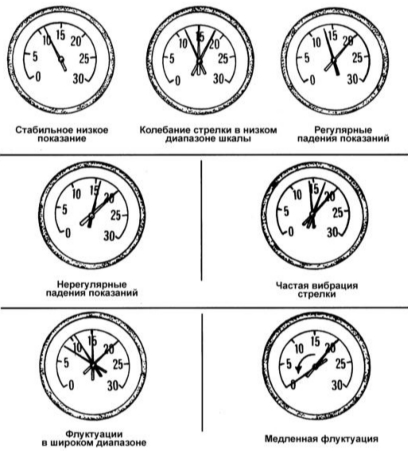
The following paragraphs provide a guide for interpreting the vacuum gauge readings.
Low needle stability may indicate leaks through the gasket between the intake manifold and the cylinder head, or between the manifold and the throttle body. A damaged vacuum hose, retarded ignition timing, or incorrect valve timing is also possible. Check the ignition timing with a timing light, then eliminate all other possible causes by performing the checks described in this Section. Only after that should the timing cover be removed to check the alignment of the timing marks.
If the reading is 3 to 8 in. Hg (76 to 203 mm Hg) below normal and the needle fluctuates, the cause may be a leaking intake manifold gasket at the intake port, or a faulty fuel injector.
A regular downward needle deflection of 2 to 4 in. Hg (51 to 102 mm Hg) from a steady reading indicates a high probability of valve leakage. Check the cylinder compression or perform a leak-down test.
Irregular deflections or drops in the reading may be caused by sticking valves or misfires. Measure the cylinder compression, perform a leak-down test, and check the condition of the spark plugs.
Frequent needle vibration within a range of 4 in. Hg (102 mm Hg) at idle, accompanied by smoke from the exhaust pipe, indicates worn valve guides. Perform a leak-down test. If the needle begins to vibrate as engine speed increases, check for signs of leaks at the intake manifold gasket and cylinder head gasket. Evaluate valve spring sag, check the valves for signs of burning, and try to identify misfires.
Minor fluctuations of the reading within a range of 1 to 2 in. Hg (25 to 51 mm Hg) may indicate a malfunction of the ignition system. Check all normal adjustments and, if necessary, perform a test using an ignition analyzer.
If the gauge needle fluctuates over a wide range, check the cylinder compression or perform a leak-down test to identify a defective cylinder or a leaking cylinder head gasket.
If the gauge needle slowly "wanders" over a wide range of the scale, check the PCV system for blockage and the idle mixture, and make sure there are no leaks through the carburetor/throttle body gasket or the intake manifold gasket.
Evaluate the speed at which the vacuum reading returns to its initial value when the throttle is closed after raising engine speed to approximately 2500 rpm by quickly opening the throttle. The reading should first drop almost to zero, then rise above the normal idle value by about 5 in. Hg (130 mm Hg), and then return to the idle reading. If the vacuum recovers slowly and does not form a peak surge when the throttle closes abruptly, check the piston rings for wear. If the reading returns slowly, check the exhaust system for restriction (the muffler or catalytic converter are often blocked). The simplest method is to disconnect the suspect section of the exhaust system and repeat the test.
Test yourself
A quick Honda Accord quiz: every answer comes with an explanation and a link to the manual page.