Variable Charge Motor Actuator (VCMA)
Components and Component Location
Components
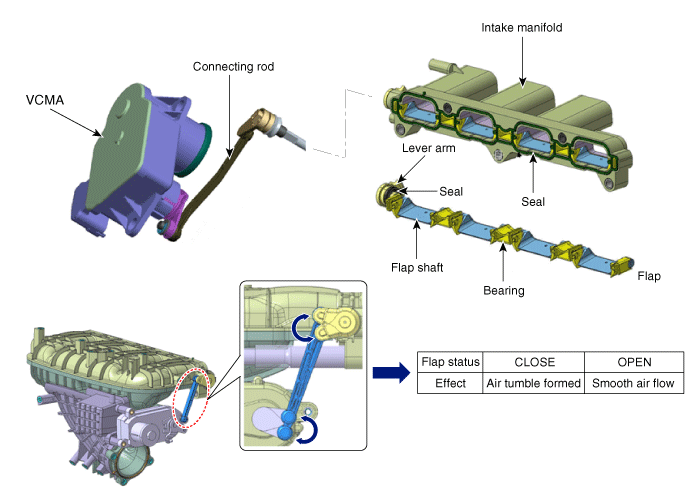
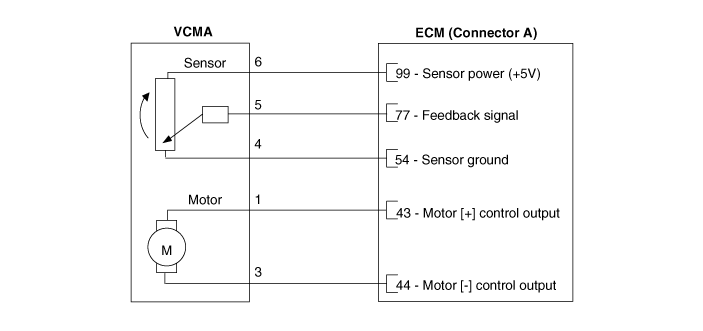
The ECM directly controls the actuator, and the engine rotation drives the VCM intake manifold flap in a linkage structure to create a swirl in the air. The actuator contains a motor and a position sensor that detect the flap position and send feedback to the ECM to determine the current flap position and detect abnormal operation caused by foreign matter sticking.
Description and Operation
Description
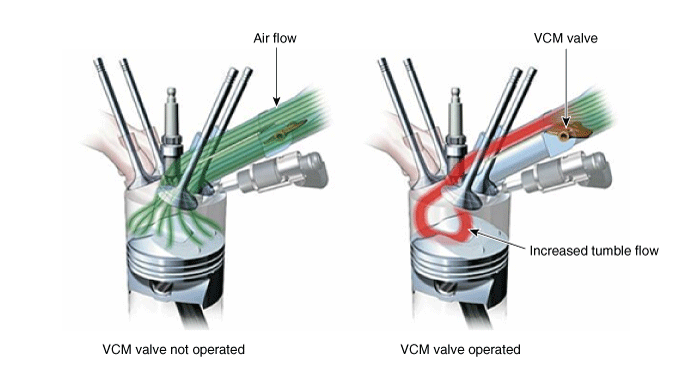
The Variable Charge Motion actuator enhances the air movement flowing inside the cylinder, improves combustion characteristics, and increases engine torque and fuel economy, particularly in the low and mid speed range. The ECM turns the actuator on and off to control the VCMA. The VCMA is normally closed and creates a swirl in the intake air when the vehicle is started. When the vehicle accelerates and reaches approx. 2600 rpm, the actuator opens the VCM flap and facilitates intake airflow.
Operation
Circuit Diagrams
Wiring Diagram
Harness Connector
Repair Procedures
Removal
Turn the ignition switch OFF and disconnect the negative (-) battery terminal.
Remove the intake manifold.
(Refer to Engine Mechanical System - "Intake Manifold")
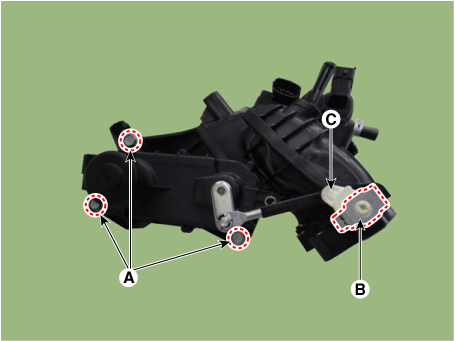
Remove the Variable Charge Motion actuator mounting bolts (A).
Using a screwdriver, remove the VCMA rod clip (B) and the connecting link between the valve (C).
Installation
Install in the reverse order of removal.
VCMA Mounting Bolt: 9.8–11.8 N·m
Adjustment
Turn the ignition off.
Connect the KDS to the Data Link Connector (DLC).
Turn the ignition on.
Select "Vehicle, Model Year, Engine, System".
Select "Vehicle Software Management".
Delete the previous VCMA adaptive value by selecting "Reset Adaptive Value".
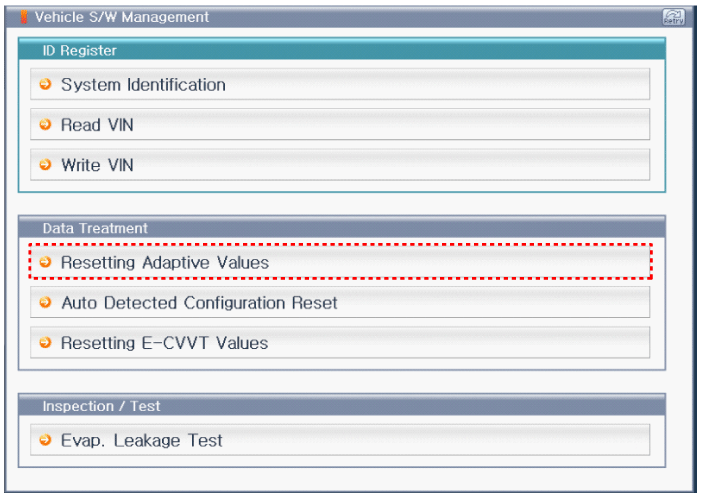
Press [Reset] when ready.
Reset is complete.
Test yourself
A quick Kia Stinger CK quiz: every answer comes with an explanation and a link to the manual page.