Barometric Pressure Sensor (BPS)
Specifications
Specification
| Item | Specification |
| Output voltage (V) | 5 |
| Pressure (kPa) | 32,5 - 284 |
| Operating Voltage (V) | 4,5 - 5,5 |
| Pressure [kPa (kgf/cm², psi)] |
Output Voltage (Vref = 5 V) |
| 32,5 (0,33, 4,71) | 0,5 |
| 70 (0,71, 10,1) | 1.1 |
| 270 (2,75, 39,1) | 4.3 |
| 284 (2,89, 41,1) | 4,5 |
Description and Operation
Description
The Boost Pressure Sensor (BPS), installed on the intercooler, measures the pressure of the compressed air from the turbocharger.
The BPS consists of a piezoelectric element and a hybrid IC that amplifies the output signal of the element. The element is a silicon diaphragm that is subjected to pressure. Its resistance changes with pressure (piezoresistive effect). One side of the silicon diaphragm is at 100% vacuum, and turbocharger boost pressure is applied to the other side. Therefore, the output produced by the silicon deformation is proportional to the pressure change.

Circuit Diagrams
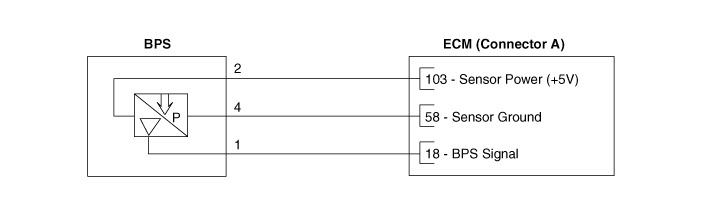
Wiring Diagram
Harness Connector

Repair Procedures
Inspection
Connect the KDS to the Data Link Connector (DLC).
With the ignition switch ON, measure the BPS output voltage at idle.
Pressure
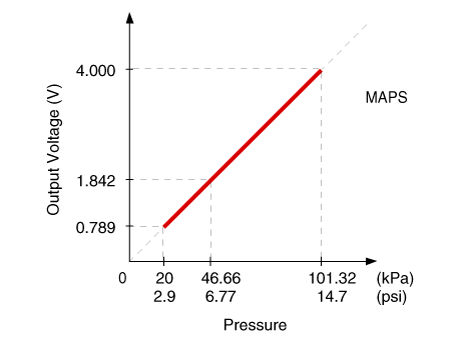
[kPa (kgf/cm², psi)]Output Voltage (V) [Vref=5V] 20,0 (0,20, 2,9) 0,79 46,7 (0,47, 6,77) 1,84 101,3 (1,03, 14,7) 4.0
Removal
Turn the ignition switch OFF and disconnect the negative (-) battery terminal.
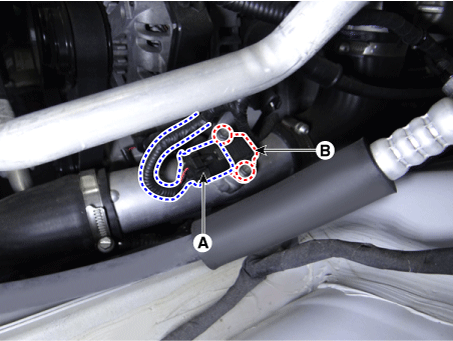
Disconnect the boost pressure sensor connector (A).
Remove the mounting bolts (B) and remove the sensor from the intercooler outlet pipe.
Boost Pressure Sensor Mounting Bolt:
9,8–11.8 N·m
Installation
Install in the reverse order of removal.
Test yourself
A quick Kia Stinger CK quiz: every answer comes with an explanation and a link to the manual page.