Automotive Chemicals
GENERAL INFORMATION
A wide range of chemicals, oils and greases is available for use during routine maintenance and repair of the vehicle. This includes a broad range of products from the chemical and petroleum industries, from cleaning agents and solvents to oils, greases and aerosols for protecting the vehicle's rubber and plastic components.
Cleaners
Carburetor and throttle body cleaner is a powerful solvent for resins, varnish and carbon deposits. Most carburetor cleaners leave a dry lubricating film that does not harden or become sticky over time. Because of this film, these cleaners are not recommended for cleaning electrical components.
Brake system cleaner is used to remove traces of grease and brake fluid from brake system components where absolute cleanliness is essential for proper function. The cleaner leaves no residue and in many cases eliminates brake squeal caused by contamination of the components.
Electrical component cleaner helps remove oxide films, corrosion and deposits from contact surfaces without affecting electrical conductivity. It can also be used to clean spark plugs, carburetor jets, voltage regulators and other components where complete removal of oil and grease is required.
Moisture displacers are used to remove water and moisture from electrical components such as the alternator, voltage regulator, fuse block and electrical connectors. Moisture displacers are typically non-conductive, non-corrosive and non-flammable.
Degreasers are extremely powerful solvents used to remove grease from the external surfaces of the engine and chassis components. They are supplied as aerosols or applied with a brush, and depending on the type, are rinsed off either with water or with a solvent.
Lubricating Fluids
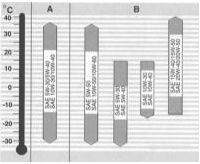 Engine Oil Viscosity Chart
Petrol engines
and all-season oils with enhanced friction-reducing properties, specification VW 500 00. All-season oils, specification VW 501 01. All-season oils, specification API SF or SG. Turbodiesel – all-season oils, specification VW 505 00. Engine oils are specially formulated compounds for lubricating the internal components of the engine. They usually contain a wide range of additives that prevent foaming and corrosion. Engine oils are available in various viscosity grades – from 5 to
80. The need for a particular oil grade is usually determined by climatic conditions and the requirements of the specific engine. Thin (light) oils are normally used in cold climates and under light engine loads. Thick (heavy) oils are used in hot conditions and under high engine loads. All-season oils have the characteristics of both light and heavy oils and are usually designated from 5W–20 to 20W–50.
Engine Oil Properties
All-season oils meeting VW 501 01 and 505 00 are relatively inexpensive oils with the following properties:
– year-round use in temperate climates; – excellent detergent properties; – good lubricating capability at all temperatures and engine loads; – high stability of initial properties over a long period.
All-season oils with improved friction-reducing properties meeting VW 500 00 have, in addition, the following advantages:
– year-round use at almost all possible outside air temperatures; – low engine power losses due to friction; – easier cold engine starting, even at very low temperatures.
CAUTION
Seasonal oils, due to their specific viscosity-temperature properties, generally cannot be used all year round. Therefore, these oils should only be used in extreme climatic zones.When using all-season oils of SAE 5W–30 grade, avoid prolonged engine operation at high speed and under constant high engine load. These restrictions do not apply to all-season oils with improved friction-reducing properties.
Engine Oil Additives
Do not add any friction-reducing additives to engine oil.
Mixing Oils
This and similar questions concern many motorists. The answer to the first one is unfortunately no, even if these are oils from "world-famous" brands (Shell, Mobil, British Petroleum). Each company produces commercial oils by adding a complete package of additives to the oil base, the chemical composition of which is kept secret. Therefore, many quality oils of the same purpose, manufactured to the operational and technical requirements of the international API classification and the European ACEA specification, but using different companies' technologies, can produce low-quality mixtures when blended due to interaction and mutual neutralization of additives, i.e., additive "incompatibility". Oils from different companies are interchangeable, and engine developers often indicate that such oils may be used. However, this does not mean they can be mixed. The API classification and ACEA specification require identical test methods (laboratory, bench, engine, etc.) for oils of different companies. If desired (or necessary), engine developers may introduce additional tests (or more stringent conditions) to these classifications.
The same applies to mixing mineral or synthetic oils (sometimes even of the same brand). Synthetic oils may have a hydrocarbon-based composition (in such cases oils of the same brand may be mixed, as recommended by the oil manufacturer, who bears responsibility for it), or a different chemical composition. Unfortunately, it is not uncommon for oil quality to deteriorate when oils are mixed. As a result, the engine may "knock", since a mixture of incompatible oils can turn into a "jelly".
The answer is even more negative regarding the possibility of mixing imported and domestic oils, especially those manufactured with the addition of "domestic" additives. Neither the seller nor the consumer knows the composition of the additives contained in the oils. Some oils of "domestic origin" are produced by "companies" that do not even have basic knowledge of petroleum products. Sometimes such "specialists" use used oils (even without proper regeneration) for the production of "commercial" oils. The quality is correspondingly poor. Therefore, advice on the possibility of mixing oils must be given with great caution!
No "cleaners" are capable of raising the octane rating of gasoline. For this purpose, special additives – anti-knock agents – are used, which are added during gasoline production at refineries. The cause of detonation (metallic knocking during engine operation) and running-on (continued engine operation with the ignition switched off) may be excessive carbon deposits in the combustion chamber.
An increase in compression in the system "when adding certain additives" does not occur due to viscosity improvers, since they do not contain them, but for other reasons.
Reducing oil consumption in an old engine and increasing cylinder compression by using high-viscosity oils is not advisable, since this will only produce a temporary improvement. Later, engine repair will cost more.
Engine knocking is caused by engine wear. Therefore, repair followed by the use of high-quality oil is cheaper. Clearances can be "reduced" with additives, but their advisability should be examined carefully so as not to harm the engine.
A few words about "marine oils" and the possibility of using them in automotive diesel engines.
Special marine diesel oils belong to Group E, for example M-16E30 and M-16E60, intended for slow-speed diesel engines running on high-sulfur viscous fuel (heavy fuel oil). These oils have technical and operational properties (quality characteristics) that differ from those of automotive diesel engine oils, so they cannot be used in automotive diesel engines. There are also marine oils of Group D, for example M-10 DTsL20, M-14 DTsL20 and M-14 DTsL30, which are used in engines running on high-sulfur fuel. These oils are water-resistant and have an increased base number and high ash content. In automotive diesel engines this leads to increased wear, which over time may not be offset by any savings. Oil M-16DR for marine diesel engines, which run on distillate fuel with higher viscosity than automotive fuel and sulfur content up to 0.5%, may be used in automotive diesel engines in summer (for heavy trucks, not passenger cars).
Always follow this rule: use a high-quality oil of the correct classification for your engine, from one brand, and do not risk mixing it with a synthetic (or semi-synthetic) oil of the same type. The engine will reward you with reliable operation. Do not buy oil from private sellers, as the packaging can be easily counterfeited.
Transmission oil is designed for use in differentials, transmissions, and other units where resistance to high temperatures is required.
Chassis and wheel bearing grease is a heavy grease used in components subject to high loads and friction, such as wheel bearings, ball joints, tie rod ends, and universal joints.
High-temperature wheel bearing grease is able to withstand the high temperatures that occur in the wheel bearings of vehicles equipped with disc brakes. It usually contains molybdenum disulfide, which is a dry-type lubricant.
White grease (lithium-based) is a heavy grease applied to metal surfaces in contact with each other in areas where moisture is a problem. It remains soft at both low and high temperatures, and is not washed out or thinned by water.
Assembly lube is a special grease for use under high pressure. It usually contains molybdenum and is used to lubricate components subject to high loads (such as main and connecting rod bearings and cam lobes) before the engine is first started after an engine overhaul.
Silicone grease is used to protect rubber, plastic, vinyl, and nylon components.
Graphite grease is used where oil cannot be used due to contamination problems (for example, in locks). Dry graphite lubricates metal parts well and protects them from moisture, acids, and other aggressive contaminants. The grease is electrically conductive and does not interrupt contact in components such as the ignition switch.
Molybdenum-based penetrating compounds are used to help loosen seized fasteners and to lubricate fasteners to prevent corrosion in the future.
Thermally conductive grease is electrically non-conductive and is used when installing electronic ignition modules that require intensive heat dissipation.
Sealants
RTV sealant is the most widely used gasket sealant. It is silicone-based, cures on contact with air, provides sealing and bonding, is water-resistant, fills surface imperfections, remains flexible, does not shrink or sag, is relatively easy to remove, and is used in addition to almost all gaskets in areas where temperatures do not exceed average values.
Anaerobic sealant, unlike RTV sealant, can be used not only in addition to gaskets but also to form them. It remains flexible, resists solvents, and fills surface irregularities well. The main difference from RTV sealant lies in the curing conditions. RTV sealant begins to cure after exposure to air, while anaerobic sealant cures only in the absence of air. This means that such sealant cures only after the components are assembled and pressed tightly together.
Pipe and thread sealant is used to seal fittings on hydraulic, pneumatic, and vacuum lines. It is usually based on a PTFE compound and is supplied as an aerosol, as a liquid applied like paint, or as tape (PTFE tape).
Chemicals
Anti-seize compound is used to prevent seizing, corrosion, binding, and galling of fasteners. High-temperature anti-seize compounds are usually based on copper-containing or graphite greases and are used on fasteners of the exhaust system and exhaust manifold.
Anaerobic thread locking compounds are used to prevent fasteners from loosening spontaneously due to vibration, and they cure only after assembly in the absence of air. Medium-strength thread locking compounds are used to secure small fasteners (nuts, bolts, screws) that will be loosened regularly later on. High-strength compounds are usually used to lock large fasteners that are not loosened on a regular basis.
Oil additives are used to change the chemical properties of oil without changing its viscosity, with the aim of reducing internal friction in the engine. It should be noted that most manufacturers of engine oils advise against using any additives with them.
Fuel additives perform several functions at once, depending on their chemical composition. They usually contain solvents that help remove sludge and clean deposits from the internal surfaces of the carburetor and the fuel injection components and intake tract. In addition, this type of additive helps remove carbon deposits that form on the walls of the combustion chambers. Some additives contain substances that lubricate the upper cylinder head components (valve train, piston rings), and others help remove condensation from the walls of the fuel tank.
Other
Brake fluid is a specially formulated compound designed to withstand the high temperatures and pressures that occur in the brake system. Do not allow brake fluid to contact painted surfaces of the vehicle or exposed skin. Keep brake fluid in a tightly sealed container to prevent moisture (the fluid is highly hygroscopic) and dirt from getting into it.
During vehicle operation, brake fluid absorbs a certain amount of water from the surrounding air. Excessive water content in brake fluid may eventually cause corrosion of the service brake system components. In addition, the boiling point of the brake fluid is significantly reduced.
Therefore, replace the brake fluid every two years!
CAUTION
If the brake fluid is very old, vapor bubbles may form in the system under heavy service brake loads. This adversely affects the efficiency of the service brake system and, thus, driving safety.Use only the recommended brake fluid (US standard FMVSS 116 DOT 4 specification).
Body opening sealing strip adhesive, as its name implies, is used to bond the sealing strips of the door, window and luggage compartment lid openings. It can also be used to secure interior trim components.
Underbody anti-corrosion coating is a tar-like compound made from petroleum base and is used to protect metal surfaces against corrosion. It also functions as sound insulation for the passenger compartment.
Waxes and polishes are used to protect painted surfaces from environmental effects. Different types of paint may require different types of waxes and polishes. Some polishes contain abrasive or chemical additives that remove the outer layer of oxidation (dullness) from painted surfaces of older vehicles. Recently, various wax-free polishes containing many chemical additives, such as polymers or silicon-based substances, have become widely available on the market. Such polishes are usually easier to apply and last longer than conventional (wax-based) products.
Test yourself
A quick Audi A3 quiz: every answer comes with an explanation and a link to the manual page.