Ventilation, Heater and Air Conditioning System
 Air Outlets
Air flow through the outlets is adjusted automatically or manually, depending on the selected control mode.
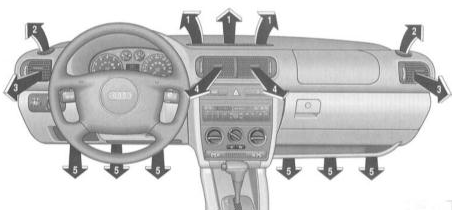
The illustration shows the air outlets located on the instrument panel.
Heated, unheated or cooled fresh air can be supplied through any of the outlets.
Air distribution is controlled by the multi-position selector C (heater) or by the air conditioning buttons.
Air inlet louvers 3 and 4 can be opened or closed separately using the knurled knobs located on the sides. The direction of airflow through the louvers can be adjusted both vertically and horizontally. The air conditioning system automatically maintains a uniform climate throughout the passenger compartment.
To do this, the temperature of the air supplied through the air inlet ducts, as well as its mass flow rate (volume) and air distribution, are changed automatically. If necessary, manual corrections can be made to this automatic process.
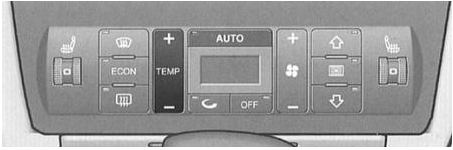
The air conditioning control panel, located on the center console, displays the set temperature and fan speed. The temperature control button is on the left side of the display, and the fan speed control button is on the right side. Adjust the temperature and fan speed by pressing the "+" or "-" buttons.

Ventilation and Heater Controls
A Temperature control
Turn the control clockwise to increase the temperature gradually.
B Fan
Four fan speeds are available. Position 0 means the air supply is off.
C Air distributor
Airflow to the footwell

Air inlet ducts 5 are open.
To direct all airflow to the feet, air inlet louvers 3 must be closed.

Airflow to the windshield
In this position, recirculation mode (button D) cannot be activated.
Warm air can also be directed to the side windows through louvers 3.
Louvers 1 and 2 are open.

Airflow through the louvers
Air inlet ducts 1, 2 and 5 are closed. Air is supplied through louvers 3 and 4.
With the air distributor set to the positions shown, some air always leaks through the other louvers.
D Recirculation mode
In recirculation mode, outside air is blocked and the air inside the passenger compartment is circulated. This prevents exhaust-polluted outside air from entering the vehicle. Do not use this mode for extended periods. If the windows fog up, press button D again to turn recirculation off, or select the
Setting Recommendations
Defrosting the Windshield and Side Windows
Set selector B to position III.
Turn control A clockwise to the stop. Set air distributor C to the
Warm air can also be directed to the side windows through louvers 3.
Preventing Fogging of the Windshield and Side Windows
If the windows fog up in high humidity, for example during rain, use the following system setting:
Set selector B to position II or III.
If necessary, turn control A slightly further into the high-temperature range.
Set air distributor C as required, between the positions

Warm air can also be directed to the side windows through louvers 3.
Rapid Warm-Up of the Passenger Compartment
Set selector B to position III. Set air distributor C to the
Turn control A clockwise to the stop. Open air inlet louvers 3.
Normal Passenger Compartment Heating
Once the windows are clear and the desired cabin temperature is reached, set the system as follows:
Set selector B to position II or III.
Set control A to the desired heater output. Set air distributor C to the
Adjust air inlet louvers 3 as desired.
Ventilation (Fresh Air Mode)
In the setting described below, unheated fresh air enters through air inlet louvers 3 and 4:
Set selector B to the desired position (III corresponds to maximum airflow).
Turn control A to the left stop.
Set air distributor C to the
Open air inlet louvers 3 and 4.
If necessary, set air distributor C to another position.
General information
For normal operation of the heating and ventilation system, the air intake in front of the windshield must be kept free of snow, ice and leaves.
To prevent fogging of the windows, keep the fan running at low speed at all times.
To stop contaminated outside air from entering the passenger compartment, press button D. To prevent fogging, do not use this mode for extended periods.
The dust filter traps airborne particles from outside air (for example, dust and pollen). Set the selector to position 0 only if the outside air is contaminated with gases.
Replace the dust filter element according to the maintenance schedule to prevent a loss of heater output.
 Air Conditioning Controls
All air conditioning modes are turned on and off by pressing the buttons. When a mode is active, the indicator light in its button is on.
Typical Setting
After turning the ignition on:
Set the temperature to 22°C (71°F) and press the AUTO button. This setting provides the fastest way to establish a comfortable climate in the passenger compartment.
Therefore, deviating from this setting makes sense only if your personal comfort requires it.
AUTO automatic mode (standard mode)
Temperature, air volume and air distribution are controlled automatically to reach the set temperature as quickly as possible and then maintain it in the passenger compartment. The system also responds automatically to changes in outside air temperature and to the effect of sunlight.
TEMP temperature control
The passenger compartment temperature can be set between 18°C (64°F) and 29°C (84°F). When the control is set to one of the extreme positions “LO” or “HI”, temperature control does not operate. The system runs continuously at maximum cooling or heating capacity.
The temperature display can be switched between the Celsius and Fahrenheit scales in the following sequence:
Press and hold the button
Then press the temperature control “+” button.

Defrost (windshield and side window defogging)
Provides the fastest possible defrosting/defogging of the windshield and side windows.
The temperature is controlled automatically. Maximum airflow is directed mainly through outlets 1 and 2.
Press this button to turn off recirculation mode and economy mode.
Recirculation mode
In recirculation mode, outside air is blocked and the air inside the passenger compartment is circulated. This prevents exhaust-polluted air from entering the vehicle. Do not drive in this mode for extended periods.
If the windows fog up, immediately switch on the
CAUTION
If it is necessary to temporarily switch off the air conditioning compressor, for example due to excessive engine load, press the recirculation button again.ECON economy mode
To save fuel, the compressor can be switched off. However, with the compressor off, the ability to maintain a comfortable climate in the passenger compartment is limited. If the passenger compartment becomes too hot or the windows fog up, the compressor can be switched on again by pressing the ECON or AUTO button.
OFF air conditioning off
Press this button to turn off the air conditioning. Outside air intake is also closed.
To turn the air conditioning on, press the AUTO button, one of the fan/temperature control or air distribution buttons, or the OFF button.

Fan speed adjustment
Press the “+” or “-” buttons to change the fan speed set automatically by the system. The actual fan speed is shown on the segmented display.

Seat heater*
Rear window heating
Air distribution buttons


the programmed air distribution mode can be changed. These buttons can be operated separately or in combination.
To return to automatic mode, turn off the corresponding functions by pressing these buttons separately, or press the AUTO button.
Airflow to the windows
All airflow is directed through outlets 1 and
2. Unlike thethe air volume is not increased.
Airflow from the instrument panel
All airflow is directed through instrument panel vents 3 and 4.
Airflow to footwell
All airflow is directed through supply ducts 5 and the outlets of the air ducts under the front seats.
Key recognition
The main manual air conditioner settings are stored automatically for convenience.
If another user of your vehicle changes the air conditioner settings, they are automatically reset to the positions programmed for your key when the ignition is turned on.
This requires the previous user to have used a key other than yours. Otherwise, the settings made by that user will be programmed to your key.
Therefore, when several drivers use the vehicle, each driver should use their own key so that the air conditioner settings are applied automatically.
General information
In cold weather, the fan switches on only after the coolant has warmed up to the required temperature. The exception is the mode.
To prevent loss of heating and cooling capacity and fogging of the windows, make sure the air intake in front of the windshield is not blocked by snow, ice or leaves.
On vehicles with automatic transmission, during hard acceleration with the accelerator pedal fully depressed, or when downshifting in advance (kick-down), the air conditioner compressor switches off for a short time to provide full engine power.
The compressor switches off when the coolant temperature is too high, to ensure normal engine cooling under extreme load conditions.
In cold weather the compressor switches off automatically. In this case it cannot be switched on even with the AUTO button.
When the compressor is on, the temperature and humidity of the passenger compartment air are reduced. This prevents the windows from fogging up.
The air conditioner works most efficiently with the sunroof* closed and the windows raised. However, if the air in the passenger compartment has become hot from the vehicle being parked in the sun for a long time, lowering the windows briefly before switching on the air conditioner can speed up cooling.
In high outside temperature and humidity, condensed water may drip from the evaporator and form a puddle under the vehicle. This is normal and does not indicate a leak in the system.
The dust filter traps airborne particles from outside air (for example, dust, pollen, etc.). Switch on recirculation mode when the outside air is polluted by exhaust gases.
Replace the dust filter element according to the maintenance schedule to prevent loss of air conditioner performance.
If the filter becomes clogged early due to operating the vehicle in areas with heavy air pollution, the filter element may need to be replaced more often than specified in the maintenance schedule.
The air supplied through the air intake vents and distributed throughout the interior is exhausted through the outlet slots under the rear window. Therefore, do not cover them with clothing or other objects.
If there is even a slight suspicion of damage to the air conditioning system, switch it off immediately and have it checked at an Audi service station. Only after this may the air conditioning system be operated again.
Repair of Audi air conditioning systems requires highly qualified technicians and special tools. Therefore, if the air conditioning system malfunctions, contact an Audi service station.
Test yourself
A quick Audi A3 quiz: every answer comes with an explanation and a link to the manual page.